Rome and the Byzantine world
Students start the year by looking at how Rome rose, weakened, and split. They see how one empire became two, and how Roman law, roads, and ideas still shape life today.
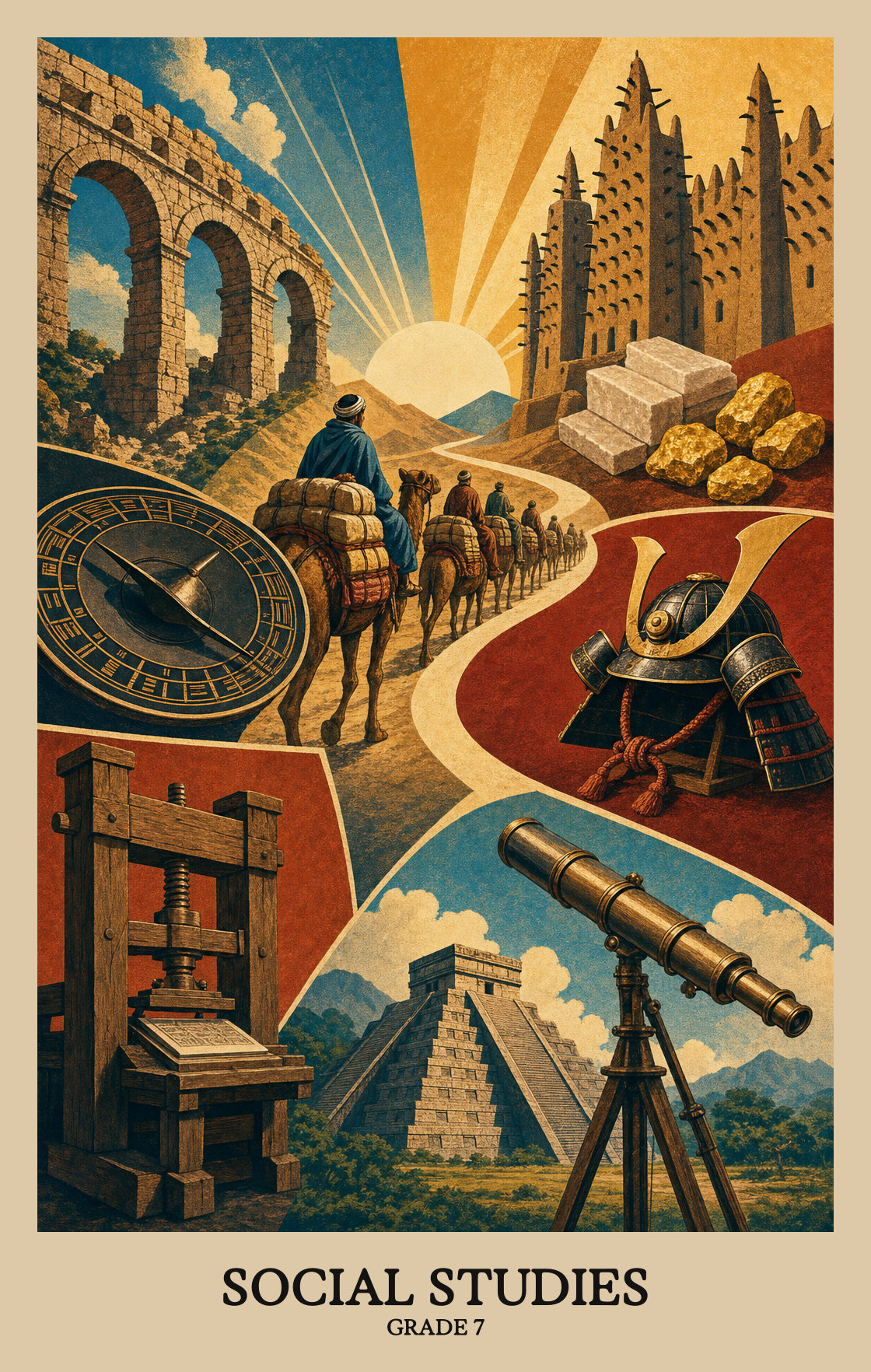
This is the year history opens up to the wider world. Students travel from the fall of Rome through medieval Islam, China, West Africa, Japan, Europe, and the Americas, then watch the Renaissance, Reformation, and Scientific Revolution reshape how people think. They learn to compare empires by looking at geography, trade, religion, and who held power. By spring, students can explain how an idea or invention from one civilization traveled and changed another.
Students start the year by looking at how Rome rose, weakened, and split. They see how one empire became two, and how Roman law, roads, and ideas still shape life today.
Students study the early Muslim world and the West African kingdoms of Ghana and Mali. They follow trade routes across deserts and seas, and see how gold, salt, books, and new ideas moved between cities.
Students explore China under the Tang, Song, and Ming, and Japan under emperors and samurai. They look at inventions like paper, printing, and the compass, and at the rules that shaped daily life.
Students study castles, knights, and the Catholic Church in Europe, then cross the ocean to the Maya, Aztec, and Inca. They compare how each society was run and how the Black Death changed everything.
Students watch Europe rediscover old Greek and Roman ideas and argue about religion. They meet figures like Leonardo, Gutenberg, and Martin Luther, and see how printing spread new thinking fast.
Students close the year with global voyages, new science, and new political ideas. They trace how thinkers like Locke and Montesquieu shaped the rights and governments that later showed up in the United States.
Students trace how Rome grew into a massive empire and why it eventually fell apart. They look at what drove that expansion and what forces, from inside and outside Rome, brought it to an end.
Students examine what made Rome powerful, including its laws, buildings, and engineering, and what caused it to fall apart from the inside, such as corruption, weakened citizenship, and the rise of private armies.
At the Roman Empire's peak, students identify where its borders stretched on a map and explain what pressures, such as invasions or internal conflict, began pulling it apart.
Students learn how the Roman Empire split into two halves, with Constantinople becoming the capital of the eastern half. That divide shaped two different Christian traditions, Eastern Orthodox and Roman Catholic, each with different ideas about who should hold power, church or government.
Students study the rise of Islamic civilization during the Middle Ages, looking at how geography, trade, religion, and government shaped daily life across a vast stretch of the world.
Students study the Arabian peninsula: its deserts, mountains, and coastlines, the seas and lands around it, and how geography shaped whether people settled in one place or kept moving with their herds.
Students learn where Islam began, who Muhammad was, and what he taught. The lesson also covers how Islam connects to Judaism and Christianity as faiths that share common roots.
The Qur'an is Islam's holy book, and the Sunnah records the Prophet Muhammad's teachings and actions. Students explain how these two texts shape what Muslims believe, how they pray, and how Islamic law guides everyday life.
Students trace how Islam and the Arabic language spread across new regions through both conquest and negotiation, and how the cultures that came together shaped a shared civilization.
Students trace how trade routes connected Asia, Africa, and Europe in the Middle Ages, what goods traveled those roads and sea lanes (spices, cloth, paper, steel), and how Arab merchants drove that exchange.
Muslim scholars across Eurasia and Africa traded ideas in science, math, medicine, and philosophy. Their discoveries shaped the civilizations that came after them.
Students study how medieval China was ruled, how people traded and farmed, how religion shaped daily life, and how geography influenced where cities and power grew.
Students learn how China reunified under the Tang Dynasty and why Buddhism spread from China into Korea and Japan during this period.
Students learn how China's Tang and Sung dynasties transformed farming, trade, and invention. Think new crops, early paper money, and tools that spread Chinese goods across Asia and beyond.
Students examine how Confucian ideas shaped Chinese society and how those ideas shifted during the Song and Mongol eras. They look at who held power, how officials were chosen, and why scholars debated what Confucius actually meant.
Students learn how Chinese traders carried goods across Central Asia by land and sailed to distant ports by sea, and why those routes made China one of the most connected civilizations of the medieval world.
Students learn how Chinese inventions like paper, the compass, and gunpowder spread across the world and changed how people communicated, navigated, and fought wars.
Students learn how ancient China built a powerful central government and filled its offices with educated officials chosen through written exams, not by family connections.
Students examine how the kingdoms of Ghana and Mali rose to power in medieval West Africa, looking at where they were located, how they traded, what they believed, and how their societies were organized.
Students learn how the Niger River and its surrounding landscapes shaped trade in gold, salt, and food across West Africa, and how that trade helped build the empires of Ghana and Mali.
Family ties, trade skills, and local markets helped West African cities grow into powerful states. Students examine how these forces shaped the kingdoms of Ghana and Mali.
Caravans crossing the Sahara carried more than gold and salt. Students examine how that trade spread Islam across West Africa, reshaping how people in Ghana and Mali worshipped, governed, and lived.
Arabic spread across West Africa as kingdoms like Ghana and Mali grew. Students trace how the language shaped laws, markets, and Islamic learning in the region.
Stories, poems, and songs passed down through generations were how African civilizations like Ghana and Mali preserved their history. Students study why these spoken and written traditions mattered when books and records were scarce.
Students study how Medieval Japan was organized: who held power, how land and trade worked, what Buddhism and Shintoism shaped, and how daily life differed across classes from samurai to peasants.
Students explore how Japan's location next to China and Korea shaped its early culture, from the writing system and religious practices to ideas about government and philosophy.
Students learn about Prince Shotoku, who ruled Japan around 600 CE, and how people lived, organized their families, and governed themselves during his reign.
Students learn how Japan's feudal system worked: who owed loyalty to whom, what rules samurai lived by, and how that warrior code shaped Japanese culture centuries later.
Students learn how Buddhism, after arriving in Japan, changed over time into new schools of practice with their own rituals, texts, and beliefs. The focus is on how Japanese monks and communities made the religion their own.
Students examine the golden age of art and storytelling in medieval Japan, including Lady Murasaki's Tale of Genji, one of the world's earliest novels, and trace how that creative period still shapes Japanese culture today.
Students examine how Japan shifted from court-based rule to military rule around the 1100s and what samurai warriors actually did in that society: who they served, how they fought, and what code they followed.
Students study how people lived in Medieval Europe: how land and religion shaped who held power, how towns and trade grew, and how the Catholic Church influenced daily life and government.
Students study the map of Europe and the vast Eurasian landmass, looking at mountains, rivers, forests, and climate to explain how the land shaped where people settled and how they lived during the Middle Ages.
After Rome fell, Christianity slowly spread across northern Europe. Students explain how churches and monasteries carried that expansion forward, acting as the main centers of education, record-keeping, and religious life in early Medieval Europe.
Feudalism was the system medieval Europeans used to trade land for loyalty and military service. Students learn how geography shaped this arrangement, why manors became economic hubs, and how the lord-vassal relationship became the backbone of political power.
Medieval popes and kings often clashed over who held more power. Students study how rulers like Charlemagne and Henry IV sometimes worked with church leaders and sometimes fought them for control over kingdoms and appointments.
Medieval England gave the modern world some of its most important legal ideas. Students learn how documents like the Magna Carta and practices like habeas corpus limited government power and planted the roots of democratic rule and representative government.
Students learn why European Christians launched the Crusades, how the wars unfolded, and what happened to Christian, Muslim, and Jewish communities as a result. The focus is on how those conflicts pulled Europe into closer contact with the Middle East.
Students trace how the Black Death traveled from Central Asia across China, the Middle East, and into Europe, then explain how millions of deaths reshaped societies and shrank the world's population.
In medieval Europe, the Catholic Church did far more than hold Sunday services. Students learn how it ran universities, shaped laws and governments, and preserved ancient books and ideas that might otherwise have been lost.
Students learn how Muslim rulers gradually lost control of Spain and Portugal over several centuries, as Christian kingdoms pushed south in a long series of wars that ended with the fall of Granada in 1492 and the birth of modern Spain and Portugal.
Students look at how two major civilizations in the Americas, the Aztec and Inca, organized their governments, religions, and daily life, then compare what they shared and where they differed.
Students look at the mountains, jungles, and coastlines of Mexico and South America to explain how geography shaped where the Maya, Aztec, and Inca built their cities, grew their food, and traded with neighbors.
Students examine who held power, how families lived, and what people believed in Meso-American and Andean civilizations, including how warfare shaped societies and how slavery worked within them.
Students trace where the Aztec and Incan empires grew up, then explain how a small force of Spanish soldiers brought both empires down. The story covers geography, politics, and the weapons and alliances that decided the outcome.
Students examine the art, storytelling, music, and buildings of the Maya, Aztec, and Inca to understand how each civilization expressed its beliefs and history without a shared written language.
Mesoamerican civilizations built detailed calendars and tracked the stars well enough to plan when to plant and harvest crops. Students explain how that knowledge of astronomy and math shaped daily life and kept people fed.
Students examine where and why the Renaissance began in Europe, what artists and thinkers produced during it, and how those ideas spread across the continent.
Students learn how Europeans in the Renaissance era looked back to ancient Greek and Roman ideas to put more focus on human achievement, reason, and individual potential alongside religious faith.
Florence and Venice were thriving trade hubs where Renaissance art, ideas, and learning first took hold. Students explain how these cities spread that creative energy across Europe through commerce and cultural exchange.
Students learn how reopened trade routes between Europe and China changed both regions, and why Marco Polo's journey along those routes matters for understanding the Renaissance.
New tools for spreading information, like the printing press and books made in everyday languages, let ideas from the Renaissance travel farther and faster. Students examine how these changes pulled more people into reading, debate, and new ways of thinking.
Students study the breakthroughs of the Renaissance, from da Vinci's anatomy sketches to Gutenberg's printing press, and explain how advances in science, art, and writing changed how people understood the world.
Students study why the Catholic Church split into competing branches in the 1500s and how that religious upheaval reshaped European politics, education, and daily life.
Students examine why the Catholic Church lost power and trust in the 1500s, looking at specific problems like corrupt money practices and church leaders selling religious pardons for cash.
Students learn what key Reformation figures believed about religion, church authority, and money, and why those beliefs upended Europe. Think Martin Luther nailing his complaints to a church door and sparking a split that reshaped governments and economies.
Protestant churches began governing themselves without kings or popes making the decisions. Those local leadership structures gave later thinkers a working model for democracy and shared power between central and local governments.
Students map which parts of Europe stayed Catholic and which turned Protestant after the Reformation, then trace how that religious split shaped which faiths took root across North and South America.
The Catholic Church responded to the Protestant Reformation by reforming itself from within. Students examine what drove that effort, including the founding of the Jesuits and the Council of Trent's decisions on church doctrine and practice.
Students trace how Christian missionaries carried the faith beyond Europe during the medieval and early modern periods, then mark mission locations on a world map.
Students study medieval Spain, when Jews and Muslims worked alongside each other and produced advances in art, literature, and science. They then trace how that period ended when religious persecution, including the Spanish Inquisition and the 1492 expulsions, forced both groups out.
Scientists in the 1500s and 1600s began explaining the world through observation and experiment rather than tradition or church authority. Students trace how those discoveries reshaped governments, religions, and everyday life in ways that still show up today.
The Scientific Revolution did not appear out of nowhere. Students trace the earlier ideas, from ancient Greek reasoning to medieval Islamic and Christian scholarship to Renaissance curiosity, that made 1500s and 1600s science possible.
Scientists like Copernicus, Galileo, and Newton changed how people understood the sun, the planets, and the laws of motion. Students learn why those ideas, and new tools like the telescope and microscope, shook up the church, governments, and everyday life.
Students learn how thinkers like Bacon and Descartes introduced the idea of testing ideas with evidence, and how that shift in thinking helped spread democratic ideas while people worked out how science and religion could exist side by side.
Students study roughly 300 years of change in Europe and beyond, from sailors mapping new trade routes to philosophers questioning how governments should work. The focus is on how new ideas about money, power, and rights reshaped the world.
Students learn how European explorers mapped new ocean routes in the 1400s and 1500s, and how those maps changed the way Europeans understood the size and shape of the world.
When Europeans sailed to the Americas in the 1400s and 1500s, foods, animals, diseases, and ideas moved between continents for the first time. Students trace what each region gained and lost from that exchange, and how it reshaped daily life and trade across Europe, Africa, Asia, and the Americas.
Students trace how trade and moneymaking evolved in 1600s Europe, from small home-based workshops to wider markets, and examine how explorers and new trade routes reshaped who bought and sold goods across the globe.
Students trace the big ideas of the Enlightenment, things like reason, individual rights, and questioning authority, back to earlier turning points in history, from ancient Greece and Rome through the Renaissance and Scientific Revolution.
Students trace how Enlightenment thinkers like John Locke shaped ideas about rights and government, and how those ideas showed up in real laws and institutions built by people like the American founders.
| Standard | Definition | Code |
|---|---|---|
| Students analyze the causes and effects of the vast expansion and ultimate… | Students trace how Rome grew into a massive empire and why it eventually fell apart. They look at what drove that expansion and what forces, from inside and outside Rome, brought it to an end. | CA-HSS.7.1 |
| Study the early strengths and lasting contributions of Rome | Students examine what made Rome powerful, including its laws, buildings, and engineering, and what caused it to fall apart from the inside, such as corruption, weakened citizenship, and the rise of private armies. | CA-HSS.7.1.1 |
| Discuss the geographic borders of the empire at its height and the factors that… | At the Roman Empire's peak, students identify where its borders stretched on a map and explain what pressures, such as invasions or internal conflict, began pulling it apart. | CA-HSS.7.1.2 |
| Describe the establishment by Constantine of the new capital in Constantinople… | Students learn how the Roman Empire split into two halves, with Constantinople becoming the capital of the eastern half. That divide shaped two different Christian traditions, Eastern Orthodox and Roman Catholic, each with different ideas about who should hold power, church or government. | CA-HSS.7.1.3 |
| Students analyze the geographic, political, economic, religious | Students study the rise of Islamic civilization during the Middle Ages, looking at how geography, trade, religion, and government shaped daily life across a vast stretch of the world. | CA-HSS.7.2 |
| Identify the physical features and describe the climate of the Arabian… | Students study the Arabian peninsula: its deserts, mountains, and coastlines, the seas and lands around it, and how geography shaped whether people settled in one place or kept moving with their herds. | CA-HSS.7.2.1 |
| Trace the origins of Islam and the life and teachings of Muhammad, including… | Students learn where Islam began, who Muhammad was, and what he taught. The lesson also covers how Islam connects to Judaism and Christianity as faiths that share common roots. | CA-HSS.7.2.2 |
| Explain the significance of the Qur’an and the Sunnah as the primary sources of… | The Qur'an is Islam's holy book, and the Sunnah records the Prophet Muhammad's teachings and actions. Students explain how these two texts shape what Muslims believe, how they pray, and how Islamic law guides everyday life. | CA-HSS.7.2.3 |
| Discuss the expansion of Muslim rule through military conquests and treaties… | Students trace how Islam and the Arabic language spread across new regions through both conquest and negotiation, and how the cultures that came together shaped a shared civilization. | CA-HSS.7.2.4 |
| Describe the growth of cities and the establishment of trade routes among Asia… | Students trace how trade routes connected Asia, Africa, and Europe in the Middle Ages, what goods traveled those roads and sea lanes (spices, cloth, paper, steel), and how Arab merchants drove that exchange. | CA-HSS.7.2.5 |
| Understand the intellectual exchanges among Muslim scholars of Eurasia and… | Muslim scholars across Eurasia and Africa traded ideas in science, math, medicine, and philosophy. Their discoveries shaped the civilizations that came after them. | CA-HSS.7.2.6 |
| Students analyze the geographic, political, economic, religious | Students study how medieval China was ruled, how people traded and farmed, how religion shaped daily life, and how geography influenced where cities and power grew. | CA-HSS.7.3 |
| Describe the reunification of China under the Tang Dynasty and reasons for the… | Students learn how China reunified under the Tang Dynasty and why Buddhism spread from China into Korea and Japan during this period. | CA-HSS.7.3.1 |
| Describe agricultural, technological | Students learn how China's Tang and Sung dynasties transformed farming, trade, and invention. Think new crops, early paper money, and tools that spread Chinese goods across Asia and beyond. | CA-HSS.7.3.2 |
| Analyze the influences of Confucianism and changes in Confucian thought during… | Students examine how Confucian ideas shaped Chinese society and how those ideas shifted during the Song and Mongol eras. They look at who held power, how officials were chosen, and why scholars debated what Confucius actually meant. | CA-HSS.7.3.3 |
| Understand the importance of both overland trade and maritime expeditions… | Students learn how Chinese traders carried goods across Central Asia by land and sailed to distant ports by sea, and why those routes made China one of the most connected civilizations of the medieval world. | CA-HSS.7.3.4 |
| Trace the historic influence of such discoveries as tea, the manufacture of… | Students learn how Chinese inventions like paper, the compass, and gunpowder spread across the world and changed how people communicated, navigated, and fought wars. | CA-HSS.7.3.5 |
| Describe the development of the imperial state and the scholar-official class | Students learn how ancient China built a powerful central government and filled its offices with educated officials chosen through written exams, not by family connections. | CA-HSS.7.3.6 |
| Students analyze the geographic, political, economic, religious | Students examine how the kingdoms of Ghana and Mali rose to power in medieval West Africa, looking at where they were located, how they traded, what they believed, and how their societies were organized. | CA-HSS.7.4 |
| Study the Niger River and the relationship of vegetation zones of forest… | Students learn how the Niger River and its surrounding landscapes shaped trade in gold, salt, and food across West Africa, and how that trade helped build the empires of Ghana and Mali. | CA-HSS.7.4.1 |
| Analyze the importance of family, labor specialization | Family ties, trade skills, and local markets helped West African cities grow into powerful states. Students examine how these forces shaped the kingdoms of Ghana and Mali. | CA-HSS.7.4.2 |
| Describe the role of the trans-Saharan caravan trade in the changing religious… | Caravans crossing the Sahara carried more than gold and salt. Students examine how that trade spread Islam across West Africa, reshaping how people in Ghana and Mali worshipped, governed, and lived. | CA-HSS.7.4.3 |
| Trace the growth of the Arabic language in government, trade | Arabic spread across West Africa as kingdoms like Ghana and Mali grew. Students trace how the language shaped laws, markets, and Islamic learning in the region. | CA-HSS.7.4.4 |
| Describe the importance of written and oral traditions in the transmission of… | Stories, poems, and songs passed down through generations were how African civilizations like Ghana and Mali preserved their history. Students study why these spoken and written traditions mattered when books and records were scarce. | CA-HSS.7.4.5 |
| Students analyze the geographic, political, economic, religious | Students study how Medieval Japan was organized: who held power, how land and trade worked, what Buddhism and Shintoism shaped, and how daily life differed across classes from samurai to peasants. | CA-HSS.7.5 |
| Describe the significance of Japan’s proximity to China and Korea and the… | Students explore how Japan's location next to China and Korea shaped its early culture, from the writing system and religious practices to ideas about government and philosophy. | CA-HSS.7.5.1 |
| Discuss the reign of Prince Shotoku of Japan and the characteristics of… | Students learn about Prince Shotoku, who ruled Japan around 600 CE, and how people lived, organized their families, and governed themselves during his reign. | CA-HSS.7.5.2 |
| Describe the values, social customs | Students learn how Japan's feudal system worked: who owed loyalty to whom, what rules samurai lived by, and how that warrior code shaped Japanese culture centuries later. | CA-HSS.7.5.3 |
| Trace the development of distinctive forms of Japanese Buddhism | Students learn how Buddhism, after arriving in Japan, changed over time into new schools of practice with their own rituals, texts, and beliefs. The focus is on how Japanese monks and communities made the religion their own. | CA-HSS.7.5.4 |
| Study the ninth and tenth centuries’ golden age of literature, art | Students examine the golden age of art and storytelling in medieval Japan, including Lady Murasaki's Tale of Genji, one of the world's earliest novels, and trace how that creative period still shapes Japanese culture today. | CA-HSS.7.5.5 |
| Analyze the rise of a military society in the late twelfth century and the role… | Students examine how Japan shifted from court-based rule to military rule around the 1100s and what samurai warriors actually did in that society: who they served, how they fought, and what code they followed. | CA-HSS.7.5.6 |
| Students analyze the geographic, political, economic, religious | Students study how people lived in Medieval Europe: how land and religion shaped who held power, how towns and trade grew, and how the Catholic Church influenced daily life and government. | CA-HSS.7.6 |
| Study the geography of the Europe and the Eurasian land mass, including its… | Students study the map of Europe and the vast Eurasian landmass, looking at mountains, rivers, forests, and climate to explain how the land shaped where people settled and how they lived during the Middle Ages. | CA-HSS.7.6.1 |
| Describe the spread of Christianity north of the Alps and the roles played by… | After Rome fell, Christianity slowly spread across northern Europe. Students explain how churches and monasteries carried that expansion forward, acting as the main centers of education, record-keeping, and religious life in early Medieval Europe. | CA-HSS.7.6.2 |
| Understand the development of feudalism, its role in the medieval European… | Feudalism was the system medieval Europeans used to trade land for loyalty and military service. Students learn how geography shaped this arrangement, why manors became economic hubs, and how the lord-vassal relationship became the backbone of political power. | CA-HSS.7.6.3 |
| Demonstrate an understanding of the conflict and cooperation between the Papacy… | Medieval popes and kings often clashed over who held more power. Students study how rulers like Charlemagne and Henry IV sometimes worked with church leaders and sometimes fought them for control over kingdoms and appointments. | CA-HSS.7.6.4 |
| Know the significance of developments in medieval English legal and… | Medieval England gave the modern world some of its most important legal ideas. Students learn how documents like the Magna Carta and practices like habeas corpus limited government power and planted the roots of democratic rule and representative government. | CA-HSS.7.6.5 |
| Discuss the causes and course of the religious Crusades and their effects on… | Students learn why European Christians launched the Crusades, how the wars unfolded, and what happened to Christian, Muslim, and Jewish communities as a result. The focus is on how those conflicts pulled Europe into closer contact with the Middle East. | CA-HSS.7.6.6 |
| Map the spread of the bubonic plague from Central Asia to China, the Middle East | Students trace how the Black Death traveled from Central Asia across China, the Middle East, and into Europe, then explain how millions of deaths reshaped societies and shrank the world's population. | CA-HSS.7.6.7 |
| Understand the importance of the Catholic church as a political, intellectual | In medieval Europe, the Catholic Church did far more than hold Sunday services. Students learn how it ran universities, shaped laws and governments, and preserved ancient books and ideas that might otherwise have been lost. | CA-HSS.7.6.8 |
| Know the history of the decline of Muslim rule in the Iberian Peninsula that… | Students learn how Muslim rulers gradually lost control of Spain and Portugal over several centuries, as Christian kingdoms pushed south in a long series of wars that ended with the fall of Granada in 1492 and the birth of modern Spain and Portugal. | CA-HSS.7.6.9 |
| Students compare and contrast the geographic, political, economic, religious | Students look at how two major civilizations in the Americas, the Aztec and Inca, organized their governments, religions, and daily life, then compare what they shared and where they differed. | CA-HSS.7.7 |
| Study the locations, landforms | Students look at the mountains, jungles, and coastlines of Mexico and South America to explain how geography shaped where the Maya, Aztec, and Inca built their cities, grew their food, and traded with neighbors. | CA-HSS.7.7.1 |
| Study the roles of people in each society, including class structures, family… | Students examine who held power, how families lived, and what people believed in Meso-American and Andean civilizations, including how warfare shaped societies and how slavery worked within them. | CA-HSS.7.7.2 |
| Explain how and where each empire arose and how the Aztec and Incan empires… | Students trace where the Aztec and Incan empires grew up, then explain how a small force of Spanish soldiers brought both empires down. The story covers geography, politics, and the weapons and alliances that decided the outcome. | CA-HSS.7.7.3 |
| Describe the artistic and oral traditions and architecture in the three… | Students examine the art, storytelling, music, and buildings of the Maya, Aztec, and Inca to understand how each civilization expressed its beliefs and history without a shared written language. | CA-HSS.7.7.4 |
| Describe the Meso-American achievements in astronomy and mathematics, including… | Mesoamerican civilizations built detailed calendars and tracked the stars well enough to plan when to plant and harvest crops. Students explain how that knowledge of astronomy and math shaped daily life and kept people fed. | CA-HSS.7.7.5 |
| Students analyze the origins, accomplishments | Students examine where and why the Renaissance began in Europe, what artists and thinkers produced during it, and how those ideas spread across the continent. | CA-HSS.7.8 |
| Describe the way in which the revival of classical learning and the arts… | Students learn how Europeans in the Renaissance era looked back to ancient Greek and Roman ideas to put more focus on human achievement, reason, and individual potential alongside religious faith. | CA-HSS.7.8.1 |
| Explain the importance of Florence in the early stages of the Renaissance and… | Florence and Venice were thriving trade hubs where Renaissance art, ideas, and learning first took hold. Students explain how these cities spread that creative energy across Europe through commerce and cultural exchange. | CA-HSS.7.8.2 |
| Understand the effects of the reopening of the ancient “Silk Road” between… | Students learn how reopened trade routes between Europe and China changed both regions, and why Marco Polo's journey along those routes matters for understanding the Renaissance. | CA-HSS.7.8.3 |
| Describe the growth and effects of new ways of disseminating information | New tools for spreading information, like the printing press and books made in everyday languages, let ideas from the Renaissance travel farther and faster. Students examine how these changes pulled more people into reading, debate, and new ways of thinking. | CA-HSS.7.8.4 |
| Detail advances made in literature, the arts, science, mathematics… | Students study the breakthroughs of the Renaissance, from da Vinci's anatomy sketches to Gutenberg's printing press, and explain how advances in science, art, and writing changed how people understood the world. | CA-HSS.7.8.5 |
| Students analyze the historical developments of the Reformation | Students study why the Catholic Church split into competing branches in the 1500s and how that religious upheaval reshaped European politics, education, and daily life. | CA-HSS.7.9 |
| List the causes for the internal turmoil in and weakening of the Catholic church | Students examine why the Catholic Church lost power and trust in the 1500s, looking at specific problems like corrupt money practices and church leaders selling religious pardons for cash. | CA-HSS.7.9.1 |
| Describe the theological, political | Students learn what key Reformation figures believed about religion, church authority, and money, and why those beliefs upended Europe. Think Martin Luther nailing his complaints to a church door and sparking a split that reshaped governments and economies. | CA-HSS.7.9.2 |
| Explain Protestants’ new practices of church self-government and the influence… | Protestant churches began governing themselves without kings or popes making the decisions. Those local leadership structures gave later thinkers a working model for democracy and shared power between central and local governments. | CA-HSS.7.9.3 |
| Identify and locate the European regions that remained Catholic and those that… | Students map which parts of Europe stayed Catholic and which turned Protestant after the Reformation, then trace how that religious split shaped which faiths took root across North and South America. | CA-HSS.7.9.4 |
| Analyze how the Counter-Reformation revitalized the Catholic church and the… | The Catholic Church responded to the Protestant Reformation by reforming itself from within. Students examine what drove that effort, including the founding of the Jesuits and the Council of Trent's decisions on church doctrine and practice. | CA-HSS.7.9.5 |
| Understand the institution and impact of missionaries on Christianity and the… | Students trace how Christian missionaries carried the faith beyond Europe during the medieval and early modern periods, then mark mission locations on a world map. | CA-HSS.7.9.6 |
| Describe the Golden Age of cooperation between Jews and Muslims in medieval… | Students study medieval Spain, when Jews and Muslims worked alongside each other and produced advances in art, literature, and science. They then trace how that period ended when religious persecution, including the Spanish Inquisition and the 1492 expulsions, forced both groups out. | CA-HSS.7.9.7 |
| Students analyze the historical developments of the Scientific Revolution and… | Scientists in the 1500s and 1600s began explaining the world through observation and experiment rather than tradition or church authority. Students trace how those discoveries reshaped governments, religions, and everyday life in ways that still show up today. | CA-HSS.7.10 |
| Discuss the roots of the Scientific Revolution | The Scientific Revolution did not appear out of nowhere. Students trace the earlier ideas, from ancient Greek reasoning to medieval Islamic and Christian scholarship to Renaissance curiosity, that made 1500s and 1600s science possible. | CA-HSS.7.10.1 |
| Understand the significance of the new scientific theories | Scientists like Copernicus, Galileo, and Newton changed how people understood the sun, the planets, and the laws of motion. Students learn why those ideas, and new tools like the telescope and microscope, shook up the church, governments, and everyday life. | CA-HSS.7.10.2 |
| Understand the scientific method advanced by Bacon and Descartes, the influence… | Students learn how thinkers like Bacon and Descartes introduced the idea of testing ideas with evidence, and how that shift in thinking helped spread democratic ideas while people worked out how science and religion could exist side by side. | CA-HSS.7.10.3 |
| Students analyze political and economic change in the sixteenth, seventeenth | Students study roughly 300 years of change in Europe and beyond, from sailors mapping new trade routes to philosophers questioning how governments should work. The focus is on how new ideas about money, power, and rights reshaped the world. | CA-HSS.7.11 |
| Know the great voyages of discovery, the locations of the routes | Students learn how European explorers mapped new ocean routes in the 1400s and 1500s, and how those maps changed the way Europeans understood the size and shape of the world. | CA-HSS.7.11.1 |
| Discuss the exchanges of plants, animals, technology, culture | When Europeans sailed to the Americas in the 1400s and 1500s, foods, animals, diseases, and ideas moved between continents for the first time. Students trace what each region gained and lost from that exchange, and how it reshaped daily life and trade across Europe, Africa, Asia, and the Americas. | CA-HSS.7.11.2 |
| Examine the origins of modern capitalism | Students trace how trade and moneymaking evolved in 1600s Europe, from small home-based workshops to wider markets, and examine how explorers and new trade routes reshaped who bought and sold goods across the globe. | CA-HSS.7.11.3 |
| Explain how the main ideas of the Enlightenment can be traced back to such… | Students trace the big ideas of the Enlightenment, things like reason, individual rights, and questioning authority, back to earlier turning points in history, from ancient Greece and Rome through the Renaissance and Scientific Revolution. | CA-HSS.7.11.4 |
| Describe how democratic thought and institutions were influenced by… | Students trace how Enlightenment thinkers like John Locke shaped ideas about rights and government, and how those ideas showed up in real laws and institutions built by people like the American founders. | CA-HSS.7.11.5 |
Students study world history from the fall of Rome through the 1700s. That includes medieval Europe, the Islamic world, China, Japan, West Africa, the Maya, Aztec, and Inca, the Renaissance, the Reformation, the Scientific Revolution, and the start of the Enlightenment.
Keep a world map on the fridge and find each place students mention. Ask them to tell the story of one person or event in their own words at dinner. Five minutes of retelling does more than rereading the textbook.
Students should be able to explain how a civilization was shaped by its geography, religion, government, and trade. They should also be able to compare two societies and back up a claim with specific examples from history.
Most teachers move roughly in chronological order, starting with Rome and Byzantium, then Islam, China, Japan, and West Africa in the fall. Medieval Europe and the Americas fit well in the winter, with the Renaissance, Reformation, Scientific Revolution, and Enlightenment in the spring.
Feudalism, the split between Eastern Orthodox and Roman Catholic Christianity, and the causes of the Reformation tend to slip. Map work also needs constant reinforcement, since students struggle to place the Mediterranean, the Silk Road, and the trans-Saharan trade routes without practice.
Try a short documentary clip, a historical novel, or a museum visit tied to whatever unit is happening now. Cooking a dish from Tang China, medieval Mali, or Renaissance Italy also makes the period feel real in about thirty minutes.
Students should write short, evidence-based responses regularly, not just on tests. A strong year includes a few longer pieces where students take a position on a historical question and support it with facts from primary and secondary sources.
Students should be able to read a textbook section and pull out the main idea without help. They should also be able to write a paragraph that makes a claim about a historical event and supports it with at least two specific facts.
No. The goal is to understand causes, effects, and big patterns across regions. Knowing a handful of key people, places, and turning points per unit matters more than memorizing long lists.