Skip to content

What does a student learn in ?

This is the year media arts moves from following a format to making work with a clear point of view. Students plan a project from idea to finished piece, using video, sound, images, or design to say something they mean. They learn to revise based on feedback and to read other people's work for craft and intent. By spring, they can pitch a project, produce it, and explain the choices behind it.

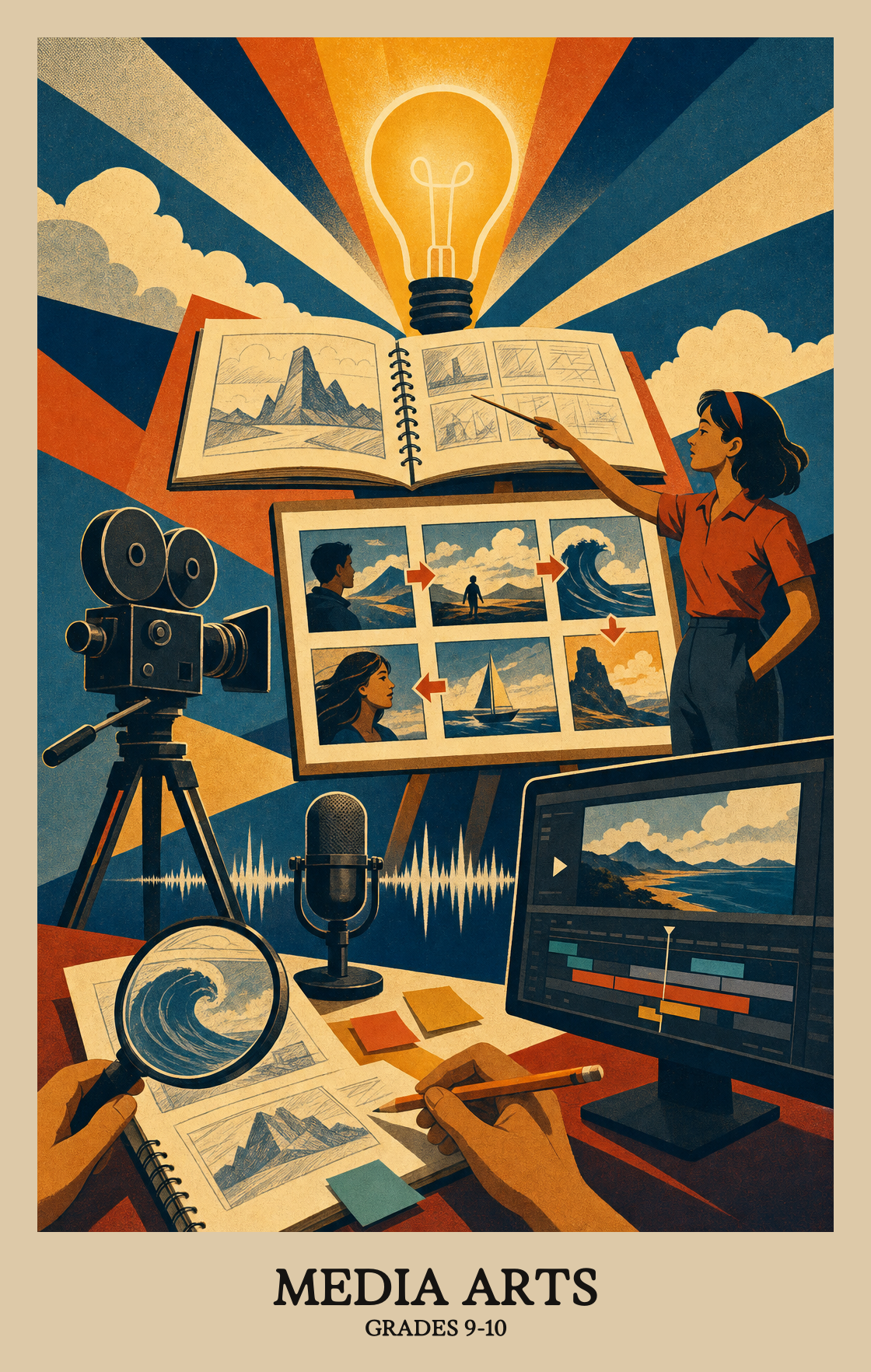
Illustration of what students learn in Grades 9-10 Arts: Media Arts
  • Project planning
  • Video and sound
  • Revising work
  • Audience and meaning
  • Critique
Source: California Content Standards for California Public Schools
Year at a glance
How the year usually goes. Every school and district set their own curriculum, so treat this as a guide, not official pacing.
  1. 1

    Finding ideas worth making

    Students start the year gathering ideas for media projects like videos, podcasts, animations, or digital art. They pull from their own experiences and the work of artists they admire to plan something they actually want to build.

  2. 2

    Building and shaping the work

    Students move from rough ideas to working drafts. They organize footage, sound, images, or code into something that holds together, and they learn the tools and techniques their project needs.

  3. 3

    Reading other people's work

    Students slow down and look closely at films, ads, games, and other media. They figure out what the maker was trying to say, how they pulled it off, and whether it worked.

  4. 4

    Art in context

    Students connect what they make and watch to the wider world. They look at how a piece fits its time, place, and audience, and how culture shapes what artists choose to show.

  5. 5

    Polishing and presenting

    Students refine their projects based on feedback and get them ready for an audience. They make choices about what to include, how to share it, and what they want viewers to take away.

Mastery Learning Standards
The required skills a student should display by the end of Grade 10.
Connecting
Standard Definition Code

Making art from what you know and live

Grades 9-10

Students draw on what they already know and what they have lived through to shape their media art projects, connecting personal experience to creative decisions.

CA-MA:Cn10.9-10.HsProficient

Art in its time and place

Grades 9-10

Students study a media artwork, then connect it to the time, place, or culture that shaped it. That context helps explain why the work looks or sounds the way it does.

CA-MA:Cn11.9-10.HsProficient
Creating
Standard Definition Code

Generating original ideas for media art

Grades 9-10

Students brainstorm and develop original ideas for media art projects, moving from an initial concept to a plan they can actually produce.

CA-MA:Cr1.9-10.HsProficient

Develop and organize your media art ideas

Grades 9-10

Students take a rough idea for a media project and shape it into something organized and ready to make. They plan the work, refine what isn't landing, and bring the concept into focus before production begins.

CA-MA:Cr2.9-10.HsProficient

Finish and refine a media art piece

Grades 9-10

Students review a media project they've made, revise what isn't working, and bring it to a finished, polished state.

CA-MA:Cr3.9-10.HsProficient
Performing/Presenting/Producing
Standard Definition Code

Choosing which media art to present

Grades 9-10

Students review their media projects, decide which pieces best show their skills, and explain why those choices fit the goals of the presentation.

CA-MA:Pr4.9-10.HsProficient

Refine your work before presenting it

Grades 9-10

Students practice and improve their media art projects until they are ready to share, making deliberate choices about how the final work looks, sounds, or moves for an audience.

CA-MA:Pr5.9-10.HsProficient

Presenting art with a clear message

Grades 9-10

Students select and arrange their media art pieces to say something specific to an audience. The choices they make about order, framing, and context shape how viewers understand the work.

CA-MA:Pr6.9-10.HsProficient
Responding
Standard Definition Code

Analyzing media art with a critical eye

Grades 9-10

Students look closely at a media piece, such as a film, graphic, or website, and explain how its design choices shape the message it sends.

CA-MA:Re7.9-10.HsProficient

Reading meaning in media art

Grades 9-10

Students analyze a media piece and explain what the creator was trying to say and why the choices made, like camera angle, sound, or color, shape that message.

CA-MA:Re8.9-10.HsProficient

Judging whether media art works

Grades 9-10

Students review a piece of media and judge it using a clear set of criteria, explaining what works, what doesn't, and why.

CA-MA:Re9.9-10.HsProficient
Common Questions
  • What is media arts in high school?

    Media arts covers things students already make and watch: short videos, photos, podcasts, animations, websites, and games. Students learn to plan a piece, make it, share it with an audience, and talk about why it works or doesn't.

  • What should students be able to make by the end of the year?

    Students should be able to take a project from idea to finished piece on their own. That means pitching the idea, drafting a plan, recording or designing it, revising based on feedback, and presenting a polished version to a real audience.

  • How can families support media arts work at home?

    Ask students to show a project and explain the choices behind it. Why this music, this shot, this opening line? Treating their work as worth discussing, the same way a family might talk about a movie or a song, builds the habit of thinking like a maker.

  • Do students need expensive equipment at home?

    No. A phone camera, free editing apps, and a quiet corner cover most assignments. What matters more is time to plan and revise, not gear.

  • How should the year be sequenced?

    Most teachers start with short, low-stakes pieces that build one skill at a time, such as framing a shot or cutting audio. Larger projects come later in the year, when students can combine skills and carry an idea through several rounds of revision.

  • Where do students usually need the most reteaching?

    Revision is the sticking point. Students often treat the first draft as the finished piece. Building in required feedback rounds, with specific things to fix each time, is usually where the biggest gains happen.

  • How is media arts work graded?

    Grades usually come from a rubric that looks at the idea, the craft, the revision process, and the finished piece. A strong project shows clear choices the student can defend, not just polish.

  • How can a parent help if a student feels stuck on a project?

    Ask what the piece is trying to say and who it is for. Most blocks come from a fuzzy idea, not a software problem. Once the message and the audience are clear, the next step usually shows up on its own.

  • How do teachers know students are ready for the next level?

    Students are ready when they can plan a project, finish it, and explain how it connects to other work they have seen, whether that is a film, an ad campaign, or a piece from another culture. That ability to place their own work in a bigger conversation is the goal.