Exploring movement ideas
Students start the year by trying out new ways to move and finding ideas for dances. They pull from stories, pictures, and their own experiences to come up with movement that means something to them.
This is the year dance shifts from copying steps to shaping them with purpose. Students build short movement pieces from their own ideas, then practice and polish them for an audience. They also watch other dancers and talk about what the movement means and why it works. By spring, students can perform a short dance they helped create and explain the choices behind it.
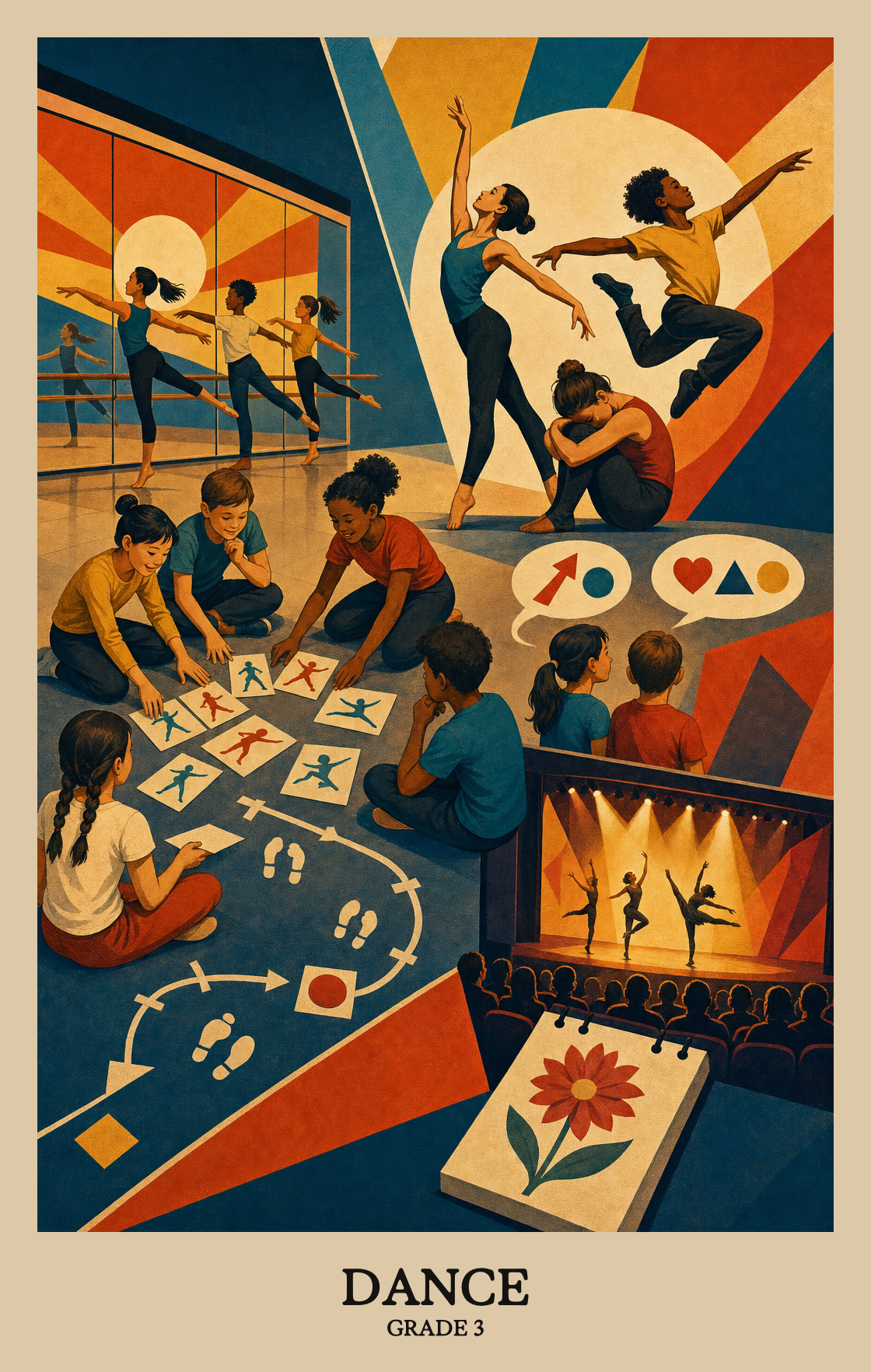
Students start the year by trying out new ways to move and finding ideas for dances. They pull from stories, pictures, and their own experiences to come up with movement that means something to them.
Students take their ideas and put them in order, so a dance has a beginning, middle, and end. They practice steps, body shapes, and patterns that fit together on purpose.
Students look closely at dances and describe what they notice. They share what a dance might be about and listen to classmates explain what they saw in the same piece.
Students learn that dances come from real places, time periods, and communities. They try movement from different traditions and talk about what a dance can say about the people who made it.
Students polish a dance and perform it for others. They practice clear movement, focus, and stage presence, then use simple criteria to judge what worked and what they would change next time.
Students connect something from their own life to a dance they make or watch, then explain how that personal experience shapes the movement or meaning.
Students look at a dance from another culture or time period and explain what it tells them about how those people lived or what they believed.
| Standard | Definition | Code |
|---|---|---|
| Using life experience to make dances | Students connect something from their own life to a dance they make or watch, then explain how that personal experience shapes the movement or meaning. | CA-DA:Cn10.3.3 |
| Dance from different cultures and times | Students look at a dance from another culture or time period and explain what it tells them about how those people lived or what they believed. | CA-DA:Cn11.3.3 |
Students come up with their own dance ideas and start turning them into movement. They experiment with how their body can express a feeling, story, or image.
Students take movement ideas and shape them into a short dance, deciding which parts to keep, which to change, and how to put it all together.
Students revisit a dance they've been building, make small changes to improve it, and practice until the piece feels finished and ready to share.
| Standard | Definition | Code |
|---|---|---|
| Coming up with new dance ideas | Students come up with their own dance ideas and start turning them into movement. They experiment with how their body can express a feeling, story, or image. | CA-DA:Cr1.3.3 |
| Turning dance ideas into a finished piece | Students take movement ideas and shape them into a short dance, deciding which parts to keep, which to change, and how to put it all together. | CA-DA:Cr2.3.3 |
| Finish and polish a dance | Students revisit a dance they've been building, make small changes to improve it, and practice until the piece feels finished and ready to share. | CA-DA:Cr3.3.3 |
Students choose which dances to perform and explain why those pieces show their best work.
Students rehearse a dance and make small improvements before performing it for others. They focus on how the body moves and work to make the movements clearer and more intentional.
Students perform a dance they have practiced and focus on sharing a clear idea or feeling with the audience, not just completing the steps.
| Standard | Definition | Code |
|---|---|---|
| Choosing dances worth performing | Students choose which dances to perform and explain why those pieces show their best work. | CA-DA:Pr4.3.3 |
| Practicing a dance until it's ready to perform | Students rehearse a dance and make small improvements before performing it for others. They focus on how the body moves and work to make the movements clearer and more intentional. | CA-DA:Pr5.3.3 |
| Perform a dance that says something | Students perform a dance they have practiced and focus on sharing a clear idea or feeling with the audience, not just completing the steps. | CA-DA:Pr6.3.3 |
Students watch a dance and describe what they notice: how the dancers move, where they travel, and whether the movements feel fast or slow, strong or gentle.
Students watch a dance and explain what they think the dancer is feeling or trying to say. They point to specific movements that gave them that idea.
Students use a short checklist or set of questions to judge a dance performance, their own or someone else's. They explain what worked and what could be stronger.
| Standard | Definition | Code |
|---|---|---|
| Watching and thinking about dance | Students watch a dance and describe what they notice: how the dancers move, where they travel, and whether the movements feel fast or slow, strong or gentle. | CA-DA:Re7.3.3 |
| What a dance is trying to say | Students watch a dance and explain what they think the dancer is feeling or trying to say. They point to specific movements that gave them that idea. | CA-DA:Re8.3.3 |
| Judging what makes a dance work | Students use a short checklist or set of questions to judge a dance performance, their own or someone else's. They explain what worked and what could be stronger. | CA-DA:Re9.3.3 |
Students make up short dances, perform them, and watch others dance. They learn to use their bodies in different ways, like changing speed, level, and direction. They also talk about what a dance might mean and where dances come from.
Put on music and ask students to invent a short movement that shows an idea, like a storm or a busy street. Watch a dance clip together and ask what they noticed and how it made them feel. Five minutes is plenty.
No. The point is to explore movement and make choices, not to perform at a high level. Students who feel shy can start by mirroring a partner or moving with a small group before showing anything on their own.
Start with movement exploration so students build a shared vocabulary of speed, level, shape, and pathway. Move into short creating tasks where students plan, refine, and show a piece. End the year with work that connects a dance to a story, culture, or personal experience.
Refining work is the hardest part. Students often want to perform a first draft and move on. Build in time to revise one section, get feedback from a partner, and try it again before showing the final version.
Give them a simple frame: name one thing the dancer did, say what it made you think of, and ask one question. Practice it as a class on a short video clip first. This keeps feedback specific and kind.
Students can plan a short dance with a clear beginning, middle, and end, perform it with control, and explain what it means. They can also watch another dance and describe what they saw using movement words like level, speed, and shape.
Assessment is based on what students create, perform, and say about dance, not on talent. Look at whether they used the movement ideas taught in class, refined their work after feedback, and connected their dance to an idea or experience.