Getting set up and staying safe online
Students start the year by learning how to protect their accounts, passwords, and personal information. They look at what a digital footprint is and how choices made online can stick around for years.
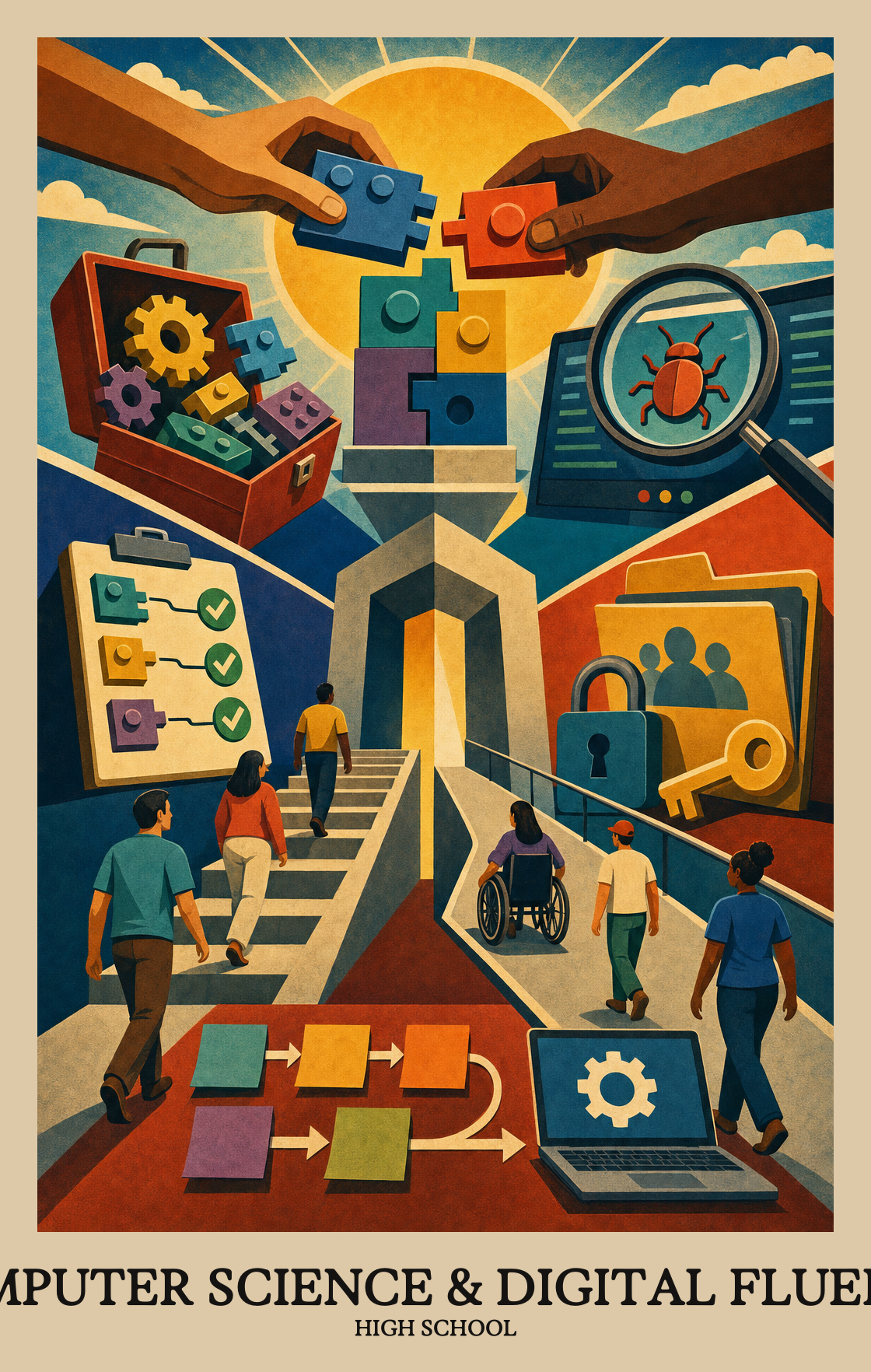
This is the year computer science shifts from using tools to building them with real intent. Students write their own programs, break them into reusable parts, and test them the way a working developer would. They also wrestle with the harder questions around the code: who gets access, what stays private, and how a small design choice can leave someone out. By spring, students can plan, write, and debug a program that solves a real problem and explain the choices they made along the way.
Students start the year by learning how to protect their accounts, passwords, and personal information. They look at what a digital footprint is and how choices made online can stick around for years.
Students gather information from different sources and turn it into charts and visuals. They notice how the same numbers can tell very different stories depending on how they are shown.
Students build working programs using loops, decisions, and reusable chunks of code. They also test their programs the way a real user would, looking for bugs and fixing them before sharing the work.
Students look under the hood at how apps, operating systems, and hardware fit together. They learn how information travels across the internet and how to troubleshoot when a device stops working.
Students compare classic ways of sorting and searching to see which one is faster or simpler for a given job. They also organize information inside their programs so it stays accurate as things change.
Students work in teams to design a program for a real audience and write clear notes so others can use it. They also weigh the ethics of technology, including privacy, access, and how to make tools that work for people with disabilities.
Students build a working digital model (a spreadsheet formula, a simulation, or a simple program) that predicts what will happen given different inputs. The focus is on testing whether the model's predictions hold up.
Students gather real data from more than one source, check it for accuracy and usefulness, then use it to build something: a program, a model, or a visualization.
Students take the same set of data and present it multiple ways, such as changing a graph type or reordering results, to show how the framing of data shapes the story it tells.
Students write a program that mixes their own custom functions with ready-made code libraries to keep the work organized. Instead of writing every line from scratch, students break the problem into reusable parts.
Students take a working function in a program and rewrite how it does its job inside, without changing what the program produces in the end. The output stays the same; only the approach changes.
Students learn two or more classic step-by-step procedures a computer follows to sort or search data, then compare them to see which one is faster or uses less memory for a given job.
Students write or modify a program that uses a list, table, or similar structure to keep track of related information as it changes. Think of storing and updating a contact list or a game's scoreboard.
Students write a working program that uses loops, conditionals, or other control structures to do something real, whether that solves a problem, expresses an idea, or tackles a topic they care about.
Students run their program through multiple test cases, including ones designed to catch likely mistakes or unexpected user actions, then fix what breaks before calling the work done.
Students work in groups to build an app, game, or tool for a specific audience, then write clear notes explaining how it works so teammates and users can understand it.
Students identify which personal details, files, and accounts need protection, such as passwords, financial records, and private messages, and explain why leaving them exposed creates real risk.
Keeping data safe requires more than a password. Students learn the practical steps, tools, and habits, from locked servers to software updates to safe browsing, that prevent unauthorized access and keep information accurate and available.
Picking stronger security, like a longer password or two-step login, often means more steps for the user. Students learn to weigh those real costs and benefits before deciding which protections are worth using.
Students examine how encryption protects data in real situations, such as online banking or private messages. They weigh how well a method works and what its limits are.
Students identify what to do before a security breach happens and how to respond if one does. This covers both prevention habits, like strong passwords and software updates, and response steps, like reporting the incident and limiting the damage.
Students type quickly and accurately enough that the keyboard stops slowing down their thinking. This is the baseline skill for almost every assignment they'll complete in high school and beyond.
Students use apps, shared documents, and online tools to learn alongside classmates and share what they know. Working digitally is treated as a skill, not just a convenience.
Mastery of this standard is expected before high school. Work on it shows up in earlier grades.
Students choose the right apps, platforms, or software for a project on their own, then use those tools to build, revise, and share polished digital work without being told which tool to use.
Students practice moving what they already know about one app or device to figure out a new one. The skill is learning to learn new tools, not just mastering the ones already in front of them.
Students learn to think before posting: what goes online stays online, and choices made now can affect future jobs, relationships, and reputation. They practice reviewing privacy settings and making deliberate decisions about what they share publicly.
Students create and follow real plans to protect their passwords, personal information, and privacy online. This includes thinking through how digital habits affect mental health and how to recognize and respond to threats like phishing or data breaches.
Students look at who benefits from a technology and who gets left out. They consider how access to computers and the internet shapes opportunities across different communities and countries.
Students look at real laws around data privacy, copyright, and online speech, then argue whether those rules help or hurt how technology gets built and used.
Students pick a real computing issue (facial recognition, data privacy, algorithm bias) and argue a position, considering who benefits, who's harmed, and what rules, if any, should apply.
Students weigh the real costs of using apps and services that collect personal data, such as convenience traded for privacy, and think through how those trade-offs affect individuals and communities.
Students examine how software and hardware can be built to work for people with disabilities, different languages, or limited internet access, and how designers anticipate problems before a product reaches the public.
Students design programs, apps, or digital content so people with disabilities can actually use them. That might mean adding alt text to images, making sure a site works with a screen reader, or choosing color contrast that someone with low vision can see.
Students look at how computer science shows up in fields like medicine, music, farming, and finance. The goal is to see that coding and data skills are useful far beyond a computer lab.
Students design a system that uses a small built-in computer (like a sensor or microcontroller) to collect data from the physical world automatically, without a person pressing a button or typing a command.
Students explain how the apps on a screen depend on the operating system underneath, which in turn depends on the physical hardware to actually run. Each layer has a job, and none of them works without the one below it.
Students create a step-by-step guide someone else can follow to diagnose and fix a broken device or component, then explain those steps clearly enough that another person could use them without help.
Students explain how the internet physically and logically works: how data travels across networks, where it gets stored, and how addresses and protocols help devices find each other.
Students explain how newer technologies, like 5G or cloud computing, are changing the way networks are built and used. They look at real examples of how these shifts affect everyday devices and online services.
| Standard | Definition | Code |
|---|---|---|
| Predicting outcomes with digital models High School | Students build a working digital model (a spreadsheet formula, a simulation, or a simple program) that predicts what will happen given different inputs. The focus is on testing whether the model's predictions hold up. | 9-12.CT.1 |
| Gather and check data for a project High School | Students gather real data from more than one source, check it for accuracy and usefulness, then use it to build something: a program, a model, or a visualization. | 9-12.CT.2 |
| Telling different stories with the same data High School | Students take the same set of data and present it multiple ways, such as changing a graph type or reordering results, to show how the framing of data shapes the story it tells. | 9-12.CT.3 |
| Writing functions to organize code High School | Students write a program that mixes their own custom functions with ready-made code libraries to keep the work organized. Instead of writing every line from scratch, students break the problem into reusable parts. | 9-12.CT.4 |
| Rewrite code that works without breaking results High School | Students take a working function in a program and rewrite how it does its job inside, without changing what the program produces in the end. The output stays the same; only the approach changes. | 9-12.CT.5 |
| Comparing algorithms and their trade-offs High School | Students learn two or more classic step-by-step procedures a computer follows to sort or search data, then compare them to see which one is faster or uses less memory for a given job. | 9-12.CT.6 |
| Organizing data that updates together High School | Students write or modify a program that uses a list, table, or similar structure to keep track of related information as it changes. Think of storing and updating a contact list or a game's scoreboard. | 9-12.CT.7 |
| Control structures in real programs High School | Students write a working program that uses loops, conditionals, or other control structures to do something real, whether that solves a problem, expresses an idea, or tackles a topic they care about. | 9-12.CT.8 |
| Debugging and testing programs High School | Students run their program through multiple test cases, including ones designed to catch likely mistakes or unexpected user actions, then fix what breaks before calling the work done. | 9-12.CT.9 |
| Build software for a real audience High School | Students work in groups to build an app, game, or tool for a specific audience, then write clear notes explaining how it works so teammates and users can understand it. | 9-12.CT.10 |
| What personal data needs protection High School | Students identify which personal details, files, and accounts need protection, such as passwords, financial records, and private messages, and explain why leaving them exposed creates real risk. | 9-12.CY.1 |
| Ways to keep information safe High School | Keeping data safe requires more than a password. Students learn the practical steps, tools, and habits, from locked servers to software updates to safe browsing, that prevent unauthorized access and keep information accurate and available. | 9-12.CY.2 |
| Security trade-offs in real decisions High School | Picking stronger security, like a longer password or two-step login, often means more steps for the user. Students learn to weigh those real costs and benefits before deciding which protections are worth using. | 9-12.CY.3 |
| Evaluating how encryption protects data High School | Students examine how encryption protects data in real situations, such as online banking or private messages. They weigh how well a method works and what its limits are. | 9-12.CY.4 |
| How to respond to a security breach High School | Students identify what to do before a security breach happens and how to respond if one does. This covers both prevention habits, like strong passwords and software updates, and response steps, like reporting the incident and limiting the damage. | 9-12.CY.5 |
| Keyboard typing skills High School | Students type quickly and accurately enough that the keyboard stops slowing down their thinking. This is the baseline skill for almost every assignment they'll complete in high school and beyond. | 9-12.DL.1 |
| Working with others using digital tools High School | Students use apps, shared documents, and online tools to learn alongside classmates and share what they know. Working digitally is treated as a skill, not just a convenience. | 9-12.DL.2 |
| No new skills at this level High School | Mastery of this standard is expected before high school. Work on it shows up in earlier grades. | 9-12.DL.3 |
| Choosing the right tools to publish digital work High School | Students choose the right apps, platforms, or software for a project on their own, then use those tools to build, revise, and share polished digital work without being told which tool to use. | 9-12.DL.4 |
| Learning new tech on your own High School | Students practice moving what they already know about one app or device to figure out a new one. The skill is learning to learn new tools, not just mastering the ones already in front of them. | 9-12.DL.5 |
| Managing your online reputation High School | Students learn to think before posting: what goes online stays online, and choices made now can affect future jobs, relationships, and reputation. They practice reviewing privacy settings and making deliberate decisions about what they share publicly. | 9-12.DL.6 |
| Staying safe and secure online High School | Students create and follow real plans to protect their passwords, personal information, and privacy online. This includes thinking through how digital habits affect mental health and how to recognize and respond to threats like phishing or data breaches. | 9-12.DL.7 |
| Who gets access to computing and who doesn't High School | Students look at who benefits from a technology and who gets left out. They consider how access to computers and the internet shapes opportunities across different communities and countries. | 9-12.IC.1 |
| Tech laws and who they protect High School | Students look at real laws around data privacy, copyright, and online speech, then argue whether those rules help or hurt how technology gets built and used. | 9-12.IC.2 |
| Ethics debates about real-world tech High School | Students pick a real computing issue (facial recognition, data privacy, algorithm bias) and argue a position, considering who benefits, who's harmed, and what rules, if any, should apply. | 9-12.IC.3 |
| Privacy trade-offs in computing High School | Students weigh the real costs of using apps and services that collect personal data, such as convenience traded for privacy, and think through how those trade-offs affect individuals and communities. | 9-12.IC.4 |
| Designing tech that works for everyone High School | Students examine how software and hardware can be built to work for people with disabilities, different languages, or limited internet access, and how designers anticipate problems before a product reaches the public. | 9-12.IC.5 |
| Designing for users with disabilities High School | Students design programs, apps, or digital content so people with disabilities can actually use them. That might mean adding alt text to images, making sure a site works with a screen reader, or choosing color contrast that someone with low vision can see. | 9-12.IC.6 |
| CS careers across every field High School | Students look at how computer science shows up in fields like medicine, music, farming, and finance. The goal is to see that coding and data skills are useful far beyond a computer lab. | 9-12.IC.7 |
| Sensors that respond to the real world High School | Students design a system that uses a small built-in computer (like a sensor or microcontroller) to collect data from the physical world automatically, without a person pressing a button or typing a command. | 9-12.NSD.1 |
| How software and hardware work together High School | Students explain how the apps on a screen depend on the operating system underneath, which in turn depends on the physical hardware to actually run. Each layer has a job, and none of them works without the one below it. | 9-12.NSD.2 |
| Fixing computer problems step by step High School | Students create a step-by-step guide someone else can follow to diagnose and fix a broken device or component, then explain those steps clearly enough that another person could use them without help. | 9-12.NSD.3 |
| How the internet moves and stores data High School | Students explain how the internet physically and logically works: how data travels across networks, where it gets stored, and how addresses and protocols help devices find each other. | 9-12.NSD.4 |
| How new tech changes networks High School | Students explain how newer technologies, like 5G or cloud computing, are changing the way networks are built and used. They look at real examples of how these shifts affect everyday devices and online services. | 9-12.NSD.5 |
Students write real programs, work with data, and think about how computers shape society. They also learn how the internet moves information around, how to keep accounts and data safe, and how to weigh ethical trade-offs in technology choices.
No. Strong reading and careful thinking matter more than advanced math at this stage. Most programs students write at home use basic arithmetic, comparisons, and lists, not algebra or calculus.
Ask students to walk through what their program is supposed to do, step by step, as if explaining it to a younger sibling. Most bugs show up when a student says the steps out loud. Free sites like Code.org and Khan Academy also give parents something concrete to look at together.
Start with programming basics like variables, loops, and functions, then move into data and lists, then algorithms and simple data structures. Save cybersecurity, networks, and ethics for shorter units woven across the year so students keep practicing code while these ideas come up.
Functions and parameters trip up most students, especially the difference between what goes in and what comes back out. Loops with conditions inside them also need repeated practice. Plan to revisit both in several units rather than teaching them once.
Have students set up a password manager, turn on two-factor authentication, and review the privacy settings on the apps they actually use. Talk through what data each app collects and whether the trade-off feels worth it.
Students can plan, write, test, and document a program that solves a real problem for a specific user. They can explain how their code works, why they chose a particular approach, and what they would change if the requirements shifted.
Most homework runs 20 to 45 minutes a few nights a week, usually coding or testing a project. Short, focused sessions work better than long ones, since students often need to step away from a bug before they can see it.
Ask each student to keep a short log of what they wrote, tested, and changed, and require commit history or shared document history. Grade the individual contributions and the team product separately so one strong coder cannot carry a quiet partner.
The strongest preparation is finishing one project students actually care about, from idea to working program with documentation. That experience matters more than memorizing syntax, and it gives students something concrete to talk about in interviews or applications.