Generating ideas from experience
Students start the year by turning their own lives and interests into sketches and plans. They keep a sketchbook, try out different starting points, and learn that good art usually begins with messy first ideas.
This is the year art becomes intentional. Students plan a piece before they make it, pull ideas from their own lives and from artists across history, and revise their work instead of calling the first try done. They also learn to talk about art with real reasons, not just whether they like it. By spring, students can show a finished piece, explain the choices they made, and give thoughtful feedback on a classmate's work.
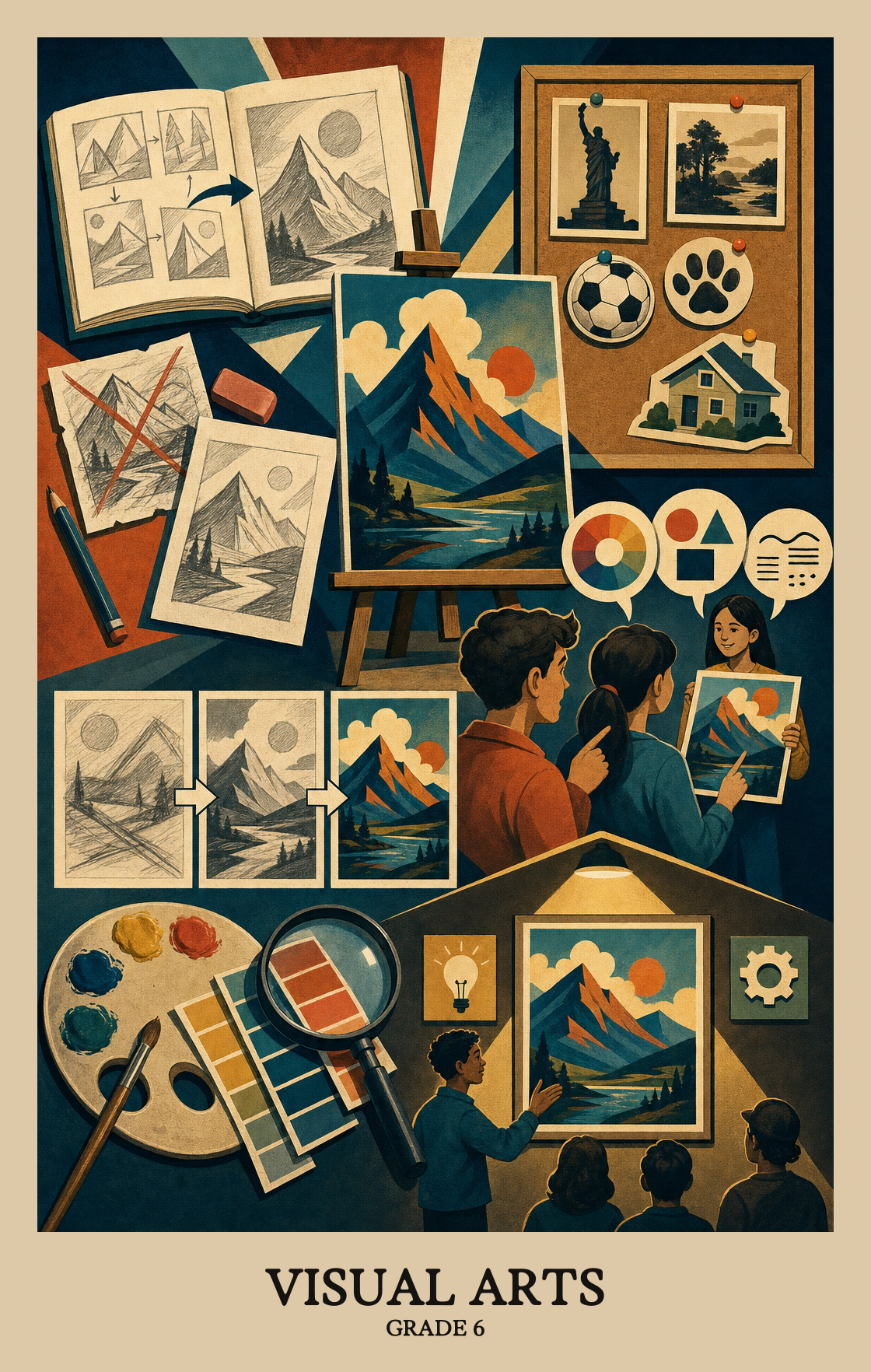
Students start the year by turning their own lives and interests into sketches and plans. They keep a sketchbook, try out different starting points, and learn that good art usually begins with messy first ideas.
Students practice real techniques with pencil, paint, clay, and digital tools. They learn how artists organize a piece using line, shape, color, and space, and they revise their work instead of stopping at the first try.
Students slow down in front of finished artworks and ask what the artist was trying to say. They learn to back up opinions with what they actually see in the piece, not just whether they like it.
Students look at art from different cultures, time periods, and communities. They notice how where and when a piece was made shapes what it means, and they connect those ideas back to their own art.
Students choose pieces worth sharing, polish them, and present them to an audience. They write or speak about what their work means and use a clear set of criteria to judge both their own art and the art of classmates.
Students pull from what they know and what they have lived through to make their artwork. Personal memories, outside subjects, and real experiences all shape the choices they make in a piece.
Students look at artworks and ask why they were made, connecting what they see to the time period, place, or culture that shaped them.
| Standard | Definition | Code |
|---|---|---|
| Using personal experience to make art | Students pull from what they know and what they have lived through to make their artwork. Personal memories, outside subjects, and real experiences all shape the choices they make in a piece. | CA-VA:Cn10.6.6 |
| Art as a window into history and culture | Students look at artworks and ask why they were made, connecting what they see to the time period, place, or culture that shaped them. | CA-VA:Cn11.6.6 |
Students brainstorm ideas for original artwork and develop those ideas into a clear creative direction before picking up a brush or pencil.
Students take a rough idea and shape it into finished artwork by making deliberate choices about materials, composition, and technique.
Students revisit a piece of artwork, make deliberate changes to improve it, and decide when it is finished.
| Standard | Definition | Code |
|---|---|---|
| Coming up with original art ideas | Students brainstorm ideas for original artwork and develop those ideas into a clear creative direction before picking up a brush or pencil. | CA-VA:Cr1.6.6 |
| Develop and organize your art ideas | Students take a rough idea and shape it into finished artwork by making deliberate choices about materials, composition, and technique. | CA-VA:Cr2.6.6 |
| Finishing and refining your artwork | Students revisit a piece of artwork, make deliberate changes to improve it, and decide when it is finished. | CA-VA:Cr3.6.6 |
Students look at their own artwork, decide which pieces are strong enough to share, and explain why those pieces belong together or represent their best work.
Students revise and improve their artwork before showing it to an audience. That means making deliberate choices about materials, craft, and detail until the piece is ready to present.
Students choose how to display or share their artwork so the ideas behind it come through clearly to the viewer.
| Standard | Definition | Code |
|---|---|---|
| Choosing which artwork to present and why | Students look at their own artwork, decide which pieces are strong enough to share, and explain why those pieces belong together or represent their best work. | CA-VA:Pr4.6.6 |
| Refine artwork before showing it | Students revise and improve their artwork before showing it to an audience. That means making deliberate choices about materials, craft, and detail until the piece is ready to present. | CA-VA:Pr5.6.6 |
| Presenting art with a clear message | Students choose how to display or share their artwork so the ideas behind it come through clearly to the viewer. | CA-VA:Pr6.6.6 |
Students look closely at a piece of visual art and describe what they notice, from the shapes and colors on the surface to the choices the artist made and why those choices matter.
Students look at a piece of artwork and explain what the artist was trying to say. They use details from the work itself to back up what they think it means.
Students look at a piece of art and judge it using a set of criteria, explaining why it works or falls short. They go beyond "I like it" and point to specific choices the artist made.
| Standard | Definition | Code |
|---|---|---|
| Reading and analyzing art | Students look closely at a piece of visual art and describe what they notice, from the shapes and colors on the surface to the choices the artist made and why those choices matter. | CA-VA:Re7.6.6 |
| Reading meaning in artwork | Students look at a piece of artwork and explain what the artist was trying to say. They use details from the work itself to back up what they think it means. | CA-VA:Re8.6.6 |
| How to judge your own artwork | Students look at a piece of art and judge it using a set of criteria, explaining why it works or falls short. They go beyond "I like it" and point to specific choices the artist made. | CA-VA:Re9.6.6 |
Students make art on purpose, not just for fun. They come up with their own ideas, plan a piece, revise it, and talk about why they made the choices they did. They also study art from different cultures and time periods to see how artists communicate ideas.
Treat the first try as a draft, not a final piece. Ask what part they like and what part bothers them, then suggest they redo just that one part on a fresh sheet. Artists at this age are learning that revising is normal, not a sign they failed.
No. A pencil, an eraser, a few markers or colored pencils, and plain paper cover most of what students practice at home. A small sketchbook is a nice addition because it lets students try ideas without worrying about wasting a good sheet.
Start with shorter idea-generation projects so students get comfortable making choices. Move into longer projects that include planning, drafting, and revising. End the year with a project students prepare for display, since presenting work and explaining choices is a big part of what sixth graders are expected to do.
Students can start with an idea, plan a piece, revise it based on feedback, and explain what they were trying to communicate. They can also look at someone else's artwork and describe what the artist did and why it might matter.
Give students a short list of things to look for before they speak, such as the artist's choice of color, the focal point, or what the piece seems to be about. Critique the work, not the person, and ask the artist what kind of feedback they want before the group jumps in.
Look at a piece of art together, in a book, a museum app, or even an album cover, and ask two questions: what do you notice, and what do you think the artist wanted people to feel? That habit builds the same thinking students practice in class.
Revising and finishing. Many students want to call a piece done after the first draft, and many struggle to explain the meaning behind their choices. Build in checkpoints during longer projects so revision feels like a normal step rather than extra work.