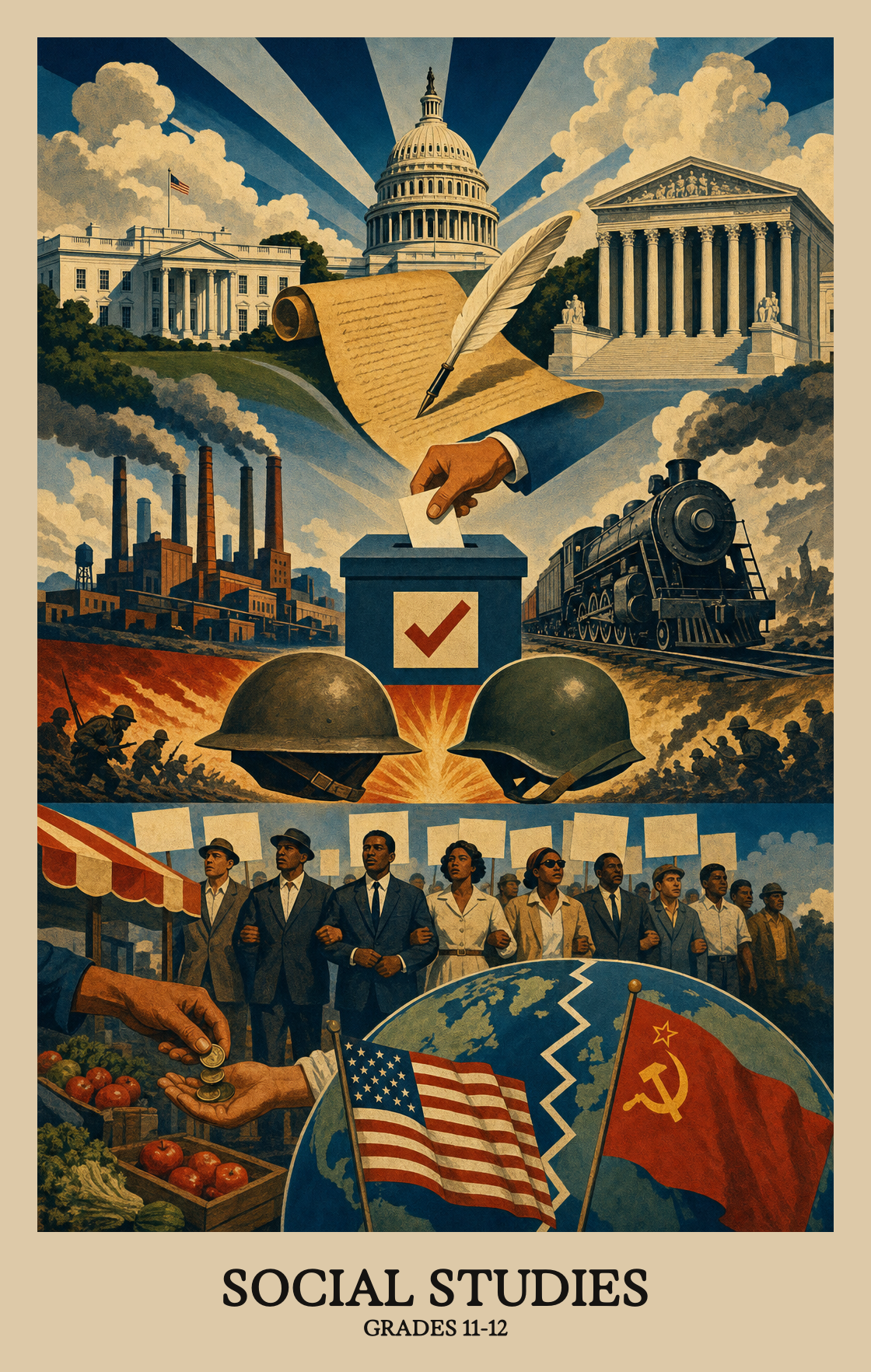
This is the year students step back and ask how the United States became what it is, and how its government actually works. In U.S. history, they trace the country from the Constitution through industrial growth, two world wars, the Depression, the Cold War, and the civil rights movement. In government and economics, they study the Bill of Rights, the three branches, elections, and how a market economy runs. By spring, students can explain a Supreme Court case or a presidential decision and argue a clear position on it.
How the year usually goes. Every school and district set their own curriculum, so treat this as a guide, not official pacing.
1
Founding ideas and early nation
Students start the year with the thinking behind the Declaration of Independence and the Constitution. They look at where rights come from, why the Bill of Rights was added, and how the country tested those ideas through the Civil War and Reconstruction.
2
Industrial America and reform
Students study how factories, railroads, and waves of immigration reshaped American cities and work. They look at the people who pushed back, including Populists and Progressives, and weigh the role of religion in shaping reform movements.
3
Rising world power through the wars
Students follow the country from the Spanish-American War through World War I, the 1920s, the Great Depression, and World War II. They examine the New Deal, the home front, Japanese American internment, and the decision to drop the atomic bombs.
4
Cold War and civil rights
Students trace U.S. foreign policy from the Marshall Plan through Vietnam and the end of the Cold War. They also study the long fight for civil and voting rights, including landmark Supreme Court cases and the leaders who shaped the movement.
5
How American government works
Students shift to government and study the three branches, federalism, and the Bill of Rights in practice. They look at landmark Supreme Court rulings, how laws and public policy get made, and how citizens take part beyond voting.
6
Elections, media, and world systems
Students close the year with campaigns, political parties, polling, and the role of the press in shaping opinion. They compare American democracy with other political systems and debate ongoing tensions like majority rule and individual rights.
Mastery Learning Standards
The required skills a student should display by the end of Grade 12.
History-Social Science
Students analyze the significant events in the founding of the nation and its…
Students examine the ideas behind the Declaration of Independence and trace how the founders tried to turn those ideas into an actual working government after the Revolution.
Describe the Enlightenment and the rise of democratic ideas as the context in…
The Enlightenment was a wave of ideas about reason, rights, and self-government that spread through Europe and the American colonies. Students study how those ideas shaped the arguments the founders used to justify breaking from Britain and building a new kind of government.
Analyze the ideological origins of the American Revolution, the Founding…
Students trace how Enlightenment ideas about natural rights shaped the Declaration of Independence, the debates over the Constitution, and the eventual addition of the Bill of Rights.
Understand the history of the Constitution after 1787 with emphasis on federal…
After 1787, the Constitution kept evolving. Students trace how power shifted between the federal government and the states, and how voting rights and democratic participation expanded over time.
Examine the effects of the Civil War and Reconstruction and of the industrial…
Students examine how the Civil War, Reconstruction, and the industrial boom reshaped where Americans lived and worked, and how the U.S. grew into a major world power by the end of the 1800s.
Students analyze the relationship among the rise of industrialization, large-…
Around 1900, factories pulled millions of people into American cities at the same time waves of immigrants arrived from southern and eastern Europe. Students examine how that combination reshaped daily life, work, and communities across the country.
Know the effects of industrialization on living and working conditions…
Students examine how factory work and city life changed in the early 1900s, including what Upton Sinclair exposed about dangerous workplaces and unsafe food in "The Jungle."
Describe the changing landscape, including the growth of cities linked by…
Students examine how American cities grew rapidly in the late 1800s and early 1900s as factories drew migrants and immigrants, and how those cities sorted people into separate neighborhoods by race, background, and income.
Around 1900, schools and community programs pushed immigrants to abandon their home languages and customs and adopt American ones. Students trace how that pressure shaped immigrant lives and what it cost families to fit in.
Analyze the effect of urban political machines and responses to them by…
City political machines traded jobs and services for votes, especially among immigrant communities. Middle-class reformers pushed back, trying to break that grip on local government. Students trace how both sides shaped American cities in the early 1900s.
Discuss corporate mergers that produced trusts and cartels and the economic and…
Students learn how giant companies in the late 1800s swallowed up competitors to control entire industries, and how the tycoons who ran them shaped government policy to protect their power.
Trace the economic development of the United States and its emergence as a…
Students trace how the U.S. grew into an industrial giant by the early 1900s, looking at why geography, trade, and natural resources gave American factories and businesses advantages other countries didn't have.
Analyze the similarities and differences between the ideologies of Social…
Social Darwinism and the Social Gospel were two opposing answers to poverty in industrial America. Social Darwinism said the poor deserved their fate; the Social Gospel said society had a duty to help them. Students compare both ideas and the people who argued for each.
Examine the effect of political programs and activities of Populists
Populists were a political movement in the late 1800s that pushed back against big banks, railroads, and wealthy landowners on behalf of struggling farmers. Students examine what the Populists actually changed and where their efforts fell short.
Understand the effect of political programs and activities of the Progressives
Progressives pushed for new laws and government programs in the early 1900s to rein in powerful railroads, protect children, and tax the wealthy. Students study what those reforms actually changed about American life.
Students analyze the role religion played in the founding of America, its…
Students examine how religious beliefs shaped the founding of the United States and trace how those beliefs continued to influence law, public debate, and everyday life. The definition covers conflicts over religious freedom that still show up in courts and politics today.
Describe the contributions of various religious groups to American civic…
Religious groups in early America helped shape civic life, from pushing for workers' rights to arguing for self-rule and individual responsibility. Students trace how those beliefs found their way into law, politics, and major reform movements.
Analyze the great religious revivals and the leaders involved in them…
Students trace how waves of religious revival, from colonial-era preaching movements to modern fundamentalism, changed American politics, social reform efforts, and everyday life across three centuries.
Cite incidences of religious intolerance in the United States
Students find real examples of Americans being targeted or excluded because of their religion, such as discrimination against Jewish, Catholic, or Mormon communities in U.S. history.
Discuss the expanding religious pluralism in the United States and California…
Large waves of immigration brought new faiths and worship traditions to the United States throughout the 1900s. Students examine how that religious diversity grew over time and what it meant for American public life.
Describe the principles of religious liberty found in the Establishment and…
Students learn what the First Amendment says about religion: the government cannot set up an official religion, and people can practice their own faith freely. The standard also covers the ongoing debate over how far apart church and state should stay.
Students trace the rise of the United States to its role as a world power in…
Students study how the U.S. went from a country that mostly stayed out of world affairs to one that shaped global events, starting in the early 1900s. They follow the decisions, conflicts, and turning points that pushed the country onto the world stage.
List the purpose and the effects of the Open Door policy
Students explain why the U.S. pushed for equal trading access in China around 1900 and what happened as a result. This policy shaped how the major powers competed for influence in Asia.
Students examine how the 1898 war with Spain led the United States to take control of territories like Puerto Rico, Cuba, and the Philippines, marking the country's first steps as a global power.
Discuss America’s role in the Panama Revolution and the building of the Panama…
Students examine how the U.S. backed Panama's break from Colombia in 1903, then built the canal connecting the Atlantic and Pacific oceans. The unit explores what the U.S. gained, what it pressured, and what that deal cost Panama.
Explain Theodore Roosevelt’s Big Stick diplomacy, William Taft’s Dollar…
Students compare three early 1900s foreign policies: Roosevelt's threat of military force, Taft's use of American business investment, and Wilson's appeal to democratic values. They read actual presidential speeches to see how each approach played out.
Students examine how World War I changed everyday life inside the United States: who worked in factories, how the government controlled prices and speech, and how the war shifted what Americans expected from Washington.
Trace the declining role of Great Britain and the expanding role of the United…
After World War II, Britain stepped back from its role as a global power while the United States stepped in. Students trace how that shift happened and what it meant for the rest of the world.
Students analyze the major political, social, economic, technological
Students examine how the 1920s reshaped American life, from new technology and economic growth to shifts in music, politics, and race relations. It's a decade-wide look at what changed and why it mattered.
Discuss the policies of Presidents Warren Harding, Calvin Coolidge
Students examine what drove the Palmer Raids, the rise of the Ku Klux Klan, and new immigration limits in the 1920s, then look at how groups like the NAACP and ACLU pushed back against those threats to civil liberties.
Examine the passage of the Eighteenth Amendment to the Constitution and the…
Students learn how the U.S. government banned alcohol in the 1920s, why Congress passed the laws that made it happen, and what followed when the ban took effect across the country.
Analyze the passage of the Nineteenth Amendment and the changing role of women…
Students examine how the Nineteenth Amendment gave women the right to vote in 1920 and how women's roles in work, politics, and daily life shifted during that era.
Describe the Harlem Renaissance and new trends in literature, music
Students study the Harlem Renaissance, a burst of Black artistic life in 1920s New York, by reading poets like Langston Hughes and novelists like Zora Neale Hurston and tracing how their work reshaped American music, art, and literature.
Trace the growth and effects of radio and movies and their role in the…
Students examine how radio broadcasts and movies spread American music, fashion, and celebrity culture to audiences around the world during the 1920s, and what changed as a result.
Discuss the rise of mass production techniques, the growth of cities, the…
Mass production, cars, and electric power reshaped American life in the 1920s. Students examine how factories, new technology, and rapid city growth created widespread prosperity and changed where and how Americans lived.
Students analyze the different explanations for the Great Depression and how…
Students trace competing explanations for the Great Depression and examine how Roosevelt's New Deal programs expanded what the federal government does for ordinary Americans.
Describe the monetary issues of the late nineteenth and early twentieth…
Students learn why Congress created the Federal Reserve in 1913 and how shaky banks, falling farm prices, and easy credit in the 1920s helped set the stage for the Great Depression.
Understand the explanations of the principal causes of the Great Depression and…
Students examine what caused the Great Depression and how the Federal Reserve, Congress, Hoover, and Roosevelt each responded. The focus is on what worked, what didn't, and how those decisions reshaped the government's role in the economy.
Discuss the human toll of the Depression, natural disasters
The Great Depression, the Dust Bowl, and failed farming methods forced hundreds of thousands of families off their land. Students examine where those families went, how their arrival reshaped California, and why their hardship fueled both radical and conservative political movements.
Analyze the effects of and the controversies arising from New Deal economic…
Students examine what the New Deal actually did: putting people to work on public projects, creating Social Security, and regulating labor. They weigh what changed when the federal government took a much larger role in the economy, and why those changes still spark debate.
Trace the advances and retreats of organized labor, from the creation of the…
Students trace how labor unions grew, lost ground, and adapted over the past century, from the rise of major union organizations to today's debates over workers' rights in a global economy.
Students analyze America’s participation in World War II
Students examine why the U.S. entered World War II, how the country mobilized at home and abroad, and what the war's outcome meant for America's place in the world.
Examine the origins of American involvement in the war, with an emphasis on the…
Students trace how the United States moved from neutrality toward war in the 1940s, focusing on the decisions, tensions, and events that led Japan to attack Pearl Harbor in December 1941.
Explain U.S. and Allied wartime strategy, including the major battles of…
Students trace how the U.S. and Allied forces planned and fought World War II, explaining the decisions behind key battles like Midway, Normandy, and Iwo Jima and what those battles decided about the outcome of the war.
Identify the roles and sacrifices of individual American soldiers, as well as…
Students learn who actually fought in World War II and what they gave up. Special units like the Tuskegee Airmen, the 442nd Regiment, and the Navajo Code Talkers made contributions that changed the outcome of the war.
Analyze Roosevelt’s foreign policy during World War II
Students examine the choices Roosevelt made in leading U.S. foreign policy during World War II, including what he promised the world in speeches like the Four Freedoms address.
Discuss the constitutional issues and impact of events on the U.S
Students examine the Supreme Court case that let the U.S. government imprison Japanese Americans during World War II, then weigh what that decision revealed about the limits of constitutional rights in wartime.
Describe major developments in aviation, weaponry, communication
Students examine how World War II pushed American factories, hospitals, and labs to develop new aircraft, weapons, radios, and medical treatments. The war also shifted where industries operated and how the country used its raw materials.
Discuss the decision to drop atomic bombs and the consequences of the decision
Students examine why the U.S. dropped atomic bombs on two Japanese cities in 1945 and what happened next. They look at the debate over that choice and the human cost of the bombings.
Analyze the effect of massive aid given to Western Europe under the Marshall…
After World War II, the U.S. sent billions of dollars to help rebuild Western Europe. Students examine why that investment mattered to both European recovery and the American economy.
Students analyze the economic boom and social transformation of post–World War…
Students examine how the United States changed after World War II, from the rise of suburbs and consumer culture to shifts in work, family life, and civil rights. The focus is on what drove the economic boom and what it left out.
Students track how jobs shifted after World War II, with fewer people working in factories and more taking office, government, and professional positions. This workforce change was part of a broader economic boom that reshaped American life.
Describe the significance of Mexican immigration and its relationship to the…
Students examine why Mexican immigrants came to California after World War II, how their labor kept farms running, and what that meant for the state's economy and communities.
Examine Truman’s labor policy and congressional reaction to it
Students examine where federal and state money went after World War II: defense budgets, welfare programs, growing national debt payments, and public education, including California's plan to make college affordable statewide.
Describe the increased powers of the presidency in response to the Great…
Students learn how the presidency grew more powerful during three major crises: the Great Depression, World War II, and the Cold War. They study the specific laws and decisions that gave presidents more authority over the economy, the military, and foreign policy.
Discuss the diverse environmental regions of North America, their relationship…
Students examine how North America's forests, plains, coasts, and deserts shaped local industries after World War II, and why those same regions face pollution, resource depletion, and other environmental challenges today.
Describe the effects on society and the economy of technological developments…
Students trace how postwar inventions reshaped everyday American life: how computers changed work, medical advances extended lives, and new farming tools fed more people with fewer hands.
Discuss forms of popular culture, with emphasis on their origins and geographic…
Students trace how American pastimes like jazz, professional sports, and architectural styles spread from their birthplaces to the rest of the country and the world after World War II.
Students trace how the U.S. dealt with other countries after World War II, from the Cold War and Korea to Vietnam, the Middle East, and beyond. They look at the decisions, alliances, and conflicts that shaped America's role in the world.
Discuss the establishment of the United Nations and International Declaration…
After World War II, countries built new international institutions to prevent another global war and stabilize the world economy. Students examine why the U.N., World Bank, and trade agreements were created and how they reshaped the rules that govern countries today.
Understand the role of military alliances, including NATO and SEATO, in…
After World War II, the U.S. and its allies formed military partnerships like NATO to prevent the Soviet Union and communist governments from expanding their power. Students examine how those alliances shaped the Cold War standoff between East and West.
Students trace how fear of Soviet communism shaped U.S. decisions at home and abroad, from the Korean War and Cuban Missile Crisis to McCarthyism and Vietnam, and examine the nuclear arms race that kept both superpowers from firing the first shot.
List the effects of foreign policy on domestic policies and vice versa
Foreign and domestic policy shape each other. Students look at how decisions like military involvement abroad sparked protest movements at home, and how public pressure inside the U.S. changed what the government did overseas.
Analyze the role of the Reagan administration and other factors in the victory…
Students examine how Reagan-era policies, including a military buildup and pressure on the Soviet economy, combined with other forces to end the Cold War and collapse the Soviet Union.
Describe U.S. Middle East policy and its strategic, political
Students examine why the U.S. got involved in the Gulf War, tracing the mix of oil, regional alliances, and military strategy that shaped American decisions in the Middle East.
Examine relations between the United States and Mexico in the twentieth…
Students study how the U.S. and Mexico have dealt with each other across the 1900s, looking at trade disputes, border policy, immigration patterns, and shared environmental problems like water rights and pollution.
Students analyze the development of federal civil rights and voting rights
Students trace how the federal government expanded civil rights and voting rights over the twentieth century, from landmark legislation to court decisions that changed who could vote and how schools, workplaces, and public life were required to treat people.
Explain how demands of African Americans helped produce a stimulus for civil…
Students trace how Black Americans pushed the federal government to act: first winning a ban on discrimination in defense factory hiring in 1941, then using their World War II military service to press Truman to desegregate the armed forces in 1948.
Students trace how civil rights law changed over 150 years by studying landmark Supreme Court cases, from rulings that upheld segregation to decisions that struck it down, including cases on school integration and affirmative action.
Describe the collaboration on legal strategy between African American and white…
Students learn how Black and white lawyers worked together to build the legal case that ended segregation in public universities, tracing the courtroom strategy that led to landmark Supreme Court rulings before Brown v. Board of Education.
Students study the leaders who pushed America to live up to its founding promises, focusing on what each person did and why it mattered. King's "Letter from Birmingham Jail" and "I Have a Dream" speech get close attention as two of the most important pieces of writing and oratory from that era.
Discuss the diffusion of the civil rights movement of African Americans from…
Students trace how the Black civil rights movement spread from Southern churches and Northern cities, then examine how that struggle shaped the fight for equal rights by Native American, Asian American, and Hispanic communities. Events like Little Rock and Birmingham show both the resistance and the momentum.
Analyze the passage and effects of civil rights and voting rights legislation
Students examine what the Civil Rights Act, the Voting Rights Act, and the Twenty-Fourth Amendment actually changed, focusing on who gained access to schools and the ballot and what stood in the way before these laws passed.
Analyze the women’s rights movement from the era of Elizabeth Stanton and Susan…
Students trace how the fight for women's rights grew from the 1800s push for the vote all the way through the 1960s movement, comparing what women demanded, what they won, and where Americans disagreed along the way.
Students analyze the major social problems and domestic policy issues in…
Students examine major social problems and policy debates shaping American life today, from healthcare and inequality to immigration and the economy. The focus is on understanding how government decisions affect real people.
Discuss the reasons for the nation’s changing immigration policy, with emphasis…
Students examine why U.S. immigration laws changed in the 20th century, focusing on how the 1965 Immigration Act opened the door to newcomers from Asia, Latin America, and Africa and reshaped who Americans are today.
Discuss the significant domestic policy speeches of Truman, Eisenhower…
Students compare how postwar presidents from Truman through Clinton addressed issues like civil rights, schools, and the economy in their major domestic speeches and policy proposals.
Describe the changing roles of women in society as reflected in the entry of…
Students examine how women's roles shifted after the 1960s, as more women entered the workforce and family structures changed. They look at how paid work, household responsibilities, and social expectations evolved together over the following decades.
Explain the constitutional crisis originating from the Watergate scandal
Students trace how the Watergate break-in grew into a constitutional standoff between Congress and the presidency, ultimately forcing a president to resign for the first time in American history.
Students trace how the U.S. debated protecting land and clean air over the last century, looking at why national parks grew, where environmental laws came from, and how those efforts clashed with landowners who argued the rules went too far.
Analyze the persistence of poverty and how different analyses of this issue…
Students examine why poverty persists in America and how competing explanations shape debates over welfare, Medicaid, and related programs. The goal is to understand how policy choices follow directly from how leaders define the problem.
Students examine how city, state, and federal governments have responded to major social shifts: people moving to suburbs or the Sun Belt, immigration patterns, struggling family farms, and rising drug use. The focus is on what policies those changes produced.
Students explain the fundamental principles and moral values of American…
Students read the Constitution and other founding documents to identify the core values American democracy is built on, such as individual rights, separation of powers, and the role of citizens in government.
Analyze the influence of ancient Greek, Roman, English
Students trace how ancient Greek and Roman ideas, English common law, and thinkers like John Locke and Montesquieu shaped the rules and structures written into the U.S. Constitution.
Discuss the character of American democracy and its promise and perils as…
Students read Tocqueville's famous 19th-century observations about America and discuss what he got right about democracy's strengths and its real dangers, like the tendency of majorities to silence minority voices.
Explain how the U.S. Constitution reflects a balance between the classical…
The Constitution tries to balance two competing goals: protecting individual rights and serving the common good. Students trace how that tension shaped the document and how the Declaration of Independence tied both ideas together as founding truths.
Explain how the Founding Fathers’ realistic view of human nature led directly…
The Founders believed people in power could not be fully trusted, so they built a government with rules that limit what leaders and ordinary citizens can do. The Federalist Papers explain the reasoning behind those limits.
Describe the systems of separated and shared powers, the role of organized…
Students learn how the U.S. government splits power among branches, why courts stay independent, and how federalism divides authority between the states and the federal government so no single person or group can take control.
Understand that the Bill of Rights limits the powers of the federal government…
The Bill of Rights does more than list freedoms. Students learn how those ten amendments set legal boundaries on what federal and state governments are actually allowed to do to individuals.
Students evaluate and take and defend positions on the scope and limits of…
Students examine which rights and freedoms citizens actually have, where those rights end, and what citizens owe in return. They practice building and defending a position on those trade-offs using evidence.
Discuss the meaning and importance of each of the rights guaranteed under the…
Students read through the first ten amendments to the Constitution and explain what each one actually protects, such as the right to speak freely, practice any religion, or gather in public, and why courts treat those protections as essential.
Explain how economic rights are secured and their importance to the individual…
Economic rights let people own property, choose their own work, and decide whether to join a union. Students examine why those freedoms matter to individuals and why protecting them is considered essential to a functioning democracy.
Discuss the individual’s legal obligations to obey the law, serve as a juror
Civic life asks more of people than just following rules. Students examine what citizens are expected to do, from voting and staying informed to volunteering, public service, and military service.
Describe the reciprocity between rights and obligations
Citizenship can be gained by birth or through naturalization. Students learn what applicants must do to become citizens, including meeting residency requirements, passing English and civics tests, and taking the oath of allegiance.
Analyze how domestic and international competition in a market economy affects…
Competition shapes what gets made and how much it costs. When businesses compete for customers, they push each other to improve quality and keep prices reasonable, whether those rivals are across town or across the world.
Explain the role of profit as the incentive to entrepreneurs in a market economy
Students learn why business owners take risks: the chance to earn more than they spend. Profit is what drives people to start and grow businesses in a market economy.
Students evaluate and take and defend positions on what the fundamental values…
Students read about civil society, the space outside government where people work, volunteer, and associate freely, then argue in writing or discussion why certain shared values matter for keeping a society free.
Explain how civil society provides opportunities for individuals to associate…
Civil society is the space between government and private life where people form clubs, churches, businesses, and advocacy groups by choice. Students learn why those voluntary associations matter for keeping a free society healthy.
Explain how civil society makes it possible for people, individually or in…
Civil society is the space outside of government where people join groups, sign petitions, attend town halls, or organize protests to shape public decisions. Students study how these actions give citizens real influence beyond just casting a ballot.
Discuss the historical role of religion and religious diversity
Religion has shaped American civic life from the country's founding. Students examine how different religious traditions have influenced public values and debate how a free society balances religious diversity with shared principles.
Compare the relationship of government and civil society in constitutional…
In a democracy, people and groups can act freely outside government control. In a dictatorship, government controls nearly every part of public and private life. Students compare how much space ordinary people have to live, organize, and speak without government permission.
Students analyze the unique roles and responsibilities of the three branches of…
Students study how Congress, the President, and the federal courts each hold different powers under the Constitution, and how those powers are designed to keep any one branch from taking too much control.
Discuss Article I of the Constitution as it relates to the legislative branch…
Article I of the Constitution sets up Congress. Students study how representatives and senators get elected, how long they serve, what laws they can pass, and how the House and Senate work together to impeach an official or turn a bill into a law.
Explain the process through which the Constitution can be amended
Changing the Constitution takes two steps: Congress proposes an amendment with a two-thirds vote, and then three-fourths of states must approve it. Students learn why the process is intentionally slow and difficult.
Identify their current representatives in the legislative branch of the…
Students read Article II of the Constitution and explain how the presidency works: who can run, how long the term lasts, how elections and removal happen, and what powers the president actually holds.
Discuss Article III of the Constitution as it relates to judicial power…
Article III sets up the federal courts. Students study how long federal judges serve, what kinds of cases the Supreme Court can hear, and how the judicial branch fits into the broader system of government.
Explain the processes of selection and confirmation of Supreme Court justices
Students trace how a Supreme Court justice goes from nominee to confirmed member of the court: who nominates, how the Senate questions and votes, and what it takes to get the job.
Students read and explain major Supreme Court rulings that changed how the Constitution is applied. Cases like Brown v. Board of Education and Miranda v. Arizona show how the Court's decisions shape everyday rights and laws.
Understand the changing interpretations of the Bill of Rights over time…
Students examine how the Supreme Court has shifted its reading of the Bill of Rights across different eras, focusing on First Amendment freedoms like speech and religion, and on the Fourteenth Amendment's guarantees of due process and equal protection.
Analyze judicial activism and judicial restraint and the effects of each policy…
Students learn the difference between judges who push the law in new directions and judges who hold back, then trace how each approach changed real court decisions across decades.
Evaluate the effects of the Court’s interpretations of the Constitution in…
Three landmark cases shaped how much power the courts, Congress, and the president actually have. Students read the arguments from both sides in Marbury v. Madison, McCulloch v. Maryland, and United States v. Nixon, then judge how each ruling changed the balance of power in the U.S. government.
Explain the controversies that have resulted over changing interpretations of…
Students trace how the Supreme Court has changed its mind about civil rights over time, using real cases like Brown v. Board of Education and Miranda v. Arizona as evidence of how those shifts happened and why they still spark debate.
Students evaluate issues regarding campaigns for national, state
Students study how political campaigns work at every level of government, from city council races to presidential runs. They look at how candidates raise money, reach voters, and make their case for office.
Political parties form, grow, and sometimes collapse over time. Students trace how the U.S. went from no parties to two dominant ones, and look at moments when a third party rose or one party briefly stood alone.
Discuss the history of the nomination process for presidential candidates and…
Primaries are now one of the biggest steps in choosing a presidential candidate. Students trace how that process changed over time, from party insiders picking nominees to voters deciding through state-by-state primary elections.
Students look at how polls, political ads, and campaign money shape elections, and weigh the real debates over who funds campaigns and whether that money influences what candidates do in office.
Describe the means that citizens use to participate in the political process
Students learn the many ways people take part in politics beyond just voting, from joining a campaign or signing a petition to attending a protest or running for office themselves.
Discuss the features of direct democracy in numerous states
Students learn how voters in many states can bypass the legislature to pass laws directly, remove an elected official from office before their term ends, or put a specific question straight to a public vote.
Students examine why voter turnout rises and falls, how district boundaries get redrawn after each census, and how the Electoral College turns state-by-state vote totals into a presidential winner.
Students analyze and compare the powers and procedures of the national, state…
Students break down how federal, state, tribal, and local governments each get their authority and how they make decisions. The goal is to see what each level can and cannot do, and how they differ from one another.
Explain how conflicts between levels of government and branches of government…
When federal, state, and local governments clash over who has authority, courts and constitutional rules decide who wins. Students learn the main ways those disputes get settled without the whole system breaking down.
Identify the major responsibilities and sources of revenue for state and local…
Students learn what state and local governments are actually responsible for, like schools, roads, and public safety, and where those governments get the money to pay for it all.
Discuss reserved powers and concurrent powers of state governments
State governments hold powers the federal government cannot touch, like setting speed limits or marriage laws, and share other powers, like collecting taxes, with the national government.
Discuss the Ninth and Tenth Amendments and interpretations of the extent of the…
The Ninth and Tenth Amendments set limits on federal power, reserving some rights and decisions for states and individuals. Students examine how courts and lawmakers have debated where those limits actually fall.
Explain how public policy is formed, including the setting of the public agenda…
A law isn't just a vote. Students trace how a policy idea moves from public debate onto the government's agenda, then becomes real through regulations and executive orders that agencies and officials carry out.
Compare the processes of lawmaking at each of the three levels of government…
Lawmaking works differently depending on whether a bill is moving through city hall, a state legislature, or Congress. Students compare those processes and examine how lobbyists and news coverage shape which laws get passed.
Identify the organization and jurisdiction of federal, state
Students learn how federal, state, and local courts are set up, what kinds of cases each one handles, and how they work together when their authority overlaps.
Understand the scope of presidential power and decision making through examina…
Students study real moments when presidents had to act fast or negotiate with Congress, such as the Cuban Missile Crisis or the Gulf War, to understand how much power the president actually holds and where that power runs out.
Students evaluate and take and defend positions on the influence of the media…
Students study how TV, newspapers, and social media shape elections, public opinion, and government decisions, then build and defend their own argument about whether that influence is good, bad, or somewhere in between.
Discuss the meaning and importance of a free and responsible press
Students explain what a free press means and why it matters in a democracy. They look at how a responsible news media holds government accountable and shapes public opinion on political issues.
Students examine how TV, radio, newspapers, and the internet shape what voters know and believe about politics. The focus is on how each medium delivers political information differently and what that means for public opinion.
Explain how public officials use the media to communicate with the citizenry…
Students examine how elected officials and government leaders use news coverage, social media, and press conferences to reach the public and steer how people think about issues and policies.
Students trace how different systems of government have risen and changed over time, focusing on what has pushed countries toward democracy and what has stood in the way.
Explain how the different philosophies and structures of feudalism…
Students compare how major political and economic systems, from feudalism to constitutional democracy, shape a country's tax policy, social programs, and treatment of individual rights. The system a government uses determines who holds power and who benefits from it.
Compare the various ways in which power is distributed, shared
Students compare how power is split up and kept in check across different government systems. They look at how parliamentary leaders like Margaret Thatcher shaped policy, and how those systems differ from shared-power governments like the United States.
Discuss the advantages and disadvantages of federal, confederal
Students compare three ways countries divide power between national and local governments, weighing what each system does well and where it falls short.
Describe for at least two countries the consequences of conditions that gave…
Students examine how economic collapse, political instability, or social crisis opened the door for dictators in at least two countries, and what life looked like for ordinary people once those regimes took hold.
Identify the forms of illegitimate power that twentieth-century African, Asian
Students examine how 20th-century dictators in Africa, Asia, and Latin America seized and kept power through fear, propaganda, and political repression, and what economic or social conditions allowed those regimes to take hold.
Students study the revolutions that reshaped Latin America over two centuries, tracing what sparked each uprising, what the revolutionaries believed, how the fighting unfolded, and what changed afterward.
Describe the ideologies that give rise to Communism, methods of maintaining…
Students examine how Communist governments came to power, how they kept control of their citizens, and how ordinary people and famous figures fought back to demand democratic rights in Eastern Europe.
Identify the successes of relatively new democracies in Africa, Asia
Students look at countries in Africa, Asia, and Latin America that became democracies in recent decades, examining what made some succeed and others backslide. They study the leaders, ideas, and social conditions behind each outcome.
Students formulate questions about and defend their analyses of tensions within…
Students pick a real tension in American democracy, such as when majority rule clashes with individual rights or when state law conflicts with federal law, and build an argument defending where they think the line should be drawn.
Standard
Definition
Code
Students analyze the significant events in the founding of the nation and its…
Grades 11-12
Students examine the ideas behind the Declaration of Independence and trace how the founders tried to turn those ideas into an actual working government after the Revolution.
Describe the Enlightenment and the rise of democratic ideas as the context in…
Grades 11-12
The Enlightenment was a wave of ideas about reason, rights, and self-government that spread through Europe and the American colonies. Students study how those ideas shaped the arguments the founders used to justify breaking from Britain and building a new kind of government.
Analyze the ideological origins of the American Revolution, the Founding…
Grades 11-12
Students trace how Enlightenment ideas about natural rights shaped the Declaration of Independence, the debates over the Constitution, and the eventual addition of the Bill of Rights.
Understand the history of the Constitution after 1787 with emphasis on federal…
Grades 11-12
After 1787, the Constitution kept evolving. Students trace how power shifted between the federal government and the states, and how voting rights and democratic participation expanded over time.
Examine the effects of the Civil War and Reconstruction and of the industrial…
Grades 11-12
Students examine how the Civil War, Reconstruction, and the industrial boom reshaped where Americans lived and worked, and how the U.S. grew into a major world power by the end of the 1800s.
Students analyze the relationship among the rise of industrialization, large-…
Grades 11-12
Around 1900, factories pulled millions of people into American cities at the same time waves of immigrants arrived from southern and eastern Europe. Students examine how that combination reshaped daily life, work, and communities across the country.
Know the effects of industrialization on living and working conditions…
Grades 11-12
Students examine how factory work and city life changed in the early 1900s, including what Upton Sinclair exposed about dangerous workplaces and unsafe food in "The Jungle."
Describe the changing landscape, including the growth of cities linked by…
Grades 11-12
Students examine how American cities grew rapidly in the late 1800s and early 1900s as factories drew migrants and immigrants, and how those cities sorted people into separate neighborhoods by race, background, and income.
Around 1900, schools and community programs pushed immigrants to abandon their home languages and customs and adopt American ones. Students trace how that pressure shaped immigrant lives and what it cost families to fit in.
Analyze the effect of urban political machines and responses to them by…
Grades 11-12
City political machines traded jobs and services for votes, especially among immigrant communities. Middle-class reformers pushed back, trying to break that grip on local government. Students trace how both sides shaped American cities in the early 1900s.
Discuss corporate mergers that produced trusts and cartels and the economic and…
Grades 11-12
Students learn how giant companies in the late 1800s swallowed up competitors to control entire industries, and how the tycoons who ran them shaped government policy to protect their power.
Trace the economic development of the United States and its emergence as a…
Grades 11-12
Students trace how the U.S. grew into an industrial giant by the early 1900s, looking at why geography, trade, and natural resources gave American factories and businesses advantages other countries didn't have.
Analyze the similarities and differences between the ideologies of Social…
Grades 11-12
Social Darwinism and the Social Gospel were two opposing answers to poverty in industrial America. Social Darwinism said the poor deserved their fate; the Social Gospel said society had a duty to help them. Students compare both ideas and the people who argued for each.
Examine the effect of political programs and activities of Populists
Grades 11-12
Populists were a political movement in the late 1800s that pushed back against big banks, railroads, and wealthy landowners on behalf of struggling farmers. Students examine what the Populists actually changed and where their efforts fell short.
Understand the effect of political programs and activities of the Progressives
Grades 11-12
Progressives pushed for new laws and government programs in the early 1900s to rein in powerful railroads, protect children, and tax the wealthy. Students study what those reforms actually changed about American life.
Students analyze the role religion played in the founding of America, its…
Grades 11-12
Students examine how religious beliefs shaped the founding of the United States and trace how those beliefs continued to influence law, public debate, and everyday life. The definition covers conflicts over religious freedom that still show up in courts and politics today.
Describe the contributions of various religious groups to American civic…
Grades 11-12
Religious groups in early America helped shape civic life, from pushing for workers' rights to arguing for self-rule and individual responsibility. Students trace how those beliefs found their way into law, politics, and major reform movements.
Analyze the great religious revivals and the leaders involved in them…
Grades 11-12
Students trace how waves of religious revival, from colonial-era preaching movements to modern fundamentalism, changed American politics, social reform efforts, and everyday life across three centuries.
Cite incidences of religious intolerance in the United States
Grades 11-12
Students find real examples of Americans being targeted or excluded because of their religion, such as discrimination against Jewish, Catholic, or Mormon communities in U.S. history.
Discuss the expanding religious pluralism in the United States and California…
Grades 11-12
Large waves of immigration brought new faiths and worship traditions to the United States throughout the 1900s. Students examine how that religious diversity grew over time and what it meant for American public life.
Describe the principles of religious liberty found in the Establishment and…
Grades 11-12
Students learn what the First Amendment says about religion: the government cannot set up an official religion, and people can practice their own faith freely. The standard also covers the ongoing debate over how far apart church and state should stay.
Students trace the rise of the United States to its role as a world power in…
Grades 11-12
Students study how the U.S. went from a country that mostly stayed out of world affairs to one that shaped global events, starting in the early 1900s. They follow the decisions, conflicts, and turning points that pushed the country onto the world stage.
List the purpose and the effects of the Open Door policy
Grades 11-12
Students explain why the U.S. pushed for equal trading access in China around 1900 and what happened as a result. This policy shaped how the major powers competed for influence in Asia.
Students examine how the 1898 war with Spain led the United States to take control of territories like Puerto Rico, Cuba, and the Philippines, marking the country's first steps as a global power.
Discuss America’s role in the Panama Revolution and the building of the Panama…
Grades 11-12
Students examine how the U.S. backed Panama's break from Colombia in 1903, then built the canal connecting the Atlantic and Pacific oceans. The unit explores what the U.S. gained, what it pressured, and what that deal cost Panama.
Explain Theodore Roosevelt’s Big Stick diplomacy, William Taft’s Dollar…
Grades 11-12
Students compare three early 1900s foreign policies: Roosevelt's threat of military force, Taft's use of American business investment, and Wilson's appeal to democratic values. They read actual presidential speeches to see how each approach played out.
Students examine how World War I changed everyday life inside the United States: who worked in factories, how the government controlled prices and speech, and how the war shifted what Americans expected from Washington.
Trace the declining role of Great Britain and the expanding role of the United…
Grades 11-12
After World War II, Britain stepped back from its role as a global power while the United States stepped in. Students trace how that shift happened and what it meant for the rest of the world.
Students analyze the major political, social, economic, technological
Grades 11-12
Students examine how the 1920s reshaped American life, from new technology and economic growth to shifts in music, politics, and race relations. It's a decade-wide look at what changed and why it mattered.
Analyze the international and domestic events, interests
Grades 11-12
Students examine what drove the Palmer Raids, the rise of the Ku Klux Klan, and new immigration limits in the 1920s, then look at how groups like the NAACP and ACLU pushed back against those threats to civil liberties.
Examine the passage of the Eighteenth Amendment to the Constitution and the…
Grades 11-12
Students learn how the U.S. government banned alcohol in the 1920s, why Congress passed the laws that made it happen, and what followed when the ban took effect across the country.
Analyze the passage of the Nineteenth Amendment and the changing role of women…
Grades 11-12
Students examine how the Nineteenth Amendment gave women the right to vote in 1920 and how women's roles in work, politics, and daily life shifted during that era.
Describe the Harlem Renaissance and new trends in literature, music
Grades 11-12
Students study the Harlem Renaissance, a burst of Black artistic life in 1920s New York, by reading poets like Langston Hughes and novelists like Zora Neale Hurston and tracing how their work reshaped American music, art, and literature.
Trace the growth and effects of radio and movies and their role in the…
Grades 11-12
Students examine how radio broadcasts and movies spread American music, fashion, and celebrity culture to audiences around the world during the 1920s, and what changed as a result.
Discuss the rise of mass production techniques, the growth of cities, the…
Grades 11-12
Mass production, cars, and electric power reshaped American life in the 1920s. Students examine how factories, new technology, and rapid city growth created widespread prosperity and changed where and how Americans lived.
Students analyze the different explanations for the Great Depression and how…
Grades 11-12
Students trace competing explanations for the Great Depression and examine how Roosevelt's New Deal programs expanded what the federal government does for ordinary Americans.
Describe the monetary issues of the late nineteenth and early twentieth…
Grades 11-12
Students learn why Congress created the Federal Reserve in 1913 and how shaky banks, falling farm prices, and easy credit in the 1920s helped set the stage for the Great Depression.
Understand the explanations of the principal causes of the Great Depression and…
Grades 11-12
Students examine what caused the Great Depression and how the Federal Reserve, Congress, Hoover, and Roosevelt each responded. The focus is on what worked, what didn't, and how those decisions reshaped the government's role in the economy.
Discuss the human toll of the Depression, natural disasters
Grades 11-12
The Great Depression, the Dust Bowl, and failed farming methods forced hundreds of thousands of families off their land. Students examine where those families went, how their arrival reshaped California, and why their hardship fueled both radical and conservative political movements.
Analyze the effects of and the controversies arising from New Deal economic…
Grades 11-12
Students examine what the New Deal actually did: putting people to work on public projects, creating Social Security, and regulating labor. They weigh what changed when the federal government took a much larger role in the economy, and why those changes still spark debate.
Trace the advances and retreats of organized labor, from the creation of the…
Grades 11-12
Students trace how labor unions grew, lost ground, and adapted over the past century, from the rise of major union organizations to today's debates over workers' rights in a global economy.
Students analyze America’s participation in World War II
Grades 11-12
Students examine why the U.S. entered World War II, how the country mobilized at home and abroad, and what the war's outcome meant for America's place in the world.
Examine the origins of American involvement in the war, with an emphasis on the…
Grades 11-12
Students trace how the United States moved from neutrality toward war in the 1940s, focusing on the decisions, tensions, and events that led Japan to attack Pearl Harbor in December 1941.
Explain U.S. and Allied wartime strategy, including the major battles of…
Grades 11-12
Students trace how the U.S. and Allied forces planned and fought World War II, explaining the decisions behind key battles like Midway, Normandy, and Iwo Jima and what those battles decided about the outcome of the war.
Identify the roles and sacrifices of individual American soldiers, as well as…
Grades 11-12
Students learn who actually fought in World War II and what they gave up. Special units like the Tuskegee Airmen, the 442nd Regiment, and the Navajo Code Talkers made contributions that changed the outcome of the war.
Analyze Roosevelt’s foreign policy during World War II
Grades 11-12
Students examine the choices Roosevelt made in leading U.S. foreign policy during World War II, including what he promised the world in speeches like the Four Freedoms address.
Discuss the constitutional issues and impact of events on the U.S
Grades 11-12
Students examine the Supreme Court case that let the U.S. government imprison Japanese Americans during World War II, then weigh what that decision revealed about the limits of constitutional rights in wartime.
Describe major developments in aviation, weaponry, communication
Grades 11-12
Students examine how World War II pushed American factories, hospitals, and labs to develop new aircraft, weapons, radios, and medical treatments. The war also shifted where industries operated and how the country used its raw materials.
Discuss the decision to drop atomic bombs and the consequences of the decision
Grades 11-12
Students examine why the U.S. dropped atomic bombs on two Japanese cities in 1945 and what happened next. They look at the debate over that choice and the human cost of the bombings.
Analyze the effect of massive aid given to Western Europe under the Marshall…
Grades 11-12
After World War II, the U.S. sent billions of dollars to help rebuild Western Europe. Students examine why that investment mattered to both European recovery and the American economy.
Students analyze the economic boom and social transformation of post–World War…
Grades 11-12
Students examine how the United States changed after World War II, from the rise of suburbs and consumer culture to shifts in work, family life, and civil rights. The focus is on what drove the economic boom and what it left out.
Students track how jobs shifted after World War II, with fewer people working in factories and more taking office, government, and professional positions. This workforce change was part of a broader economic boom that reshaped American life.
Describe the significance of Mexican immigration and its relationship to the…
Grades 11-12
Students examine why Mexican immigrants came to California after World War II, how their labor kept farms running, and what that meant for the state's economy and communities.
Analyze new federal government spending on defense, welfare, interest on the…
Grades 11-12
Students examine where federal and state money went after World War II: defense budgets, welfare programs, growing national debt payments, and public education, including California's plan to make college affordable statewide.
Describe the increased powers of the presidency in response to the Great…
Grades 11-12
Students learn how the presidency grew more powerful during three major crises: the Great Depression, World War II, and the Cold War. They study the specific laws and decisions that gave presidents more authority over the economy, the military, and foreign policy.
Discuss the diverse environmental regions of North America, their relationship…
Grades 11-12
Students examine how North America's forests, plains, coasts, and deserts shaped local industries after World War II, and why those same regions face pollution, resource depletion, and other environmental challenges today.
Describe the effects on society and the economy of technological developments…
Grades 11-12
Students trace how postwar inventions reshaped everyday American life: how computers changed work, medical advances extended lives, and new farming tools fed more people with fewer hands.
Discuss forms of popular culture, with emphasis on their origins and geographic…
Grades 11-12
Students trace how American pastimes like jazz, professional sports, and architectural styles spread from their birthplaces to the rest of the country and the world after World War II.
Students trace how the U.S. dealt with other countries after World War II, from the Cold War and Korea to Vietnam, the Middle East, and beyond. They look at the decisions, alliances, and conflicts that shaped America's role in the world.
Discuss the establishment of the United Nations and International Declaration…
Grades 11-12
After World War II, countries built new international institutions to prevent another global war and stabilize the world economy. Students examine why the U.N., World Bank, and trade agreements were created and how they reshaped the rules that govern countries today.
Understand the role of military alliances, including NATO and SEATO, in…
Grades 11-12
After World War II, the U.S. and its allies formed military partnerships like NATO to prevent the Soviet Union and communist governments from expanding their power. Students examine how those alliances shaped the Cold War standoff between East and West.
Students trace how fear of Soviet communism shaped U.S. decisions at home and abroad, from the Korean War and Cuban Missile Crisis to McCarthyism and Vietnam, and examine the nuclear arms race that kept both superpowers from firing the first shot.
List the effects of foreign policy on domestic policies and vice versa
Grades 11-12
Foreign and domestic policy shape each other. Students look at how decisions like military involvement abroad sparked protest movements at home, and how public pressure inside the U.S. changed what the government did overseas.
Analyze the role of the Reagan administration and other factors in the victory…
Grades 11-12
Students examine how Reagan-era policies, including a military buildup and pressure on the Soviet economy, combined with other forces to end the Cold War and collapse the Soviet Union.
Describe U.S. Middle East policy and its strategic, political
Grades 11-12
Students examine why the U.S. got involved in the Gulf War, tracing the mix of oil, regional alliances, and military strategy that shaped American decisions in the Middle East.
Examine relations between the United States and Mexico in the twentieth…
Grades 11-12
Students study how the U.S. and Mexico have dealt with each other across the 1900s, looking at trade disputes, border policy, immigration patterns, and shared environmental problems like water rights and pollution.
Students analyze the development of federal civil rights and voting rights
Grades 11-12
Students trace how the federal government expanded civil rights and voting rights over the twentieth century, from landmark legislation to court decisions that changed who could vote and how schools, workplaces, and public life were required to treat people.
Explain how demands of African Americans helped produce a stimulus for civil…
Grades 11-12
Students trace how Black Americans pushed the federal government to act: first winning a ban on discrimination in defense factory hiring in 1941, then using their World War II military service to press Truman to desegregate the armed forces in 1948.
Students trace how civil rights law changed over 150 years by studying landmark Supreme Court cases, from rulings that upheld segregation to decisions that struck it down, including cases on school integration and affirmative action.
Describe the collaboration on legal strategy between African American and white…
Grades 11-12
Students learn how Black and white lawyers worked together to build the legal case that ended segregation in public universities, tracing the courtroom strategy that led to landmark Supreme Court rulings before Brown v. Board of Education.
Students study the leaders who pushed America to live up to its founding promises, focusing on what each person did and why it mattered. King's "Letter from Birmingham Jail" and "I Have a Dream" speech get close attention as two of the most important pieces of writing and oratory from that era.
Discuss the diffusion of the civil rights movement of African Americans from…
Grades 11-12
Students trace how the Black civil rights movement spread from Southern churches and Northern cities, then examine how that struggle shaped the fight for equal rights by Native American, Asian American, and Hispanic communities. Events like Little Rock and Birmingham show both the resistance and the momentum.
Analyze the passage and effects of civil rights and voting rights legislation
Grades 11-12
Students examine what the Civil Rights Act, the Voting Rights Act, and the Twenty-Fourth Amendment actually changed, focusing on who gained access to schools and the ballot and what stood in the way before these laws passed.
Analyze the women’s rights movement from the era of Elizabeth Stanton and Susan…
Grades 11-12
Students trace how the fight for women's rights grew from the 1800s push for the vote all the way through the 1960s movement, comparing what women demanded, what they won, and where Americans disagreed along the way.
Students analyze the major social problems and domestic policy issues in…
Grades 11-12
Students examine major social problems and policy debates shaping American life today, from healthcare and inequality to immigration and the economy. The focus is on understanding how government decisions affect real people.
Discuss the reasons for the nation’s changing immigration policy, with emphasis…
Grades 11-12
Students examine why U.S. immigration laws changed in the 20th century, focusing on how the 1965 Immigration Act opened the door to newcomers from Asia, Latin America, and Africa and reshaped who Americans are today.
Discuss the significant domestic policy speeches of Truman, Eisenhower…
Grades 11-12
Students compare how postwar presidents from Truman through Clinton addressed issues like civil rights, schools, and the economy in their major domestic speeches and policy proposals.
Describe the changing roles of women in society as reflected in the entry of…
Grades 11-12
Students examine how women's roles shifted after the 1960s, as more women entered the workforce and family structures changed. They look at how paid work, household responsibilities, and social expectations evolved together over the following decades.
Explain the constitutional crisis originating from the Watergate scandal
Grades 11-12
Students trace how the Watergate break-in grew into a constitutional standoff between Congress and the presidency, ultimately forcing a president to resign for the first time in American history.
Students trace how the U.S. debated protecting land and clean air over the last century, looking at why national parks grew, where environmental laws came from, and how those efforts clashed with landowners who argued the rules went too far.
Analyze the persistence of poverty and how different analyses of this issue…
Grades 11-12
Students examine why poverty persists in America and how competing explanations shape debates over welfare, Medicaid, and related programs. The goal is to understand how policy choices follow directly from how leaders define the problem.
Students examine how city, state, and federal governments have responded to major social shifts: people moving to suburbs or the Sun Belt, immigration patterns, struggling family farms, and rising drug use. The focus is on what policies those changes produced.
Students explain the fundamental principles and moral values of American…
Grades 11-12
Students read the Constitution and other founding documents to identify the core values American democracy is built on, such as individual rights, separation of powers, and the role of citizens in government.
Analyze the influence of ancient Greek, Roman, English
Grades 11-12
Students trace how ancient Greek and Roman ideas, English common law, and thinkers like John Locke and Montesquieu shaped the rules and structures written into the U.S. Constitution.
Discuss the character of American democracy and its promise and perils as…
Grades 11-12
Students read Tocqueville's famous 19th-century observations about America and discuss what he got right about democracy's strengths and its real dangers, like the tendency of majorities to silence minority voices.
Explain how the U.S. Constitution reflects a balance between the classical…
Grades 11-12
The Constitution tries to balance two competing goals: protecting individual rights and serving the common good. Students trace how that tension shaped the document and how the Declaration of Independence tied both ideas together as founding truths.
Explain how the Founding Fathers’ realistic view of human nature led directly…
Grades 11-12
The Founders believed people in power could not be fully trusted, so they built a government with rules that limit what leaders and ordinary citizens can do. The Federalist Papers explain the reasoning behind those limits.
Describe the systems of separated and shared powers, the role of organized…
Grades 11-12
Students learn how the U.S. government splits power among branches, why courts stay independent, and how federalism divides authority between the states and the federal government so no single person or group can take control.
Understand that the Bill of Rights limits the powers of the federal government…
Grades 11-12
The Bill of Rights does more than list freedoms. Students learn how those ten amendments set legal boundaries on what federal and state governments are actually allowed to do to individuals.
Students evaluate and take and defend positions on the scope and limits of…
Grades 11-12
Students examine which rights and freedoms citizens actually have, where those rights end, and what citizens owe in return. They practice building and defending a position on those trade-offs using evidence.
Discuss the meaning and importance of each of the rights guaranteed under the…
Grades 11-12
Students read through the first ten amendments to the Constitution and explain what each one actually protects, such as the right to speak freely, practice any religion, or gather in public, and why courts treat those protections as essential.
Explain how economic rights are secured and their importance to the individual…
Grades 11-12
Economic rights let people own property, choose their own work, and decide whether to join a union. Students examine why those freedoms matter to individuals and why protecting them is considered essential to a functioning democracy.
Understand the obligations of civic-mindedness, including voting, being…
Grades 11-12
Civic life asks more of people than just following rules. Students examine what citizens are expected to do, from voting and staying informed to volunteering, public service, and military service.
Explain how one becomes a citizen of the United States, including the process…
Grades 11-12
Citizenship can be gained by birth or through naturalization. Students learn what applicants must do to become citizens, including meeting residency requirements, passing English and civics tests, and taking the oath of allegiance.
Analyze how domestic and international competition in a market economy affects…
Grades 11-12
Competition shapes what gets made and how much it costs. When businesses compete for customers, they push each other to improve quality and keep prices reasonable, whether those rivals are across town or across the world.
Explain the role of profit as the incentive to entrepreneurs in a market economy
Grades 11-12
Students learn why business owners take risks: the chance to earn more than they spend. Profit is what drives people to start and grow businesses in a market economy.
Students evaluate and take and defend positions on what the fundamental values…
Grades 11-12
Students read about civil society, the space outside government where people work, volunteer, and associate freely, then argue in writing or discussion why certain shared values matter for keeping a society free.
Explain how civil society provides opportunities for individuals to associate…
Grades 11-12
Civil society is the space between government and private life where people form clubs, churches, businesses, and advocacy groups by choice. Students learn why those voluntary associations matter for keeping a free society healthy.
Explain how civil society makes it possible for people, individually or in…
Grades 11-12
Civil society is the space outside of government where people join groups, sign petitions, attend town halls, or organize protests to shape public decisions. Students study how these actions give citizens real influence beyond just casting a ballot.
Discuss the historical role of religion and religious diversity
Grades 11-12
Religion has shaped American civic life from the country's founding. Students examine how different religious traditions have influenced public values and debate how a free society balances religious diversity with shared principles.
Compare the relationship of government and civil society in constitutional…
Grades 11-12
In a democracy, people and groups can act freely outside government control. In a dictatorship, government controls nearly every part of public and private life. Students compare how much space ordinary people have to live, organize, and speak without government permission.
Students analyze the unique roles and responsibilities of the three branches of…
Grades 11-12
Students study how Congress, the President, and the federal courts each hold different powers under the Constitution, and how those powers are designed to keep any one branch from taking too much control.
Discuss Article I of the Constitution as it relates to the legislative branch…
Grades 11-12
Article I of the Constitution sets up Congress. Students study how representatives and senators get elected, how long they serve, what laws they can pass, and how the House and Senate work together to impeach an official or turn a bill into a law.
Explain the process through which the Constitution can be amended
Grades 11-12
Changing the Constitution takes two steps: Congress proposes an amendment with a two-thirds vote, and then three-fourths of states must approve it. Students learn why the process is intentionally slow and difficult.
Discuss Article II of the Constitution as it relates to the executive branch…
Grades 11-12
Students read Article II of the Constitution and explain how the presidency works: who can run, how long the term lasts, how elections and removal happen, and what powers the president actually holds.
Discuss Article III of the Constitution as it relates to judicial power…
Grades 11-12
Article III sets up the federal courts. Students study how long federal judges serve, what kinds of cases the Supreme Court can hear, and how the judicial branch fits into the broader system of government.
Explain the processes of selection and confirmation of Supreme Court justices
Grades 11-12
Students trace how a Supreme Court justice goes from nominee to confirmed member of the court: who nominates, how the Senate questions and votes, and what it takes to get the job.
Students read and explain major Supreme Court rulings that changed how the Constitution is applied. Cases like Brown v. Board of Education and Miranda v. Arizona show how the Court's decisions shape everyday rights and laws.
Understand the changing interpretations of the Bill of Rights over time…
Grades 11-12
Students examine how the Supreme Court has shifted its reading of the Bill of Rights across different eras, focusing on First Amendment freedoms like speech and religion, and on the Fourteenth Amendment's guarantees of due process and equal protection.
Analyze judicial activism and judicial restraint and the effects of each policy…
Grades 11-12
Students learn the difference between judges who push the law in new directions and judges who hold back, then trace how each approach changed real court decisions across decades.
Evaluate the effects of the Court’s interpretations of the Constitution in…
Grades 11-12
Three landmark cases shaped how much power the courts, Congress, and the president actually have. Students read the arguments from both sides in Marbury v. Madison, McCulloch v. Maryland, and United States v. Nixon, then judge how each ruling changed the balance of power in the U.S. government.
Explain the controversies that have resulted over changing interpretations of…
Grades 11-12
Students trace how the Supreme Court has changed its mind about civil rights over time, using real cases like Brown v. Board of Education and Miranda v. Arizona as evidence of how those shifts happened and why they still spark debate.
Students evaluate issues regarding campaigns for national, state
Grades 11-12
Students study how political campaigns work at every level of government, from city council races to presidential runs. They look at how candidates raise money, reach voters, and make their case for office.
Political parties form, grow, and sometimes collapse over time. Students trace how the U.S. went from no parties to two dominant ones, and look at moments when a third party rose or one party briefly stood alone.
Discuss the history of the nomination process for presidential candidates and…
Grades 11-12
Primaries are now one of the biggest steps in choosing a presidential candidate. Students trace how that process changed over time, from party insiders picking nominees to voters deciding through state-by-state primary elections.
Students look at how polls, political ads, and campaign money shape elections, and weigh the real debates over who funds campaigns and whether that money influences what candidates do in office.
Describe the means that citizens use to participate in the political process
Grades 11-12
Students learn the many ways people take part in politics beyond just voting, from joining a campaign or signing a petition to attending a protest or running for office themselves.
Discuss the features of direct democracy in numerous states
Grades 11-12
Students learn how voters in many states can bypass the legislature to pass laws directly, remove an elected official from office before their term ends, or put a specific question straight to a public vote.
Students examine why voter turnout rises and falls, how district boundaries get redrawn after each census, and how the Electoral College turns state-by-state vote totals into a presidential winner.
Students analyze and compare the powers and procedures of the national, state…
Grades 11-12
Students break down how federal, state, tribal, and local governments each get their authority and how they make decisions. The goal is to see what each level can and cannot do, and how they differ from one another.
Explain how conflicts between levels of government and branches of government…
Grades 11-12
When federal, state, and local governments clash over who has authority, courts and constitutional rules decide who wins. Students learn the main ways those disputes get settled without the whole system breaking down.
Identify the major responsibilities and sources of revenue for state and local…
Grades 11-12
Students learn what state and local governments are actually responsible for, like schools, roads, and public safety, and where those governments get the money to pay for it all.
Discuss reserved powers and concurrent powers of state governments
Grades 11-12
State governments hold powers the federal government cannot touch, like setting speed limits or marriage laws, and share other powers, like collecting taxes, with the national government.
Discuss the Ninth and Tenth Amendments and interpretations of the extent of the…
Grades 11-12
The Ninth and Tenth Amendments set limits on federal power, reserving some rights and decisions for states and individuals. Students examine how courts and lawmakers have debated where those limits actually fall.
Explain how public policy is formed, including the setting of the public agenda…
Grades 11-12
A law isn't just a vote. Students trace how a policy idea moves from public debate onto the government's agenda, then becomes real through regulations and executive orders that agencies and officials carry out.
Compare the processes of lawmaking at each of the three levels of government…
Grades 11-12
Lawmaking works differently depending on whether a bill is moving through city hall, a state legislature, or Congress. Students compare those processes and examine how lobbyists and news coverage shape which laws get passed.
Identify the organization and jurisdiction of federal, state
Grades 11-12
Students learn how federal, state, and local courts are set up, what kinds of cases each one handles, and how they work together when their authority overlaps.
Understand the scope of presidential power and decision making through examina…
Grades 11-12
Students study real moments when presidents had to act fast or negotiate with Congress, such as the Cuban Missile Crisis or the Gulf War, to understand how much power the president actually holds and where that power runs out.
Students evaluate and take and defend positions on the influence of the media…
Grades 11-12
Students study how TV, newspapers, and social media shape elections, public opinion, and government decisions, then build and defend their own argument about whether that influence is good, bad, or somewhere in between.
Discuss the meaning and importance of a free and responsible press
Grades 11-12
Students explain what a free press means and why it matters in a democracy. They look at how a responsible news media holds government accountable and shapes public opinion on political issues.
Students examine how TV, radio, newspapers, and the internet shape what voters know and believe about politics. The focus is on how each medium delivers political information differently and what that means for public opinion.
Explain how public officials use the media to communicate with the citizenry…
Grades 11-12
Students examine how elected officials and government leaders use news coverage, social media, and press conferences to reach the public and steer how people think about issues and policies.
Students trace how different systems of government have risen and changed over time, focusing on what has pushed countries toward democracy and what has stood in the way.
Explain how the different philosophies and structures of feudalism…
Grades 11-12
Students compare how major political and economic systems, from feudalism to constitutional democracy, shape a country's tax policy, social programs, and treatment of individual rights. The system a government uses determines who holds power and who benefits from it.
Compare the various ways in which power is distributed, shared
Grades 11-12
Students compare how power is split up and kept in check across different government systems. They look at how parliamentary leaders like Margaret Thatcher shaped policy, and how those systems differ from shared-power governments like the United States.
Discuss the advantages and disadvantages of federal, confederal
Grades 11-12
Students compare three ways countries divide power between national and local governments, weighing what each system does well and where it falls short.
Describe for at least two countries the consequences of conditions that gave…
Grades 11-12
Students examine how economic collapse, political instability, or social crisis opened the door for dictators in at least two countries, and what life looked like for ordinary people once those regimes took hold.
Identify the forms of illegitimate power that twentieth-century African, Asian
Grades 11-12
Students examine how 20th-century dictators in Africa, Asia, and Latin America seized and kept power through fear, propaganda, and political repression, and what economic or social conditions allowed those regimes to take hold.
Students study the revolutions that reshaped Latin America over two centuries, tracing what sparked each uprising, what the revolutionaries believed, how the fighting unfolded, and what changed afterward.
Describe the ideologies that give rise to Communism, methods of maintaining…
Grades 11-12
Students examine how Communist governments came to power, how they kept control of their citizens, and how ordinary people and famous figures fought back to demand democratic rights in Eastern Europe.
Identify the successes of relatively new democracies in Africa, Asia
Grades 11-12
Students look at countries in Africa, Asia, and Latin America that became democracies in recent decades, examining what made some succeed and others backslide. They study the leaders, ideas, and social conditions behind each outcome.
Students formulate questions about and defend their analyses of tensions within…
Grades 11-12
Students pick a real tension in American democracy, such as when majority rule clashes with individual rights or when state law conflicts with federal law, and build an argument defending where they think the line should be drawn.
Students examine the ideas behind the Declaration of Independence and trace how the founders tried to turn those ideas into an actual working government after the Revolution.
Describe the Enlightenment and the rise of democratic ideas as the context in…
The Enlightenment was a wave of ideas about reason, rights, and self-government that spread through Europe and the American colonies. Students study how those ideas shaped the arguments the founders used to justify breaking from Britain and building a new kind of government.
Analyze the ideological origins of the American Revolution, the Founding…
Students trace how Enlightenment ideas about natural rights shaped the Declaration of Independence, the debates over the Constitution, and the eventual addition of the Bill of Rights.
Understand the history of the Constitution after 1787 with emphasis on federal…
After 1787, the Constitution kept evolving. Students trace how power shifted between the federal government and the states, and how voting rights and democratic participation expanded over time.
Examine the effects of the Civil War and Reconstruction and of the industrial…
Students examine how the Civil War, Reconstruction, and the industrial boom reshaped where Americans lived and worked, and how the U.S. grew into a major world power by the end of the 1800s.
Students analyze the relationship among the rise of industrialization, large-…
Around 1900, factories pulled millions of people into American cities at the same time waves of immigrants arrived from southern and eastern Europe. Students examine how that combination reshaped daily life, work, and communities across the country.
Know the effects of industrialization on living and working conditions…
Students examine how factory work and city life changed in the early 1900s, including what Upton Sinclair exposed about dangerous workplaces and unsafe food in "The Jungle."
Describe the changing landscape, including the growth of cities linked by…
Students examine how American cities grew rapidly in the late 1800s and early 1900s as factories drew migrants and immigrants, and how those cities sorted people into separate neighborhoods by race, background, and income.
Around 1900, schools and community programs pushed immigrants to abandon their home languages and customs and adopt American ones. Students trace how that pressure shaped immigrant lives and what it cost families to fit in.
Analyze the effect of urban political machines and responses to them by…
City political machines traded jobs and services for votes, especially among immigrant communities. Middle-class reformers pushed back, trying to break that grip on local government. Students trace how both sides shaped American cities in the early 1900s.
Discuss corporate mergers that produced trusts and cartels and the economic and…
Students learn how giant companies in the late 1800s swallowed up competitors to control entire industries, and how the tycoons who ran them shaped government policy to protect their power.
Trace the economic development of the United States and its emergence as a…
Students trace how the U.S. grew into an industrial giant by the early 1900s, looking at why geography, trade, and natural resources gave American factories and businesses advantages other countries didn't have.
Analyze the similarities and differences between the ideologies of Social…
Social Darwinism and the Social Gospel were two opposing answers to poverty in industrial America. Social Darwinism said the poor deserved their fate; the Social Gospel said society had a duty to help them. Students compare both ideas and the people who argued for each.
Examine the effect of political programs and activities of Populists
Populists were a political movement in the late 1800s that pushed back against big banks, railroads, and wealthy landowners on behalf of struggling farmers. Students examine what the Populists actually changed and where their efforts fell short.
Understand the effect of political programs and activities of the Progressives
Progressives pushed for new laws and government programs in the early 1900s to rein in powerful railroads, protect children, and tax the wealthy. Students study what those reforms actually changed about American life.
Students analyze the role religion played in the founding of America, its…
Students examine how religious beliefs shaped the founding of the United States and trace how those beliefs continued to influence law, public debate, and everyday life. The definition covers conflicts over religious freedom that still show up in courts and politics today.
Describe the contributions of various religious groups to American civic…
Religious groups in early America helped shape civic life, from pushing for workers' rights to arguing for self-rule and individual responsibility. Students trace how those beliefs found their way into law, politics, and major reform movements.
Analyze the great religious revivals and the leaders involved in them…
Students trace how waves of religious revival, from colonial-era preaching movements to modern fundamentalism, changed American politics, social reform efforts, and everyday life across three centuries.
Cite incidences of religious intolerance in the United States
Students find real examples of Americans being targeted or excluded because of their religion, such as discrimination against Jewish, Catholic, or Mormon communities in U.S. history.
Discuss the expanding religious pluralism in the United States and California…
Large waves of immigration brought new faiths and worship traditions to the United States throughout the 1900s. Students examine how that religious diversity grew over time and what it meant for American public life.
Describe the principles of religious liberty found in the Establishment and…
Students learn what the First Amendment says about religion: the government cannot set up an official religion, and people can practice their own faith freely. The standard also covers the ongoing debate over how far apart church and state should stay.
Students trace the rise of the United States to its role as a world power in…
Students study how the U.S. went from a country that mostly stayed out of world affairs to one that shaped global events, starting in the early 1900s. They follow the decisions, conflicts, and turning points that pushed the country onto the world stage.
List the purpose and the effects of the Open Door policy
Students explain why the U.S. pushed for equal trading access in China around 1900 and what happened as a result. This policy shaped how the major powers competed for influence in Asia.
Students examine how the 1898 war with Spain led the United States to take control of territories like Puerto Rico, Cuba, and the Philippines, marking the country's first steps as a global power.
Discuss America’s role in the Panama Revolution and the building of the Panama…
Students examine how the U.S. backed Panama's break from Colombia in 1903, then built the canal connecting the Atlantic and Pacific oceans. The unit explores what the U.S. gained, what it pressured, and what that deal cost Panama.
Explain Theodore Roosevelt’s Big Stick diplomacy, William Taft’s Dollar…
Students compare three early 1900s foreign policies: Roosevelt's threat of military force, Taft's use of American business investment, and Wilson's appeal to democratic values. They read actual presidential speeches to see how each approach played out.
Students examine how World War I changed everyday life inside the United States: who worked in factories, how the government controlled prices and speech, and how the war shifted what Americans expected from Washington.
Trace the declining role of Great Britain and the expanding role of the United…
After World War II, Britain stepped back from its role as a global power while the United States stepped in. Students trace how that shift happened and what it meant for the rest of the world.
Students analyze the major political, social, economic, technological
Students examine how the 1920s reshaped American life, from new technology and economic growth to shifts in music, politics, and race relations. It's a decade-wide look at what changed and why it mattered.
Discuss the policies of Presidents Warren Harding, Calvin Coolidge
Students examine what drove the Palmer Raids, the rise of the Ku Klux Klan, and new immigration limits in the 1920s, then look at how groups like the NAACP and ACLU pushed back against those threats to civil liberties.
Examine the passage of the Eighteenth Amendment to the Constitution and the…
Students learn how the U.S. government banned alcohol in the 1920s, why Congress passed the laws that made it happen, and what followed when the ban took effect across the country.
Analyze the passage of the Nineteenth Amendment and the changing role of women…
Students examine how the Nineteenth Amendment gave women the right to vote in 1920 and how women's roles in work, politics, and daily life shifted during that era.
Describe the Harlem Renaissance and new trends in literature, music
Students study the Harlem Renaissance, a burst of Black artistic life in 1920s New York, by reading poets like Langston Hughes and novelists like Zora Neale Hurston and tracing how their work reshaped American music, art, and literature.
Trace the growth and effects of radio and movies and their role in the…
Students examine how radio broadcasts and movies spread American music, fashion, and celebrity culture to audiences around the world during the 1920s, and what changed as a result.
Discuss the rise of mass production techniques, the growth of cities, the…
Mass production, cars, and electric power reshaped American life in the 1920s. Students examine how factories, new technology, and rapid city growth created widespread prosperity and changed where and how Americans lived.
Students analyze the different explanations for the Great Depression and how…
Students trace competing explanations for the Great Depression and examine how Roosevelt's New Deal programs expanded what the federal government does for ordinary Americans.
Describe the monetary issues of the late nineteenth and early twentieth…
Students learn why Congress created the Federal Reserve in 1913 and how shaky banks, falling farm prices, and easy credit in the 1920s helped set the stage for the Great Depression.
Understand the explanations of the principal causes of the Great Depression and…
Students examine what caused the Great Depression and how the Federal Reserve, Congress, Hoover, and Roosevelt each responded. The focus is on what worked, what didn't, and how those decisions reshaped the government's role in the economy.
Discuss the human toll of the Depression, natural disasters
The Great Depression, the Dust Bowl, and failed farming methods forced hundreds of thousands of families off their land. Students examine where those families went, how their arrival reshaped California, and why their hardship fueled both radical and conservative political movements.
Analyze the effects of and the controversies arising from New Deal economic…
Students examine what the New Deal actually did: putting people to work on public projects, creating Social Security, and regulating labor. They weigh what changed when the federal government took a much larger role in the economy, and why those changes still spark debate.
Trace the advances and retreats of organized labor, from the creation of the…
Students trace how labor unions grew, lost ground, and adapted over the past century, from the rise of major union organizations to today's debates over workers' rights in a global economy.
Students analyze America’s participation in World War II
Students examine why the U.S. entered World War II, how the country mobilized at home and abroad, and what the war's outcome meant for America's place in the world.
Examine the origins of American involvement in the war, with an emphasis on the…
Students trace how the United States moved from neutrality toward war in the 1940s, focusing on the decisions, tensions, and events that led Japan to attack Pearl Harbor in December 1941.
Explain U.S. and Allied wartime strategy, including the major battles of…
Students trace how the U.S. and Allied forces planned and fought World War II, explaining the decisions behind key battles like Midway, Normandy, and Iwo Jima and what those battles decided about the outcome of the war.
Identify the roles and sacrifices of individual American soldiers, as well as…
Students learn who actually fought in World War II and what they gave up. Special units like the Tuskegee Airmen, the 442nd Regiment, and the Navajo Code Talkers made contributions that changed the outcome of the war.
Analyze Roosevelt’s foreign policy during World War II
Students examine the choices Roosevelt made in leading U.S. foreign policy during World War II, including what he promised the world in speeches like the Four Freedoms address.
Discuss the constitutional issues and impact of events on the U.S
Students examine the Supreme Court case that let the U.S. government imprison Japanese Americans during World War II, then weigh what that decision revealed about the limits of constitutional rights in wartime.
Describe major developments in aviation, weaponry, communication
Students examine how World War II pushed American factories, hospitals, and labs to develop new aircraft, weapons, radios, and medical treatments. The war also shifted where industries operated and how the country used its raw materials.
Discuss the decision to drop atomic bombs and the consequences of the decision
Students examine why the U.S. dropped atomic bombs on two Japanese cities in 1945 and what happened next. They look at the debate over that choice and the human cost of the bombings.
Analyze the effect of massive aid given to Western Europe under the Marshall…
After World War II, the U.S. sent billions of dollars to help rebuild Western Europe. Students examine why that investment mattered to both European recovery and the American economy.
Students analyze the economic boom and social transformation of post–World War…
Students examine how the United States changed after World War II, from the rise of suburbs and consumer culture to shifts in work, family life, and civil rights. The focus is on what drove the economic boom and what it left out.
Students track how jobs shifted after World War II, with fewer people working in factories and more taking office, government, and professional positions. This workforce change was part of a broader economic boom that reshaped American life.
Describe the significance of Mexican immigration and its relationship to the…
Students examine why Mexican immigrants came to California after World War II, how their labor kept farms running, and what that meant for the state's economy and communities.
Examine Truman’s labor policy and congressional reaction to it
Students examine where federal and state money went after World War II: defense budgets, welfare programs, growing national debt payments, and public education, including California's plan to make college affordable statewide.
Describe the increased powers of the presidency in response to the Great…
Students learn how the presidency grew more powerful during three major crises: the Great Depression, World War II, and the Cold War. They study the specific laws and decisions that gave presidents more authority over the economy, the military, and foreign policy.
Discuss the diverse environmental regions of North America, their relationship…
Students examine how North America's forests, plains, coasts, and deserts shaped local industries after World War II, and why those same regions face pollution, resource depletion, and other environmental challenges today.
Describe the effects on society and the economy of technological developments…
Students trace how postwar inventions reshaped everyday American life: how computers changed work, medical advances extended lives, and new farming tools fed more people with fewer hands.
Discuss forms of popular culture, with emphasis on their origins and geographic…
Students trace how American pastimes like jazz, professional sports, and architectural styles spread from their birthplaces to the rest of the country and the world after World War II.
Students trace how the U.S. dealt with other countries after World War II, from the Cold War and Korea to Vietnam, the Middle East, and beyond. They look at the decisions, alliances, and conflicts that shaped America's role in the world.
Discuss the establishment of the United Nations and International Declaration…
After World War II, countries built new international institutions to prevent another global war and stabilize the world economy. Students examine why the U.N., World Bank, and trade agreements were created and how they reshaped the rules that govern countries today.
Understand the role of military alliances, including NATO and SEATO, in…
After World War II, the U.S. and its allies formed military partnerships like NATO to prevent the Soviet Union and communist governments from expanding their power. Students examine how those alliances shaped the Cold War standoff between East and West.
Students trace how fear of Soviet communism shaped U.S. decisions at home and abroad, from the Korean War and Cuban Missile Crisis to McCarthyism and Vietnam, and examine the nuclear arms race that kept both superpowers from firing the first shot.
List the effects of foreign policy on domestic policies and vice versa
Foreign and domestic policy shape each other. Students look at how decisions like military involvement abroad sparked protest movements at home, and how public pressure inside the U.S. changed what the government did overseas.
Analyze the role of the Reagan administration and other factors in the victory…
Students examine how Reagan-era policies, including a military buildup and pressure on the Soviet economy, combined with other forces to end the Cold War and collapse the Soviet Union.
Describe U.S. Middle East policy and its strategic, political
Students examine why the U.S. got involved in the Gulf War, tracing the mix of oil, regional alliances, and military strategy that shaped American decisions in the Middle East.
Examine relations between the United States and Mexico in the twentieth…
Students study how the U.S. and Mexico have dealt with each other across the 1900s, looking at trade disputes, border policy, immigration patterns, and shared environmental problems like water rights and pollution.
Students analyze the development of federal civil rights and voting rights
Students trace how the federal government expanded civil rights and voting rights over the twentieth century, from landmark legislation to court decisions that changed who could vote and how schools, workplaces, and public life were required to treat people.
Explain how demands of African Americans helped produce a stimulus for civil…
Students trace how Black Americans pushed the federal government to act: first winning a ban on discrimination in defense factory hiring in 1941, then using their World War II military service to press Truman to desegregate the armed forces in 1948.
Students trace how civil rights law changed over 150 years by studying landmark Supreme Court cases, from rulings that upheld segregation to decisions that struck it down, including cases on school integration and affirmative action.
Describe the collaboration on legal strategy between African American and white…
Students learn how Black and white lawyers worked together to build the legal case that ended segregation in public universities, tracing the courtroom strategy that led to landmark Supreme Court rulings before Brown v. Board of Education.
Students study the leaders who pushed America to live up to its founding promises, focusing on what each person did and why it mattered. King's "Letter from Birmingham Jail" and "I Have a Dream" speech get close attention as two of the most important pieces of writing and oratory from that era.
Discuss the diffusion of the civil rights movement of African Americans from…
Students trace how the Black civil rights movement spread from Southern churches and Northern cities, then examine how that struggle shaped the fight for equal rights by Native American, Asian American, and Hispanic communities. Events like Little Rock and Birmingham show both the resistance and the momentum.
Analyze the passage and effects of civil rights and voting rights legislation
Students examine what the Civil Rights Act, the Voting Rights Act, and the Twenty-Fourth Amendment actually changed, focusing on who gained access to schools and the ballot and what stood in the way before these laws passed.
Analyze the women’s rights movement from the era of Elizabeth Stanton and Susan…
Students trace how the fight for women's rights grew from the 1800s push for the vote all the way through the 1960s movement, comparing what women demanded, what they won, and where Americans disagreed along the way.
Students analyze the major social problems and domestic policy issues in…
Students examine major social problems and policy debates shaping American life today, from healthcare and inequality to immigration and the economy. The focus is on understanding how government decisions affect real people.
Discuss the reasons for the nation’s changing immigration policy, with emphasis…
Students examine why U.S. immigration laws changed in the 20th century, focusing on how the 1965 Immigration Act opened the door to newcomers from Asia, Latin America, and Africa and reshaped who Americans are today.
Discuss the significant domestic policy speeches of Truman, Eisenhower…
Students compare how postwar presidents from Truman through Clinton addressed issues like civil rights, schools, and the economy in their major domestic speeches and policy proposals.
Describe the changing roles of women in society as reflected in the entry of…
Students examine how women's roles shifted after the 1960s, as more women entered the workforce and family structures changed. They look at how paid work, household responsibilities, and social expectations evolved together over the following decades.
Explain the constitutional crisis originating from the Watergate scandal
Students trace how the Watergate break-in grew into a constitutional standoff between Congress and the presidency, ultimately forcing a president to resign for the first time in American history.
Students trace how the U.S. debated protecting land and clean air over the last century, looking at why national parks grew, where environmental laws came from, and how those efforts clashed with landowners who argued the rules went too far.
Analyze the persistence of poverty and how different analyses of this issue…
Students examine why poverty persists in America and how competing explanations shape debates over welfare, Medicaid, and related programs. The goal is to understand how policy choices follow directly from how leaders define the problem.
Students examine how city, state, and federal governments have responded to major social shifts: people moving to suburbs or the Sun Belt, immigration patterns, struggling family farms, and rising drug use. The focus is on what policies those changes produced.
Students explain the fundamental principles and moral values of American…
Students read the Constitution and other founding documents to identify the core values American democracy is built on, such as individual rights, separation of powers, and the role of citizens in government.
Analyze the influence of ancient Greek, Roman, English
Students trace how ancient Greek and Roman ideas, English common law, and thinkers like John Locke and Montesquieu shaped the rules and structures written into the U.S. Constitution.
Discuss the character of American democracy and its promise and perils as…
Students read Tocqueville's famous 19th-century observations about America and discuss what he got right about democracy's strengths and its real dangers, like the tendency of majorities to silence minority voices.
Explain how the U.S. Constitution reflects a balance between the classical…
The Constitution tries to balance two competing goals: protecting individual rights and serving the common good. Students trace how that tension shaped the document and how the Declaration of Independence tied both ideas together as founding truths.
Explain how the Founding Fathers’ realistic view of human nature led directly…
The Founders believed people in power could not be fully trusted, so they built a government with rules that limit what leaders and ordinary citizens can do. The Federalist Papers explain the reasoning behind those limits.
Describe the systems of separated and shared powers, the role of organized…
Students learn how the U.S. government splits power among branches, why courts stay independent, and how federalism divides authority between the states and the federal government so no single person or group can take control.
Understand that the Bill of Rights limits the powers of the federal government…
The Bill of Rights does more than list freedoms. Students learn how those ten amendments set legal boundaries on what federal and state governments are actually allowed to do to individuals.
Students evaluate and take and defend positions on the scope and limits of…
Students examine which rights and freedoms citizens actually have, where those rights end, and what citizens owe in return. They practice building and defending a position on those trade-offs using evidence.
Discuss the meaning and importance of each of the rights guaranteed under the…
Students read through the first ten amendments to the Constitution and explain what each one actually protects, such as the right to speak freely, practice any religion, or gather in public, and why courts treat those protections as essential.
Explain how economic rights are secured and their importance to the individual…
Economic rights let people own property, choose their own work, and decide whether to join a union. Students examine why those freedoms matter to individuals and why protecting them is considered essential to a functioning democracy.
Discuss the individual’s legal obligations to obey the law, serve as a juror
Civic life asks more of people than just following rules. Students examine what citizens are expected to do, from voting and staying informed to volunteering, public service, and military service.
Describe the reciprocity between rights and obligations
Citizenship can be gained by birth or through naturalization. Students learn what applicants must do to become citizens, including meeting residency requirements, passing English and civics tests, and taking the oath of allegiance.
Analyze how domestic and international competition in a market economy affects…
Competition shapes what gets made and how much it costs. When businesses compete for customers, they push each other to improve quality and keep prices reasonable, whether those rivals are across town or across the world.
Explain the role of profit as the incentive to entrepreneurs in a market economy
Students learn why business owners take risks: the chance to earn more than they spend. Profit is what drives people to start and grow businesses in a market economy.
Students evaluate and take and defend positions on what the fundamental values…
Students read about civil society, the space outside government where people work, volunteer, and associate freely, then argue in writing or discussion why certain shared values matter for keeping a society free.
Explain how civil society provides opportunities for individuals to associate…
Civil society is the space between government and private life where people form clubs, churches, businesses, and advocacy groups by choice. Students learn why those voluntary associations matter for keeping a free society healthy.
Explain how civil society makes it possible for people, individually or in…
Civil society is the space outside of government where people join groups, sign petitions, attend town halls, or organize protests to shape public decisions. Students study how these actions give citizens real influence beyond just casting a ballot.
Discuss the historical role of religion and religious diversity
Religion has shaped American civic life from the country's founding. Students examine how different religious traditions have influenced public values and debate how a free society balances religious diversity with shared principles.
Compare the relationship of government and civil society in constitutional…
In a democracy, people and groups can act freely outside government control. In a dictatorship, government controls nearly every part of public and private life. Students compare how much space ordinary people have to live, organize, and speak without government permission.
Students analyze the unique roles and responsibilities of the three branches of…
Students study how Congress, the President, and the federal courts each hold different powers under the Constitution, and how those powers are designed to keep any one branch from taking too much control.
Discuss Article I of the Constitution as it relates to the legislative branch…
Article I of the Constitution sets up Congress. Students study how representatives and senators get elected, how long they serve, what laws they can pass, and how the House and Senate work together to impeach an official or turn a bill into a law.
Explain the process through which the Constitution can be amended
Changing the Constitution takes two steps: Congress proposes an amendment with a two-thirds vote, and then three-fourths of states must approve it. Students learn why the process is intentionally slow and difficult.
Identify their current representatives in the legislative branch of the…
Students read Article II of the Constitution and explain how the presidency works: who can run, how long the term lasts, how elections and removal happen, and what powers the president actually holds.
Discuss Article III of the Constitution as it relates to judicial power…
Article III sets up the federal courts. Students study how long federal judges serve, what kinds of cases the Supreme Court can hear, and how the judicial branch fits into the broader system of government.
Explain the processes of selection and confirmation of Supreme Court justices
Students trace how a Supreme Court justice goes from nominee to confirmed member of the court: who nominates, how the Senate questions and votes, and what it takes to get the job.
Students read and explain major Supreme Court rulings that changed how the Constitution is applied. Cases like Brown v. Board of Education and Miranda v. Arizona show how the Court's decisions shape everyday rights and laws.
Understand the changing interpretations of the Bill of Rights over time…
Students examine how the Supreme Court has shifted its reading of the Bill of Rights across different eras, focusing on First Amendment freedoms like speech and religion, and on the Fourteenth Amendment's guarantees of due process and equal protection.
Analyze judicial activism and judicial restraint and the effects of each policy…
Students learn the difference between judges who push the law in new directions and judges who hold back, then trace how each approach changed real court decisions across decades.
Evaluate the effects of the Court’s interpretations of the Constitution in…
Three landmark cases shaped how much power the courts, Congress, and the president actually have. Students read the arguments from both sides in Marbury v. Madison, McCulloch v. Maryland, and United States v. Nixon, then judge how each ruling changed the balance of power in the U.S. government.
Explain the controversies that have resulted over changing interpretations of…
Students trace how the Supreme Court has changed its mind about civil rights over time, using real cases like Brown v. Board of Education and Miranda v. Arizona as evidence of how those shifts happened and why they still spark debate.
Students evaluate issues regarding campaigns for national, state
Students study how political campaigns work at every level of government, from city council races to presidential runs. They look at how candidates raise money, reach voters, and make their case for office.
Political parties form, grow, and sometimes collapse over time. Students trace how the U.S. went from no parties to two dominant ones, and look at moments when a third party rose or one party briefly stood alone.
Discuss the history of the nomination process for presidential candidates and…
Primaries are now one of the biggest steps in choosing a presidential candidate. Students trace how that process changed over time, from party insiders picking nominees to voters deciding through state-by-state primary elections.
Students look at how polls, political ads, and campaign money shape elections, and weigh the real debates over who funds campaigns and whether that money influences what candidates do in office.
Describe the means that citizens use to participate in the political process
Students learn the many ways people take part in politics beyond just voting, from joining a campaign or signing a petition to attending a protest or running for office themselves.
Discuss the features of direct democracy in numerous states
Students learn how voters in many states can bypass the legislature to pass laws directly, remove an elected official from office before their term ends, or put a specific question straight to a public vote.
Students examine why voter turnout rises and falls, how district boundaries get redrawn after each census, and how the Electoral College turns state-by-state vote totals into a presidential winner.
Students analyze and compare the powers and procedures of the national, state…
Students break down how federal, state, tribal, and local governments each get their authority and how they make decisions. The goal is to see what each level can and cannot do, and how they differ from one another.
Explain how conflicts between levels of government and branches of government…
When federal, state, and local governments clash over who has authority, courts and constitutional rules decide who wins. Students learn the main ways those disputes get settled without the whole system breaking down.
Identify the major responsibilities and sources of revenue for state and local…
Students learn what state and local governments are actually responsible for, like schools, roads, and public safety, and where those governments get the money to pay for it all.
Discuss reserved powers and concurrent powers of state governments
State governments hold powers the federal government cannot touch, like setting speed limits or marriage laws, and share other powers, like collecting taxes, with the national government.
Discuss the Ninth and Tenth Amendments and interpretations of the extent of the…
The Ninth and Tenth Amendments set limits on federal power, reserving some rights and decisions for states and individuals. Students examine how courts and lawmakers have debated where those limits actually fall.
Explain how public policy is formed, including the setting of the public agenda…
A law isn't just a vote. Students trace how a policy idea moves from public debate onto the government's agenda, then becomes real through regulations and executive orders that agencies and officials carry out.
Compare the processes of lawmaking at each of the three levels of government…
Lawmaking works differently depending on whether a bill is moving through city hall, a state legislature, or Congress. Students compare those processes and examine how lobbyists and news coverage shape which laws get passed.
Identify the organization and jurisdiction of federal, state
Students learn how federal, state, and local courts are set up, what kinds of cases each one handles, and how they work together when their authority overlaps.
Understand the scope of presidential power and decision making through examina…
Students study real moments when presidents had to act fast or negotiate with Congress, such as the Cuban Missile Crisis or the Gulf War, to understand how much power the president actually holds and where that power runs out.
Students evaluate and take and defend positions on the influence of the media…
Students study how TV, newspapers, and social media shape elections, public opinion, and government decisions, then build and defend their own argument about whether that influence is good, bad, or somewhere in between.
Discuss the meaning and importance of a free and responsible press
Students explain what a free press means and why it matters in a democracy. They look at how a responsible news media holds government accountable and shapes public opinion on political issues.
Students examine how TV, radio, newspapers, and the internet shape what voters know and believe about politics. The focus is on how each medium delivers political information differently and what that means for public opinion.
Explain how public officials use the media to communicate with the citizenry…
Students examine how elected officials and government leaders use news coverage, social media, and press conferences to reach the public and steer how people think about issues and policies.
Students trace how different systems of government have risen and changed over time, focusing on what has pushed countries toward democracy and what has stood in the way.
Explain how the different philosophies and structures of feudalism…
Students compare how major political and economic systems, from feudalism to constitutional democracy, shape a country's tax policy, social programs, and treatment of individual rights. The system a government uses determines who holds power and who benefits from it.
Compare the various ways in which power is distributed, shared
Students compare how power is split up and kept in check across different government systems. They look at how parliamentary leaders like Margaret Thatcher shaped policy, and how those systems differ from shared-power governments like the United States.
Discuss the advantages and disadvantages of federal, confederal
Students compare three ways countries divide power between national and local governments, weighing what each system does well and where it falls short.
Describe for at least two countries the consequences of conditions that gave…
Students examine how economic collapse, political instability, or social crisis opened the door for dictators in at least two countries, and what life looked like for ordinary people once those regimes took hold.
Identify the forms of illegitimate power that twentieth-century African, Asian
Students examine how 20th-century dictators in Africa, Asia, and Latin America seized and kept power through fear, propaganda, and political repression, and what economic or social conditions allowed those regimes to take hold.
Students study the revolutions that reshaped Latin America over two centuries, tracing what sparked each uprising, what the revolutionaries believed, how the fighting unfolded, and what changed afterward.
Describe the ideologies that give rise to Communism, methods of maintaining…
Students examine how Communist governments came to power, how they kept control of their citizens, and how ordinary people and famous figures fought back to demand democratic rights in Eastern Europe.
Identify the successes of relatively new democracies in Africa, Asia
Students look at countries in Africa, Asia, and Latin America that became democracies in recent decades, examining what made some succeed and others backslide. They study the leaders, ideas, and social conditions behind each outcome.
Students formulate questions about and defend their analyses of tensions within…
Students pick a real tension in American democracy, such as when majority rule clashes with individual rights or when state law conflicts with federal law, and build an argument defending where they think the line should be drawn.
Standard
Definition
Code
Students analyze the significant events in the founding of the nation and its…
Grades 11-12
Students examine the ideas behind the Declaration of Independence and trace how the founders tried to turn those ideas into an actual working government after the Revolution.
Describe the Enlightenment and the rise of democratic ideas as the context in…
Grades 11-12
The Enlightenment was a wave of ideas about reason, rights, and self-government that spread through Europe and the American colonies. Students study how those ideas shaped the arguments the founders used to justify breaking from Britain and building a new kind of government.
Analyze the ideological origins of the American Revolution, the Founding…
Grades 11-12
Students trace how Enlightenment ideas about natural rights shaped the Declaration of Independence, the debates over the Constitution, and the eventual addition of the Bill of Rights.
Understand the history of the Constitution after 1787 with emphasis on federal…
Grades 11-12
After 1787, the Constitution kept evolving. Students trace how power shifted between the federal government and the states, and how voting rights and democratic participation expanded over time.
Examine the effects of the Civil War and Reconstruction and of the industrial…
Grades 11-12
Students examine how the Civil War, Reconstruction, and the industrial boom reshaped where Americans lived and worked, and how the U.S. grew into a major world power by the end of the 1800s.
Students analyze the relationship among the rise of industrialization, large-…
Grades 11-12
Around 1900, factories pulled millions of people into American cities at the same time waves of immigrants arrived from southern and eastern Europe. Students examine how that combination reshaped daily life, work, and communities across the country.
Know the effects of industrialization on living and working conditions…
Grades 11-12
Students examine how factory work and city life changed in the early 1900s, including what Upton Sinclair exposed about dangerous workplaces and unsafe food in "The Jungle."
Describe the changing landscape, including the growth of cities linked by…
Grades 11-12
Students examine how American cities grew rapidly in the late 1800s and early 1900s as factories drew migrants and immigrants, and how those cities sorted people into separate neighborhoods by race, background, and income.
Around 1900, schools and community programs pushed immigrants to abandon their home languages and customs and adopt American ones. Students trace how that pressure shaped immigrant lives and what it cost families to fit in.
Analyze the effect of urban political machines and responses to them by…
Grades 11-12
City political machines traded jobs and services for votes, especially among immigrant communities. Middle-class reformers pushed back, trying to break that grip on local government. Students trace how both sides shaped American cities in the early 1900s.
Discuss corporate mergers that produced trusts and cartels and the economic and…
Grades 11-12
Students learn how giant companies in the late 1800s swallowed up competitors to control entire industries, and how the tycoons who ran them shaped government policy to protect their power.
Trace the economic development of the United States and its emergence as a…
Grades 11-12
Students trace how the U.S. grew into an industrial giant by the early 1900s, looking at why geography, trade, and natural resources gave American factories and businesses advantages other countries didn't have.
Analyze the similarities and differences between the ideologies of Social…
Grades 11-12
Social Darwinism and the Social Gospel were two opposing answers to poverty in industrial America. Social Darwinism said the poor deserved their fate; the Social Gospel said society had a duty to help them. Students compare both ideas and the people who argued for each.
Examine the effect of political programs and activities of Populists
Grades 11-12
Populists were a political movement in the late 1800s that pushed back against big banks, railroads, and wealthy landowners on behalf of struggling farmers. Students examine what the Populists actually changed and where their efforts fell short.
Understand the effect of political programs and activities of the Progressives
Grades 11-12
Progressives pushed for new laws and government programs in the early 1900s to rein in powerful railroads, protect children, and tax the wealthy. Students study what those reforms actually changed about American life.
Students analyze the role religion played in the founding of America, its…
Grades 11-12
Students examine how religious beliefs shaped the founding of the United States and trace how those beliefs continued to influence law, public debate, and everyday life. The definition covers conflicts over religious freedom that still show up in courts and politics today.
Describe the contributions of various religious groups to American civic…
Grades 11-12
Religious groups in early America helped shape civic life, from pushing for workers' rights to arguing for self-rule and individual responsibility. Students trace how those beliefs found their way into law, politics, and major reform movements.
Analyze the great religious revivals and the leaders involved in them…
Grades 11-12
Students trace how waves of religious revival, from colonial-era preaching movements to modern fundamentalism, changed American politics, social reform efforts, and everyday life across three centuries.
Cite incidences of religious intolerance in the United States
Grades 11-12
Students find real examples of Americans being targeted or excluded because of their religion, such as discrimination against Jewish, Catholic, or Mormon communities in U.S. history.
Discuss the expanding religious pluralism in the United States and California…
Grades 11-12
Large waves of immigration brought new faiths and worship traditions to the United States throughout the 1900s. Students examine how that religious diversity grew over time and what it meant for American public life.
Describe the principles of religious liberty found in the Establishment and…
Grades 11-12
Students learn what the First Amendment says about religion: the government cannot set up an official religion, and people can practice their own faith freely. The standard also covers the ongoing debate over how far apart church and state should stay.
Students trace the rise of the United States to its role as a world power in…
Grades 11-12
Students study how the U.S. went from a country that mostly stayed out of world affairs to one that shaped global events, starting in the early 1900s. They follow the decisions, conflicts, and turning points that pushed the country onto the world stage.
List the purpose and the effects of the Open Door policy
Grades 11-12
Students explain why the U.S. pushed for equal trading access in China around 1900 and what happened as a result. This policy shaped how the major powers competed for influence in Asia.
Students examine how the 1898 war with Spain led the United States to take control of territories like Puerto Rico, Cuba, and the Philippines, marking the country's first steps as a global power.
Discuss America’s role in the Panama Revolution and the building of the Panama…
Grades 11-12
Students examine how the U.S. backed Panama's break from Colombia in 1903, then built the canal connecting the Atlantic and Pacific oceans. The unit explores what the U.S. gained, what it pressured, and what that deal cost Panama.
Explain Theodore Roosevelt’s Big Stick diplomacy, William Taft’s Dollar…
Grades 11-12
Students compare three early 1900s foreign policies: Roosevelt's threat of military force, Taft's use of American business investment, and Wilson's appeal to democratic values. They read actual presidential speeches to see how each approach played out.
Students examine how World War I changed everyday life inside the United States: who worked in factories, how the government controlled prices and speech, and how the war shifted what Americans expected from Washington.
Trace the declining role of Great Britain and the expanding role of the United…
Grades 11-12
After World War II, Britain stepped back from its role as a global power while the United States stepped in. Students trace how that shift happened and what it meant for the rest of the world.
Students analyze the major political, social, economic, technological
Grades 11-12
Students examine how the 1920s reshaped American life, from new technology and economic growth to shifts in music, politics, and race relations. It's a decade-wide look at what changed and why it mattered.
Analyze the international and domestic events, interests
Grades 11-12
Students examine what drove the Palmer Raids, the rise of the Ku Klux Klan, and new immigration limits in the 1920s, then look at how groups like the NAACP and ACLU pushed back against those threats to civil liberties.
Examine the passage of the Eighteenth Amendment to the Constitution and the…
Grades 11-12
Students learn how the U.S. government banned alcohol in the 1920s, why Congress passed the laws that made it happen, and what followed when the ban took effect across the country.
Analyze the passage of the Nineteenth Amendment and the changing role of women…
Grades 11-12
Students examine how the Nineteenth Amendment gave women the right to vote in 1920 and how women's roles in work, politics, and daily life shifted during that era.
Describe the Harlem Renaissance and new trends in literature, music
Grades 11-12
Students study the Harlem Renaissance, a burst of Black artistic life in 1920s New York, by reading poets like Langston Hughes and novelists like Zora Neale Hurston and tracing how their work reshaped American music, art, and literature.
Trace the growth and effects of radio and movies and their role in the…
Grades 11-12
Students examine how radio broadcasts and movies spread American music, fashion, and celebrity culture to audiences around the world during the 1920s, and what changed as a result.
Discuss the rise of mass production techniques, the growth of cities, the…
Grades 11-12
Mass production, cars, and electric power reshaped American life in the 1920s. Students examine how factories, new technology, and rapid city growth created widespread prosperity and changed where and how Americans lived.
Students analyze the different explanations for the Great Depression and how…
Grades 11-12
Students trace competing explanations for the Great Depression and examine how Roosevelt's New Deal programs expanded what the federal government does for ordinary Americans.
Describe the monetary issues of the late nineteenth and early twentieth…
Grades 11-12
Students learn why Congress created the Federal Reserve in 1913 and how shaky banks, falling farm prices, and easy credit in the 1920s helped set the stage for the Great Depression.
Understand the explanations of the principal causes of the Great Depression and…
Grades 11-12
Students examine what caused the Great Depression and how the Federal Reserve, Congress, Hoover, and Roosevelt each responded. The focus is on what worked, what didn't, and how those decisions reshaped the government's role in the economy.
Discuss the human toll of the Depression, natural disasters
Grades 11-12
The Great Depression, the Dust Bowl, and failed farming methods forced hundreds of thousands of families off their land. Students examine where those families went, how their arrival reshaped California, and why their hardship fueled both radical and conservative political movements.
Analyze the effects of and the controversies arising from New Deal economic…
Grades 11-12
Students examine what the New Deal actually did: putting people to work on public projects, creating Social Security, and regulating labor. They weigh what changed when the federal government took a much larger role in the economy, and why those changes still spark debate.
Trace the advances and retreats of organized labor, from the creation of the…
Grades 11-12
Students trace how labor unions grew, lost ground, and adapted over the past century, from the rise of major union organizations to today's debates over workers' rights in a global economy.
Students analyze America’s participation in World War II
Grades 11-12
Students examine why the U.S. entered World War II, how the country mobilized at home and abroad, and what the war's outcome meant for America's place in the world.
Examine the origins of American involvement in the war, with an emphasis on the…
Grades 11-12
Students trace how the United States moved from neutrality toward war in the 1940s, focusing on the decisions, tensions, and events that led Japan to attack Pearl Harbor in December 1941.
Explain U.S. and Allied wartime strategy, including the major battles of…
Grades 11-12
Students trace how the U.S. and Allied forces planned and fought World War II, explaining the decisions behind key battles like Midway, Normandy, and Iwo Jima and what those battles decided about the outcome of the war.
Identify the roles and sacrifices of individual American soldiers, as well as…
Grades 11-12
Students learn who actually fought in World War II and what they gave up. Special units like the Tuskegee Airmen, the 442nd Regiment, and the Navajo Code Talkers made contributions that changed the outcome of the war.
Analyze Roosevelt’s foreign policy during World War II
Grades 11-12
Students examine the choices Roosevelt made in leading U.S. foreign policy during World War II, including what he promised the world in speeches like the Four Freedoms address.
Discuss the constitutional issues and impact of events on the U.S
Grades 11-12
Students examine the Supreme Court case that let the U.S. government imprison Japanese Americans during World War II, then weigh what that decision revealed about the limits of constitutional rights in wartime.
Describe major developments in aviation, weaponry, communication
Grades 11-12
Students examine how World War II pushed American factories, hospitals, and labs to develop new aircraft, weapons, radios, and medical treatments. The war also shifted where industries operated and how the country used its raw materials.
Discuss the decision to drop atomic bombs and the consequences of the decision
Grades 11-12
Students examine why the U.S. dropped atomic bombs on two Japanese cities in 1945 and what happened next. They look at the debate over that choice and the human cost of the bombings.
Analyze the effect of massive aid given to Western Europe under the Marshall…
Grades 11-12
After World War II, the U.S. sent billions of dollars to help rebuild Western Europe. Students examine why that investment mattered to both European recovery and the American economy.
Students analyze the economic boom and social transformation of post–World War…
Grades 11-12
Students examine how the United States changed after World War II, from the rise of suburbs and consumer culture to shifts in work, family life, and civil rights. The focus is on what drove the economic boom and what it left out.
Students track how jobs shifted after World War II, with fewer people working in factories and more taking office, government, and professional positions. This workforce change was part of a broader economic boom that reshaped American life.
Describe the significance of Mexican immigration and its relationship to the…
Grades 11-12
Students examine why Mexican immigrants came to California after World War II, how their labor kept farms running, and what that meant for the state's economy and communities.
Analyze new federal government spending on defense, welfare, interest on the…
Grades 11-12
Students examine where federal and state money went after World War II: defense budgets, welfare programs, growing national debt payments, and public education, including California's plan to make college affordable statewide.
Describe the increased powers of the presidency in response to the Great…
Grades 11-12
Students learn how the presidency grew more powerful during three major crises: the Great Depression, World War II, and the Cold War. They study the specific laws and decisions that gave presidents more authority over the economy, the military, and foreign policy.
Discuss the diverse environmental regions of North America, their relationship…
Grades 11-12
Students examine how North America's forests, plains, coasts, and deserts shaped local industries after World War II, and why those same regions face pollution, resource depletion, and other environmental challenges today.
Describe the effects on society and the economy of technological developments…
Grades 11-12
Students trace how postwar inventions reshaped everyday American life: how computers changed work, medical advances extended lives, and new farming tools fed more people with fewer hands.
Discuss forms of popular culture, with emphasis on their origins and geographic…
Grades 11-12
Students trace how American pastimes like jazz, professional sports, and architectural styles spread from their birthplaces to the rest of the country and the world after World War II.
Students trace how the U.S. dealt with other countries after World War II, from the Cold War and Korea to Vietnam, the Middle East, and beyond. They look at the decisions, alliances, and conflicts that shaped America's role in the world.
Discuss the establishment of the United Nations and International Declaration…
Grades 11-12
After World War II, countries built new international institutions to prevent another global war and stabilize the world economy. Students examine why the U.N., World Bank, and trade agreements were created and how they reshaped the rules that govern countries today.
Understand the role of military alliances, including NATO and SEATO, in…
Grades 11-12
After World War II, the U.S. and its allies formed military partnerships like NATO to prevent the Soviet Union and communist governments from expanding their power. Students examine how those alliances shaped the Cold War standoff between East and West.
Students trace how fear of Soviet communism shaped U.S. decisions at home and abroad, from the Korean War and Cuban Missile Crisis to McCarthyism and Vietnam, and examine the nuclear arms race that kept both superpowers from firing the first shot.
List the effects of foreign policy on domestic policies and vice versa
Grades 11-12
Foreign and domestic policy shape each other. Students look at how decisions like military involvement abroad sparked protest movements at home, and how public pressure inside the U.S. changed what the government did overseas.
Analyze the role of the Reagan administration and other factors in the victory…
Grades 11-12
Students examine how Reagan-era policies, including a military buildup and pressure on the Soviet economy, combined with other forces to end the Cold War and collapse the Soviet Union.
Describe U.S. Middle East policy and its strategic, political
Grades 11-12
Students examine why the U.S. got involved in the Gulf War, tracing the mix of oil, regional alliances, and military strategy that shaped American decisions in the Middle East.
Examine relations between the United States and Mexico in the twentieth…
Grades 11-12
Students study how the U.S. and Mexico have dealt with each other across the 1900s, looking at trade disputes, border policy, immigration patterns, and shared environmental problems like water rights and pollution.
Students analyze the development of federal civil rights and voting rights
Grades 11-12
Students trace how the federal government expanded civil rights and voting rights over the twentieth century, from landmark legislation to court decisions that changed who could vote and how schools, workplaces, and public life were required to treat people.
Explain how demands of African Americans helped produce a stimulus for civil…
Grades 11-12
Students trace how Black Americans pushed the federal government to act: first winning a ban on discrimination in defense factory hiring in 1941, then using their World War II military service to press Truman to desegregate the armed forces in 1948.
Students trace how civil rights law changed over 150 years by studying landmark Supreme Court cases, from rulings that upheld segregation to decisions that struck it down, including cases on school integration and affirmative action.
Describe the collaboration on legal strategy between African American and white…
Grades 11-12
Students learn how Black and white lawyers worked together to build the legal case that ended segregation in public universities, tracing the courtroom strategy that led to landmark Supreme Court rulings before Brown v. Board of Education.
Students study the leaders who pushed America to live up to its founding promises, focusing on what each person did and why it mattered. King's "Letter from Birmingham Jail" and "I Have a Dream" speech get close attention as two of the most important pieces of writing and oratory from that era.
Discuss the diffusion of the civil rights movement of African Americans from…
Grades 11-12
Students trace how the Black civil rights movement spread from Southern churches and Northern cities, then examine how that struggle shaped the fight for equal rights by Native American, Asian American, and Hispanic communities. Events like Little Rock and Birmingham show both the resistance and the momentum.
Analyze the passage and effects of civil rights and voting rights legislation
Grades 11-12
Students examine what the Civil Rights Act, the Voting Rights Act, and the Twenty-Fourth Amendment actually changed, focusing on who gained access to schools and the ballot and what stood in the way before these laws passed.
Analyze the women’s rights movement from the era of Elizabeth Stanton and Susan…
Grades 11-12
Students trace how the fight for women's rights grew from the 1800s push for the vote all the way through the 1960s movement, comparing what women demanded, what they won, and where Americans disagreed along the way.
Students analyze the major social problems and domestic policy issues in…
Grades 11-12
Students examine major social problems and policy debates shaping American life today, from healthcare and inequality to immigration and the economy. The focus is on understanding how government decisions affect real people.
Discuss the reasons for the nation’s changing immigration policy, with emphasis…
Grades 11-12
Students examine why U.S. immigration laws changed in the 20th century, focusing on how the 1965 Immigration Act opened the door to newcomers from Asia, Latin America, and Africa and reshaped who Americans are today.
Discuss the significant domestic policy speeches of Truman, Eisenhower…
Grades 11-12
Students compare how postwar presidents from Truman through Clinton addressed issues like civil rights, schools, and the economy in their major domestic speeches and policy proposals.
Describe the changing roles of women in society as reflected in the entry of…
Grades 11-12
Students examine how women's roles shifted after the 1960s, as more women entered the workforce and family structures changed. They look at how paid work, household responsibilities, and social expectations evolved together over the following decades.
Explain the constitutional crisis originating from the Watergate scandal
Grades 11-12
Students trace how the Watergate break-in grew into a constitutional standoff between Congress and the presidency, ultimately forcing a president to resign for the first time in American history.
Students trace how the U.S. debated protecting land and clean air over the last century, looking at why national parks grew, where environmental laws came from, and how those efforts clashed with landowners who argued the rules went too far.
Analyze the persistence of poverty and how different analyses of this issue…
Grades 11-12
Students examine why poverty persists in America and how competing explanations shape debates over welfare, Medicaid, and related programs. The goal is to understand how policy choices follow directly from how leaders define the problem.
Students examine how city, state, and federal governments have responded to major social shifts: people moving to suburbs or the Sun Belt, immigration patterns, struggling family farms, and rising drug use. The focus is on what policies those changes produced.
Students explain the fundamental principles and moral values of American…
Grades 11-12
Students read the Constitution and other founding documents to identify the core values American democracy is built on, such as individual rights, separation of powers, and the role of citizens in government.
Analyze the influence of ancient Greek, Roman, English
Grades 11-12
Students trace how ancient Greek and Roman ideas, English common law, and thinkers like John Locke and Montesquieu shaped the rules and structures written into the U.S. Constitution.
Discuss the character of American democracy and its promise and perils as…
Grades 11-12
Students read Tocqueville's famous 19th-century observations about America and discuss what he got right about democracy's strengths and its real dangers, like the tendency of majorities to silence minority voices.
Explain how the U.S. Constitution reflects a balance between the classical…
Grades 11-12
The Constitution tries to balance two competing goals: protecting individual rights and serving the common good. Students trace how that tension shaped the document and how the Declaration of Independence tied both ideas together as founding truths.
Explain how the Founding Fathers’ realistic view of human nature led directly…
Grades 11-12
The Founders believed people in power could not be fully trusted, so they built a government with rules that limit what leaders and ordinary citizens can do. The Federalist Papers explain the reasoning behind those limits.
Describe the systems of separated and shared powers, the role of organized…
Grades 11-12
Students learn how the U.S. government splits power among branches, why courts stay independent, and how federalism divides authority between the states and the federal government so no single person or group can take control.
Understand that the Bill of Rights limits the powers of the federal government…
Grades 11-12
The Bill of Rights does more than list freedoms. Students learn how those ten amendments set legal boundaries on what federal and state governments are actually allowed to do to individuals.
Students evaluate and take and defend positions on the scope and limits of…
Grades 11-12
Students examine which rights and freedoms citizens actually have, where those rights end, and what citizens owe in return. They practice building and defending a position on those trade-offs using evidence.
Discuss the meaning and importance of each of the rights guaranteed under the…
Grades 11-12
Students read through the first ten amendments to the Constitution and explain what each one actually protects, such as the right to speak freely, practice any religion, or gather in public, and why courts treat those protections as essential.
Explain how economic rights are secured and their importance to the individual…
Grades 11-12
Economic rights let people own property, choose their own work, and decide whether to join a union. Students examine why those freedoms matter to individuals and why protecting them is considered essential to a functioning democracy.
Understand the obligations of civic-mindedness, including voting, being…
Grades 11-12
Civic life asks more of people than just following rules. Students examine what citizens are expected to do, from voting and staying informed to volunteering, public service, and military service.
Explain how one becomes a citizen of the United States, including the process…
Grades 11-12
Citizenship can be gained by birth or through naturalization. Students learn what applicants must do to become citizens, including meeting residency requirements, passing English and civics tests, and taking the oath of allegiance.
Analyze how domestic and international competition in a market economy affects…
Grades 11-12
Competition shapes what gets made and how much it costs. When businesses compete for customers, they push each other to improve quality and keep prices reasonable, whether those rivals are across town or across the world.
Explain the role of profit as the incentive to entrepreneurs in a market economy
Grades 11-12
Students learn why business owners take risks: the chance to earn more than they spend. Profit is what drives people to start and grow businesses in a market economy.
Students evaluate and take and defend positions on what the fundamental values…
Grades 11-12
Students read about civil society, the space outside government where people work, volunteer, and associate freely, then argue in writing or discussion why certain shared values matter for keeping a society free.
Explain how civil society provides opportunities for individuals to associate…
Grades 11-12
Civil society is the space between government and private life where people form clubs, churches, businesses, and advocacy groups by choice. Students learn why those voluntary associations matter for keeping a free society healthy.
Explain how civil society makes it possible for people, individually or in…
Grades 11-12
Civil society is the space outside of government where people join groups, sign petitions, attend town halls, or organize protests to shape public decisions. Students study how these actions give citizens real influence beyond just casting a ballot.
Discuss the historical role of religion and religious diversity
Grades 11-12
Religion has shaped American civic life from the country's founding. Students examine how different religious traditions have influenced public values and debate how a free society balances religious diversity with shared principles.
Compare the relationship of government and civil society in constitutional…
Grades 11-12
In a democracy, people and groups can act freely outside government control. In a dictatorship, government controls nearly every part of public and private life. Students compare how much space ordinary people have to live, organize, and speak without government permission.
Students analyze the unique roles and responsibilities of the three branches of…
Grades 11-12
Students study how Congress, the President, and the federal courts each hold different powers under the Constitution, and how those powers are designed to keep any one branch from taking too much control.
Discuss Article I of the Constitution as it relates to the legislative branch…
Grades 11-12
Article I of the Constitution sets up Congress. Students study how representatives and senators get elected, how long they serve, what laws they can pass, and how the House and Senate work together to impeach an official or turn a bill into a law.
Explain the process through which the Constitution can be amended
Grades 11-12
Changing the Constitution takes two steps: Congress proposes an amendment with a two-thirds vote, and then three-fourths of states must approve it. Students learn why the process is intentionally slow and difficult.
Discuss Article II of the Constitution as it relates to the executive branch…
Grades 11-12
Students read Article II of the Constitution and explain how the presidency works: who can run, how long the term lasts, how elections and removal happen, and what powers the president actually holds.
Discuss Article III of the Constitution as it relates to judicial power…
Grades 11-12
Article III sets up the federal courts. Students study how long federal judges serve, what kinds of cases the Supreme Court can hear, and how the judicial branch fits into the broader system of government.
Explain the processes of selection and confirmation of Supreme Court justices
Grades 11-12
Students trace how a Supreme Court justice goes from nominee to confirmed member of the court: who nominates, how the Senate questions and votes, and what it takes to get the job.
Students read and explain major Supreme Court rulings that changed how the Constitution is applied. Cases like Brown v. Board of Education and Miranda v. Arizona show how the Court's decisions shape everyday rights and laws.
Understand the changing interpretations of the Bill of Rights over time…
Grades 11-12
Students examine how the Supreme Court has shifted its reading of the Bill of Rights across different eras, focusing on First Amendment freedoms like speech and religion, and on the Fourteenth Amendment's guarantees of due process and equal protection.
Analyze judicial activism and judicial restraint and the effects of each policy…
Grades 11-12
Students learn the difference between judges who push the law in new directions and judges who hold back, then trace how each approach changed real court decisions across decades.
Evaluate the effects of the Court’s interpretations of the Constitution in…
Grades 11-12
Three landmark cases shaped how much power the courts, Congress, and the president actually have. Students read the arguments from both sides in Marbury v. Madison, McCulloch v. Maryland, and United States v. Nixon, then judge how each ruling changed the balance of power in the U.S. government.
Explain the controversies that have resulted over changing interpretations of…
Grades 11-12
Students trace how the Supreme Court has changed its mind about civil rights over time, using real cases like Brown v. Board of Education and Miranda v. Arizona as evidence of how those shifts happened and why they still spark debate.
Students evaluate issues regarding campaigns for national, state
Grades 11-12
Students study how political campaigns work at every level of government, from city council races to presidential runs. They look at how candidates raise money, reach voters, and make their case for office.
Political parties form, grow, and sometimes collapse over time. Students trace how the U.S. went from no parties to two dominant ones, and look at moments when a third party rose or one party briefly stood alone.
Discuss the history of the nomination process for presidential candidates and…
Grades 11-12
Primaries are now one of the biggest steps in choosing a presidential candidate. Students trace how that process changed over time, from party insiders picking nominees to voters deciding through state-by-state primary elections.
Students look at how polls, political ads, and campaign money shape elections, and weigh the real debates over who funds campaigns and whether that money influences what candidates do in office.
Describe the means that citizens use to participate in the political process
Grades 11-12
Students learn the many ways people take part in politics beyond just voting, from joining a campaign or signing a petition to attending a protest or running for office themselves.
Discuss the features of direct democracy in numerous states
Grades 11-12
Students learn how voters in many states can bypass the legislature to pass laws directly, remove an elected official from office before their term ends, or put a specific question straight to a public vote.
Students examine why voter turnout rises and falls, how district boundaries get redrawn after each census, and how the Electoral College turns state-by-state vote totals into a presidential winner.
Students analyze and compare the powers and procedures of the national, state…
Grades 11-12
Students break down how federal, state, tribal, and local governments each get their authority and how they make decisions. The goal is to see what each level can and cannot do, and how they differ from one another.
Explain how conflicts between levels of government and branches of government…
Grades 11-12
When federal, state, and local governments clash over who has authority, courts and constitutional rules decide who wins. Students learn the main ways those disputes get settled without the whole system breaking down.
Identify the major responsibilities and sources of revenue for state and local…
Grades 11-12
Students learn what state and local governments are actually responsible for, like schools, roads, and public safety, and where those governments get the money to pay for it all.
Discuss reserved powers and concurrent powers of state governments
Grades 11-12
State governments hold powers the federal government cannot touch, like setting speed limits or marriage laws, and share other powers, like collecting taxes, with the national government.
Discuss the Ninth and Tenth Amendments and interpretations of the extent of the…
Grades 11-12
The Ninth and Tenth Amendments set limits on federal power, reserving some rights and decisions for states and individuals. Students examine how courts and lawmakers have debated where those limits actually fall.
Explain how public policy is formed, including the setting of the public agenda…
Grades 11-12
A law isn't just a vote. Students trace how a policy idea moves from public debate onto the government's agenda, then becomes real through regulations and executive orders that agencies and officials carry out.
Compare the processes of lawmaking at each of the three levels of government…
Grades 11-12
Lawmaking works differently depending on whether a bill is moving through city hall, a state legislature, or Congress. Students compare those processes and examine how lobbyists and news coverage shape which laws get passed.
Identify the organization and jurisdiction of federal, state
Grades 11-12
Students learn how federal, state, and local courts are set up, what kinds of cases each one handles, and how they work together when their authority overlaps.
Understand the scope of presidential power and decision making through examina…
Grades 11-12
Students study real moments when presidents had to act fast or negotiate with Congress, such as the Cuban Missile Crisis or the Gulf War, to understand how much power the president actually holds and where that power runs out.
Students evaluate and take and defend positions on the influence of the media…
Grades 11-12
Students study how TV, newspapers, and social media shape elections, public opinion, and government decisions, then build and defend their own argument about whether that influence is good, bad, or somewhere in between.
Discuss the meaning and importance of a free and responsible press
Grades 11-12
Students explain what a free press means and why it matters in a democracy. They look at how a responsible news media holds government accountable and shapes public opinion on political issues.
Students examine how TV, radio, newspapers, and the internet shape what voters know and believe about politics. The focus is on how each medium delivers political information differently and what that means for public opinion.
Explain how public officials use the media to communicate with the citizenry…
Grades 11-12
Students examine how elected officials and government leaders use news coverage, social media, and press conferences to reach the public and steer how people think about issues and policies.
Students trace how different systems of government have risen and changed over time, focusing on what has pushed countries toward democracy and what has stood in the way.
Explain how the different philosophies and structures of feudalism…
Grades 11-12
Students compare how major political and economic systems, from feudalism to constitutional democracy, shape a country's tax policy, social programs, and treatment of individual rights. The system a government uses determines who holds power and who benefits from it.
Compare the various ways in which power is distributed, shared
Grades 11-12
Students compare how power is split up and kept in check across different government systems. They look at how parliamentary leaders like Margaret Thatcher shaped policy, and how those systems differ from shared-power governments like the United States.
Discuss the advantages and disadvantages of federal, confederal
Grades 11-12
Students compare three ways countries divide power between national and local governments, weighing what each system does well and where it falls short.
Describe for at least two countries the consequences of conditions that gave…
Grades 11-12
Students examine how economic collapse, political instability, or social crisis opened the door for dictators in at least two countries, and what life looked like for ordinary people once those regimes took hold.
Identify the forms of illegitimate power that twentieth-century African, Asian
Grades 11-12
Students examine how 20th-century dictators in Africa, Asia, and Latin America seized and kept power through fear, propaganda, and political repression, and what economic or social conditions allowed those regimes to take hold.
Students study the revolutions that reshaped Latin America over two centuries, tracing what sparked each uprising, what the revolutionaries believed, how the fighting unfolded, and what changed afterward.
Describe the ideologies that give rise to Communism, methods of maintaining…
Grades 11-12
Students examine how Communist governments came to power, how they kept control of their citizens, and how ordinary people and famous figures fought back to demand democratic rights in Eastern Europe.
Identify the successes of relatively new democracies in Africa, Asia
Grades 11-12
Students look at countries in Africa, Asia, and Latin America that became democracies in recent decades, examining what made some succeed and others backslide. They study the leaders, ideas, and social conditions behind each outcome.
Students formulate questions about and defend their analyses of tensions within…
Grades 11-12
Students pick a real tension in American democracy, such as when majority rule clashes with individual rights or when state law conflicts with federal law, and build an argument defending where they think the line should be drawn.
What do students study in eleventh and twelfth grade social studies?
Eleventh grade covers United States history from the founding through the present, with a heavy focus on the twentieth century. Twelfth grade is American government and civics, including the Constitution, the three branches, elections, the courts, and how other political systems compare.
How can families help with all the reading and writing this year?
Most of the work is reading dense material and then arguing a position with evidence. At home, ask students to explain one event or court case in plain language, then push back gently and ask what evidence supports their view. Five minutes of that beats rereading a chapter.
How should the United States history course be paced across the year?
A common arc spends the first weeks on the founding and Reconstruction, then moves into industrialization and the Progressive Era by late fall. Winter covers the 1920s, Great Depression, and World War II. Spring handles the Cold War, civil rights, and recent decades, leaving room for review.
Does memorizing dates and names still matter?
Some anchor dates and figures matter because they hold the story together, but the bigger goal is explaining cause and effect. Students should be able to say why an event happened and what changed because of it, not just when it happened.
What civics knowledge should a graduating senior actually walk away with?
Seniors should be able to explain what each branch of government does, how a bill becomes a law, what the Bill of Rights protects, and how elections and the courts work. They should also know their own representatives and how to register to vote.
Which topics usually need the most reteaching?
Federalism, judicial review, and the difference between the legislative and executive roles trip up the most students. Landmark Supreme Court cases also need repeated exposure across the year, since students often memorize the names without understanding the rulings.
How can families support learning about current events without arguments at home?
Pick one news story a week and ask the student to connect it to something from class, such as a constitutional right, a past election, or a Supreme Court case. The goal is practice using historical context, not winning a debate at the dinner table.
How should primary sources like the Federalist Papers or King's Letter from Birmingham Jail be taught?
Short excerpts work better than full texts. Have students paraphrase a paragraph in their own words, identify the main claim, and then connect it to a current issue. This builds the close-reading habit without burying students in archaic language.
How do families know a senior is ready for college-level history or government?
A ready senior can write a clear argument with evidence from a document, explain a court case in their own words, and discuss a political issue without just repeating a talking point. If those three things feel solid by spring, they are in good shape.