Knowing yourself
Students name a wider range of feelings and what sets them off. They practice ways to calm down when emotions run big, like taking a breath, stepping away, or asking for help.
This is the stretch when feelings get more complicated and friendships get harder to manage. Students learn to name what they feel, notice the same in others, and try simple ways to calm down or work things out. They set a small goal and track the steps to reach it. By spring, they can walk through a disagreement with a classmate and explain what they tried.
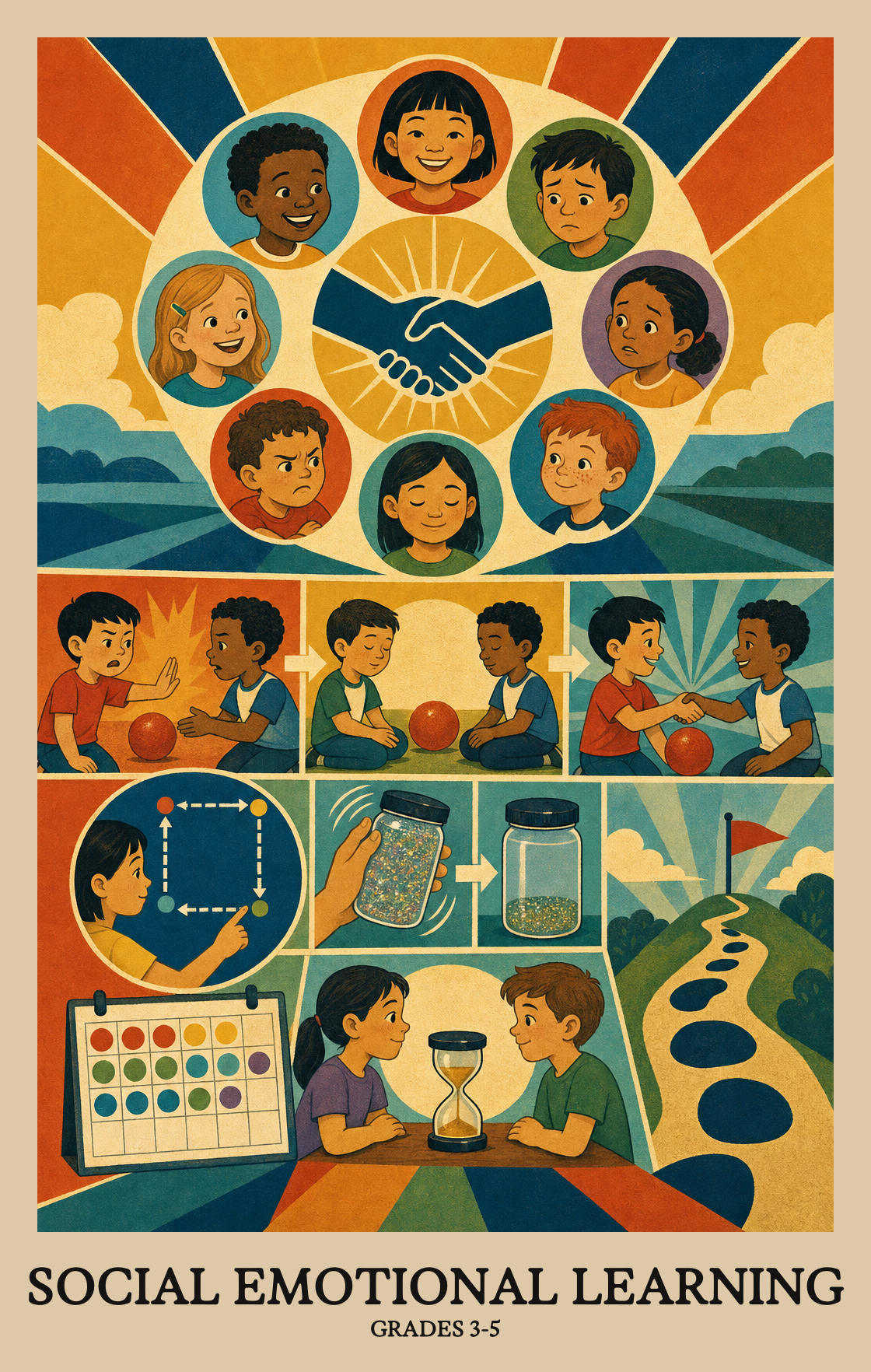
Students name a wider range of feelings and what sets them off. They practice ways to calm down when emotions run big, like taking a breath, stepping away, or asking for help.
Students describe what makes them them: interests, beliefs, skills, and the groups they belong to. They notice how family, friends, and teachers help shape who they are becoming.
Students pick up on tone of voice, body language, and the situation to guess how someone else might feel. They practice showing the other person they were heard.
Students learn what keeps a friendship steady, including handling peer pressure and getting along with classmates who are different from them. They learn what to do when they see bullying.
Students learn simple steps for cooling off an argument, hearing the other side, and finding a fix both people can live with. They practice these steps on small, everyday problems.
Students set a short goal and break it into steps. They weigh how a choice affects themselves and others, and find small ways to help out at school and in the neighborhood.
Students name feelings beyond happy or sad, like frustration, pride, or disappointment, and think about what caused them.
Students name what they are feeling and practice ways to calm down or cope, like taking deep breaths or pausing before reacting.
Students put words to who they are: what they're good at, what they believe, and where they come from. They recognize that belonging to different groups, a family, a culture, a community, shapes their identity too.
Students explain how the people around them, family, friends, teachers, and neighbors, help shape who they are becoming. They think about what support looks like from different people in their lives.
Students pick a small goal, like finishing a book or improving a test score, and take a first real step toward it.
Students break a goal into smaller steps and put those steps in order, so the goal feels reachable instead of overwhelming.
| Standard | Definition | Code |
|---|---|---|
| Naming emotions and what causes them Grades 3-5 | Students name feelings beyond happy or sad, like frustration, pride, or disappointment, and think about what caused them. | NY-SEL.1A.2a |
| Coping skills for handling big emotions Grades 3-5 | Students name what they are feeling and practice ways to calm down or cope, like taking deep breaths or pausing before reacting. | NY-SEL.1A.2b |
| Who you are and what matters to you Grades 3-5 | Students put words to who they are: what they're good at, what they believe, and where they come from. They recognize that belonging to different groups, a family, a culture, a community, shapes their identity too. | NY-SEL.1B.2a |
| People who shape who you are Grades 3-5 | Students explain how the people around them, family, friends, teachers, and neighbors, help shape who they are becoming. They think about what support looks like from different people in their lives. | NY-SEL.1B.2b |
| Setting and starting a short-term goal Grades 3-5 | Students pick a small goal, like finishing a book or improving a test score, and take a first real step toward it. | NY-SEL.1C.2a |
| Steps for reaching a goal Grades 3-5 | Students break a goal into smaller steps and put those steps in order, so the goal feels reachable instead of overwhelming. | NY-SEL.1C.2b |
Students read body language, tone of voice, and what's happening around them to figure out how someone else is feeling.
Students put someone else's feelings into their own words, showing that person they were heard. This is the start of empathy in action.
Students look at how people from different backgrounds, cultures, and communities have shaped the world around them, and practice naming what those contributions actually are.
Students practice talking and listening with people who are different from them, adjusting how they communicate so everyone feels heard and understood.
Students practice what to do when someone is being bullied, including speaking up for themselves or a friend, or finding a trusted adult who can help.
Students practice specific ways to build and keep healthy friendships, including what to say or do when a friend pressures them to act against their values.
Students practice specific ways to work well with classmates who have different backgrounds, opinions, or experiences. That might mean listening carefully, asking questions, or finding common ground on a shared task.
Students learn specific steps they can use to stop a conflict before it starts, cool it down in the moment, or work through a disagreement with someone else.
Students practice basic steps for working through disagreements with others, like taking turns talking or finding a solution both people can agree on.
| Standard | Definition | Code |
|---|---|---|
| Reading cues to understand how others feel Grades 3-5 | Students read body language, tone of voice, and what's happening around them to figure out how someone else is feeling. | NY-SEL.2A.2a |
| Understand how someone else feels Grades 3-5 | Students put someone else's feelings into their own words, showing that person they were heard. This is the start of empathy in action. | NY-SEL.2A.2b |
| How different people help our communities Grades 3-5 | Students look at how people from different backgrounds, cultures, and communities have shaped the world around them, and practice naming what those contributions actually are. | NY-SEL.2B.2a |
| Talking with different kinds of people Grades 3-5 | Students practice talking and listening with people who are different from them, adjusting how they communicate so everyone feels heard and understood. | NY-SEL.2B.2b |
| What to do when someone is bullied Grades 3-5 | Students practice what to do when someone is being bullied, including speaking up for themselves or a friend, or finding a trusted adult who can help. | NY-SEL.2B.2c |
| Keeping friendships healthy under peer pressure Grades 3-5 | Students practice specific ways to build and keep healthy friendships, including what to say or do when a friend pressures them to act against their values. | NY-SEL.2C.2a |
| Working well with people different from you Grades 3-5 | Students practice specific ways to work well with classmates who have different backgrounds, opinions, or experiences. That might mean listening carefully, asking questions, or finding common ground on a shared task. | NY-SEL.2C.2b |
| Handling conflicts with other people Grades 3-5 | Students learn specific steps they can use to stop a conflict before it starts, cool it down in the moment, or work through a disagreement with someone else. | NY-SEL.2D.2a |
| Solving conflicts with classmates Grades 3-5 | Students practice basic steps for working through disagreements with others, like taking turns talking or finding a solution both people can agree on. | NY-SEL.2D.2b |
Students think through how a choice might affect themselves and the people around them before acting. Safety and well-being are both part of the picture.
Students learn to recognize how the rules and expectations of a setting, like a classroom, a playground, or a family dinner, shape the choices they make. What feels like the right call at recess may not be the right call in a library.
Students learn a short set of steps for making decisions, like whether to join in, speak up, or back off, and practice thinking through how each choice might affect themselves and the people around them.
Students think of more than one way to handle a situation, then weigh how each choice would affect themselves and the people around them. They practice this with both classroom problems and everyday social ones.
Students name specific steps they can take to help their school, like standing up for a classmate being treated unfairly or pitching in to make the classroom a better place for everyone.
Students name specific things they can do to help their neighborhood or school, like organizing a cleanup, writing a letter, or standing up when something feels unfair.
| Standard | Definition | Code |
|---|---|---|
| Keeping yourself and others safe Grades 3-5 | Students think through how a choice might affect themselves and the people around them before acting. Safety and well-being are both part of the picture. | NY-SEL.3A.2a |
| How social expectations shape your choices Grades 3-5 | Students learn to recognize how the rules and expectations of a setting, like a classroom, a playground, or a family dinner, shape the choices they make. What feels like the right call at recess may not be the right call in a library. | NY-SEL.3A.2b |
| Making choices that consider others Grades 3-5 | Students learn a short set of steps for making decisions, like whether to join in, speak up, or back off, and practice thinking through how each choice might affect themselves and the people around them. | NY-SEL.3B.2a |
| Weigh solutions before you decide Grades 3-5 | Students think of more than one way to handle a situation, then weigh how each choice would affect themselves and the people around them. They practice this with both classroom problems and everyday social ones. | NY-SEL.3B.2b |
| Ways to help your school community Grades 3-5 | Students name specific steps they can take to help their school, like standing up for a classmate being treated unfairly or pitching in to make the classroom a better place for everyone. | NY-SEL.3C.2a |
| Ways to help your community Grades 3-5 | Students name specific things they can do to help their neighborhood or school, like organizing a cleanup, writing a letter, or standing up when something feels unfair. | NY-SEL.3C.2b |
Students learn to name bigger feelings like frustration, jealousy, or pride and figure out what set them off. They practice ways to calm down, work through small conflicts, and notice how friends and classmates might be feeling. They also start setting short goals and thinking through choices before acting.
When a child is upset, name the feeling out loud and let them ride it out before talking about what to do. Once everyone is calm, ask what happened and what might help next time, such as taking a break, drinking water, or asking for a hug. Repeat the same few strategies so they become automatic.
A short-term goal is something a child can finish in a week or two, like reading every night, learning to tie shoes, or saving for a small toy. Help break it into two or three steps and check in on it together. Finishing small goals builds the habit they need for bigger ones later.
Listen first and thank them for telling. Ask what happened, how they felt, and what they tried, then decide together whether to talk to the teacher. Students this age are learning that speaking up for themselves or a friend is a sign of courage, not tattling.
Start with self-awareness in the fall: naming feelings, noticing what triggers them, and practicing calming strategies. Move into social awareness and friendship skills by winter, then conflict resolution and group work in late winter. Save decision making and community action for spring, once trust and shared language are in place.
Conflict navigation and reading social cues take the longest to stick. Students can name a strategy in a lesson and forget it ten minutes later on the playground. Plan to revisit the same handful of conflict steps every few weeks and coach them in real moments, not just during lessons.
Students can name a range of feelings in themselves and others, use a calming strategy without being prompted, and work through a small disagreement with a peer. They can describe parts of their own identity, set a short goal and track steps toward it, and name one way to contribute to the class or school.
Give students regular chances to share strengths, interests, family traditions, and opinions in low-stakes ways. Point out contributions from a wide range of people in read-alouds and lessons across the year. The goal is for students to describe who they are and see classmates accurately, not just tolerate differences.
Use a simple three-step routine: stop, think about who this affects, pick a choice. Walk through it during real moments like recess problems or group work disagreements. Over time students start running the steps on their own instead of waiting for an adult to sort it out.
By the end of fifth grade, students should be able to calm themselves down most of the time, talk through a problem with a friend without an adult stepping in, and ask a trusted adult for help when something is too big. They should also be able to set a small goal and stick with it for a couple of weeks.