Building stories and characters
Students come up with story ideas and start imagining characters. They draw on their own experiences to invent scenes and decide what a character might want, say, or do.
This is the year theater becomes more deliberate, with students planning a scene before they perform it. Students pull from their own lives and from stories they know to shape characters and choices on stage. They rehearse, take notes from classmates, and try the scene again with changes that make it clearer. By spring, students can act in a short scene, explain why their character behaves a certain way, and say what worked in a classmate's performance.
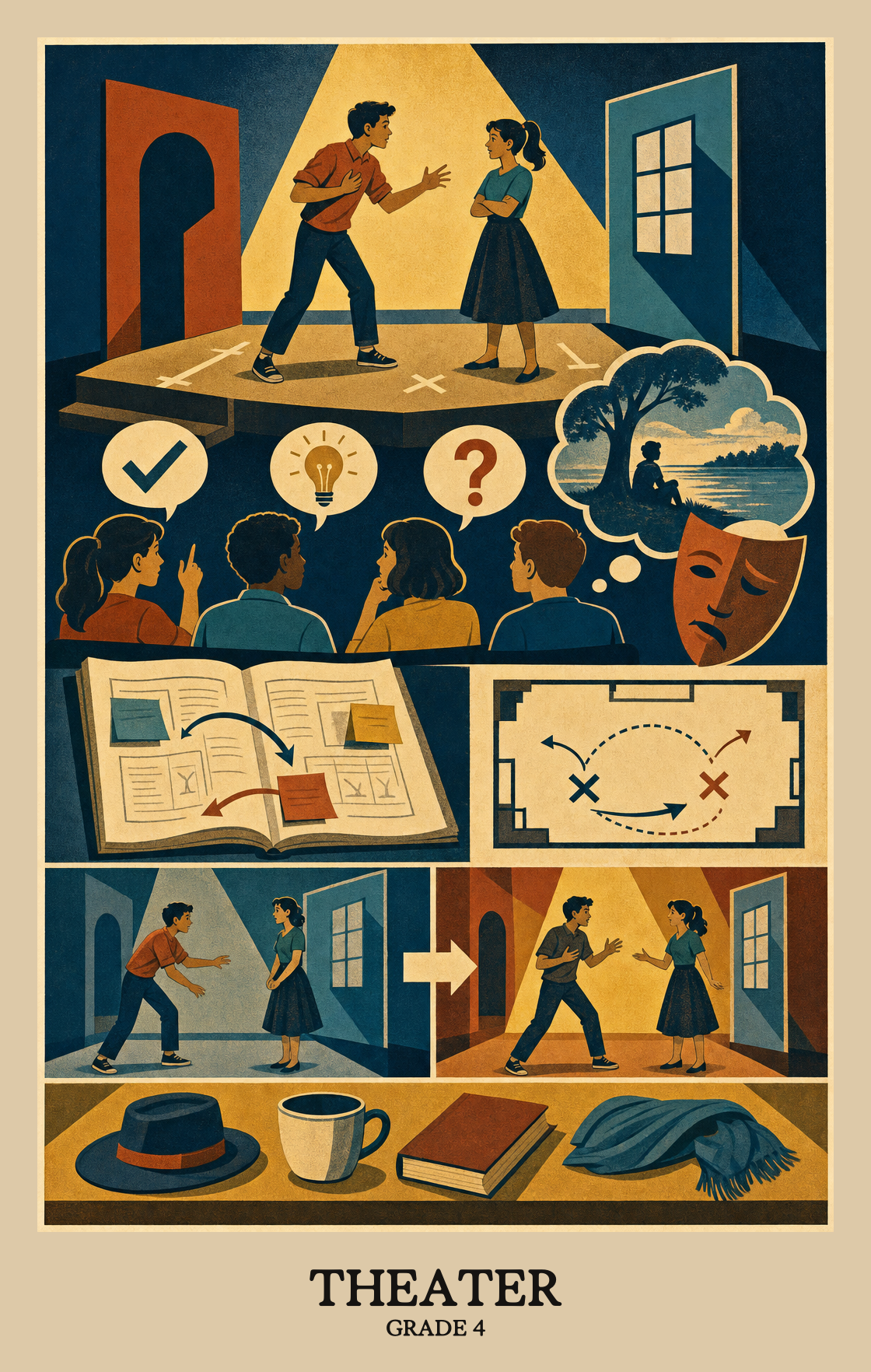
Students come up with story ideas and start imagining characters. They draw on their own experiences to invent scenes and decide what a character might want, say, or do.
Students work in small groups to organize their ideas into short scenes. They try out different choices, give each other feedback, and rework the parts that are not clear yet.
Students practice using voice, face, and body to bring a scene to life for an audience. They pick which work to share and rehearse until the meaning comes through.
Students watch performances and talk about what they noticed and what the story meant. They learn to back up their opinions with specific moments from the scene.
Students connect plays and stories to the people, places, and times they come from. They notice how theater reflects different cultures and how it changes across history.
Students draw on things they know and moments they have lived through to build a character or scene. Real memories and curiosity about the world shape the choices students make on stage.
Students look at a play or performance and ask where it came from. They connect what they see on stage to the time period, culture, or community that shaped it.
| Standard | Definition | Code |
|---|---|---|
| Using real life to make theater | Students draw on things they know and moments they have lived through to build a character or scene. Real memories and curiosity about the world shape the choices students make on stage. | TH:Cn10.4 |
| Theater reflects the world around us | Students look at a play or performance and ask where it came from. They connect what they see on stage to the time period, culture, or community that shaped it. | TH:Cn11.4 |
Students brainstorm characters, settings, and scenes for a short play or performance. They sketch out ideas and start shaping them into something that could be acted out onstage.
Students take their character ideas and shape them into a short scene, deciding what each character wants, how they move, and what they say.
Students revisit a scene or character they've been building and make specific changes to improve it, from clearer dialogue to stronger movement, before calling it finished.
| Standard | Definition | Code |
|---|---|---|
| Coming up with ideas for a play | Students brainstorm characters, settings, and scenes for a short play or performance. They sketch out ideas and start shaping them into something that could be acted out onstage. | TH:Cr1.4 |
| Turning a theater idea into a scene | Students take their character ideas and shape them into a short scene, deciding what each character wants, how they move, and what they say. | TH:Cr2.4 |
| Finishing a scene until it works | Students revisit a scene or character they've been building and make specific changes to improve it, from clearer dialogue to stronger movement, before calling it finished. | TH:Cr3.4 |
Students choose a scene or character to perform and explain why it fits the story and the audience watching it.
Students rehearse a scene or monologue, then make specific improvements to voice, movement, or timing before performing it for an audience.
Students perform a scene or monologue and make deliberate choices, like tone of voice or movement, to communicate a specific feeling or idea to the audience.
| Standard | Definition | Code |
|---|---|---|
| Choosing scenes worth performing | Students choose a scene or character to perform and explain why it fits the story and the audience watching it. | TH:Pr4.4 |
| Rehearse and refine a scene for performance | Students rehearse a scene or monologue, then make specific improvements to voice, movement, or timing before performing it for an audience. | TH:Pr5.4 |
| Perform to share a clear meaning | Students perform a scene or monologue and make deliberate choices, like tone of voice or movement, to communicate a specific feeling or idea to the audience. | TH:Pr6.4 |
Students look closely at a scene or performance and explain what they notice, describing specific moments that shaped how the story or character felt to them.
Students explain what a scene or character is really about, going beyond what happens on stage to say what the playwright or performer meant to show.
Students look at a scene or performance and decide what makes it work well or fall flat, using specific reasons to back up their opinion.
| Standard | Definition | Code |
|---|---|---|
| Reading a play with fresh eyes | Students look closely at a scene or performance and explain what they notice, describing specific moments that shaped how the story or character felt to them. | TH:Re7.4 |
| What a play is trying to say | Students explain what a scene or character is really about, going beyond what happens on stage to say what the playwright or performer meant to show. | TH:Re8.4 |
| Judging what makes a performance work | Students look at a scene or performance and decide what makes it work well or fall flat, using specific reasons to back up their opinion. | TH:Re9.4 |
Students make up scenes, play characters, and put together short plays. They also watch performances and talk about what worked and why. Expect a mix of acting games, group planning, and small performances for classmates.
Start small. Read a picture book together and take turns doing the voices, or act out a scene from a favorite movie in the living room. Five minutes of silly practice at home builds the comfort students need to speak up in front of classmates.
Not usually at this age. Students work with short scenes and often improvise. Memorizing a few lines for a class performance is common, but the focus is on understanding the character and telling a clear story, not perfect recall.
Start with acting games and group storytelling to build trust. Move into making and shaping short scenes in the middle of the year. End with rehearsing, performing, and reflecting on a longer piece so all four areas come together.
Students can build a character with voice and body, work with a group to shape a short scene, and revise their work after feedback. They can also watch a performance and explain what the story meant and how the actors made choices to show it.
After a show, movie, or school play, ask what the story was really about and which character felt most real. Ask why. Two minutes of honest talk on the car ride home does the same work as a class discussion.
Giving useful feedback to classmates is the hardest piece. Students default to saying it was good or bad. Plan time for sentence starters and short reflection routines so feedback stays specific and kind across the year.
Students look at stories from different times and places and ask why people told them. A folktale from another country or a scene set a hundred years ago becomes a way to talk about how life was different and what stayed the same.
By spring, students should be willing to try a role, stay in character for a short scene, and talk about a performance with more than just liked it or did not like it. Comfort speaking in front of a small group is the clearest sign.