Knowing yourself under pressure
Students notice how big feelings show up in their body and their thinking. They practice naming what they feel and talking it through with a trusted friend or adult instead of bottling it up.
This is the year students start managing their inner life like an adult. They learn to name complicated feelings, talk them through with someone they trust, and use self-talk and personal strengths to push past setbacks. Students also set a real long-term goal, plan the steps to get there, and work through conflicts with peers using actual strategies. By spring, students can hold a hard conversation, stick with a goal for months, and notice when a group dynamic is unfair.
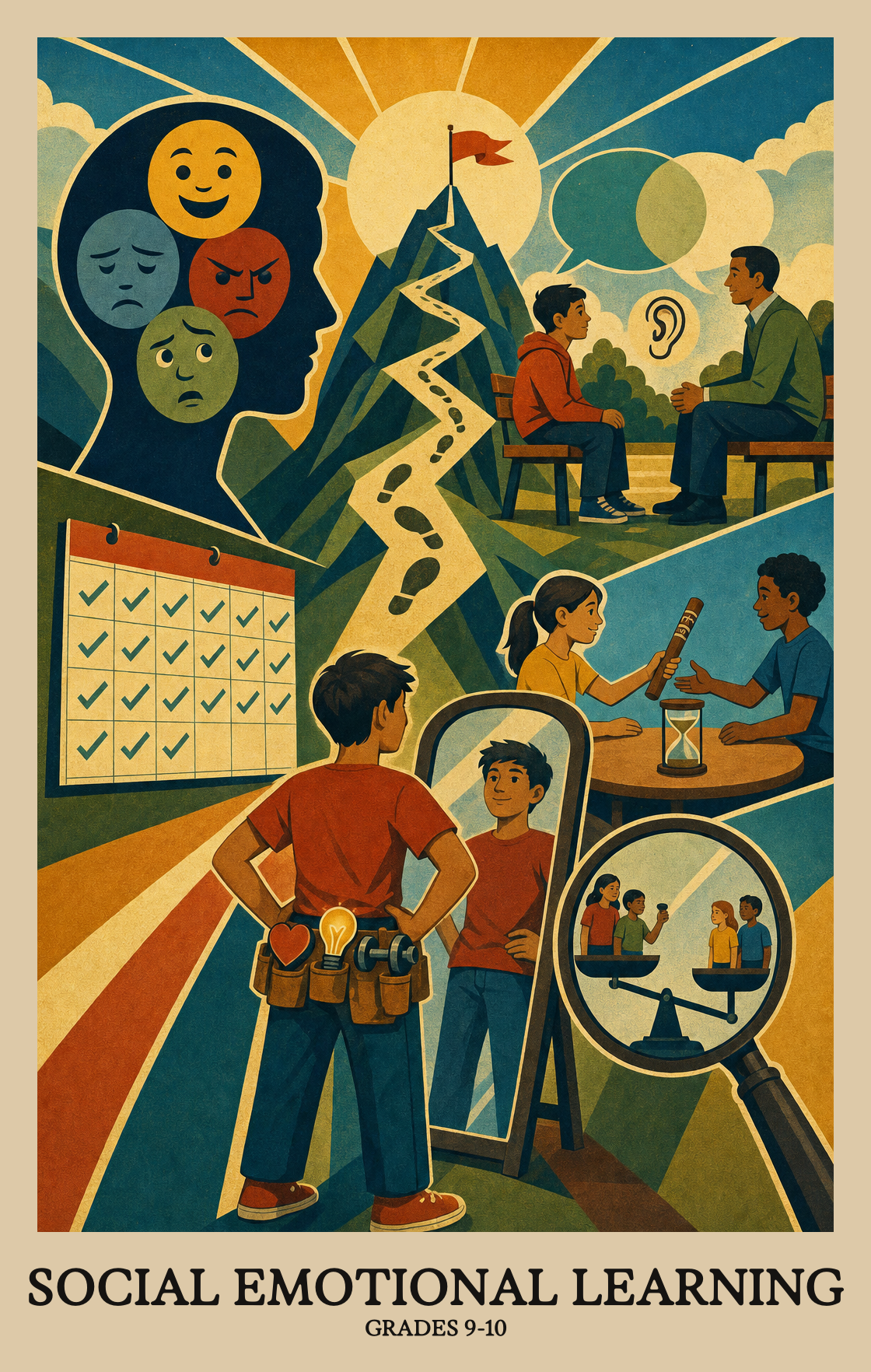
Students notice how big feelings show up in their body and their thinking. They practice naming what they feel and talking it through with a trusted friend or adult instead of bottling it up.
Students work on positive self-talk and lean on role models who shape who they are becoming. They pick a goal that matters to them and map out the steps to get there over months, not days.
Students compare their own background and views with those of classmates who grew up differently. They ask honest questions, listen with care, and notice how stereotypes and small put-downs affect people.
Students build real friendships across different groups and speak up when someone is hurt. When conflict happens, they use specific tools to cool things down and work it out instead of cutting people off.
Students think through how friends, social media, and people in power shape the choices they make. They practice making decisions they can stand behind, even when the easy choice points the other way.
Students plan and carry out a service project at school or in their neighborhood. They reflect on what changed because of their work and what they would do differently next time.
Students notice complicated or conflicting emotions and recognize how those feelings affect their thinking, mood, and physical state.
Students practice putting complicated feelings into words with someone they trust, like a friend, counselor, or family member, then use that conversation to decide how to act.
Students practice talking to themselves in a more positive way, like naming what they are good at or what they are grateful for, and then use those strengths to work through a real problem.
Students name trusted adults in their lives and think through how those relationships have shaped who they are becoming.
Students write out a long-term goal, then list the specific steps needed to reach it, in order.
Students track a long-term goal by checking specific signs of progress, then name what is getting in the way, including obstacles they can control and ones they cannot.
| Standard | Definition | Code |
|---|---|---|
| Noticing how emotions affect your mind and body Grades 9-10 | Students notice complicated or conflicting emotions and recognize how those feelings affect their thinking, mood, and physical state. | NY-SEL.1A.4a |
| Sharing hard feelings with people you trust Grades 9-10 | Students practice putting complicated feelings into words with someone they trust, like a friend, counselor, or family member, then use that conversation to decide how to act. | NY-SEL.1A.4b |
| Positive self-talk and personal strengths Grades 9-10 | Students practice talking to themselves in a more positive way, like naming what they are good at or what they are grateful for, and then use those strengths to work through a real problem. | NY-SEL.1B.4a |
| Finding adults who shape who you are Grades 9-10 | Students name trusted adults in their lives and think through how those relationships have shaped who they are becoming. | NY-SEL.1B.4b |
| Setting long-term goals with action steps Grades 9-10 | Students write out a long-term goal, then list the specific steps needed to reach it, in order. | NY-SEL.1C.4a |
| Tracking long-term goals and real barriers Grades 9-10 | Students track a long-term goal by checking specific signs of progress, then name what is getting in the way, including obstacles they can control and ones they cannot. | NY-SEL.1C.4b |
Students look at a situation from someone else's point of view and notice where their thinking lines up and where it differs, especially with people from different backgrounds.
Students practice asking thoughtful questions and listening carefully to understand how someone else sees the world, especially when that person's experiences look different from their own.
Students identify traits that define different cultures, including their own, then think through how to present themselves authentically across different social settings.
Students practice building real relationships across cultural and social differences. When harm happens, they find the words to say something about it.
Students think about how asking for help or offering it changes a relationship, whether that means building trust, creating tension, or shifting the balance between two people.
Students look back on their part in a group that included people different from them, thinking about what they did, how it went, and what they learned from working across those differences.
Students look at real conflict situations and figure out which conversation moves, like listening, asking questions, or reframing, actually help people work through disagreement instead of making it worse.
Students practice resolving real disagreements, including ones rooted in race, religion, identity, or ability, across different social settings, from friend groups to classrooms to community situations.
| Standard | Definition | Code |
|---|---|---|
| Seeing your view and someone else's Grades 9-10 | Students look at a situation from someone else's point of view and notice where their thinking lines up and where it differs, especially with people from different backgrounds. | NY-SEL.2A.4a |
| Asking questions to understand how others feel Grades 9-10 | Students practice asking thoughtful questions and listening carefully to understand how someone else sees the world, especially when that person's experiences look different from their own. | NY-SEL.2A.4b |
| Navigating your identity across cultural spaces Grades 9-10 | Students identify traits that define different cultures, including their own, then think through how to present themselves authentically across different social settings. | NY-SEL.2B.4a |
| Speaking up when someone is harmed Grades 9-10 | Students practice building real relationships across cultural and social differences. When harm happens, they find the words to say something about it. | NY-SEL.2B.4b |
| Asking for help changes relationships Grades 9-10 | Students think about how asking for help or offering it changes a relationship, whether that means building trust, creating tension, or shifting the balance between two people. | NY-SEL.2C.4a |
| Working in groups across differences Grades 9-10 | Students look back on their part in a group that included people different from them, thinking about what they did, how it went, and what they learned from working across those differences. | NY-SEL.2C.4b |
| Talking through conflict Grades 9-10 | Students look at real conflict situations and figure out which conversation moves, like listening, asking questions, or reframing, actually help people work through disagreement instead of making it worse. | NY-SEL.2D.4a |
| Resolving conflicts in groups and one-on-one Grades 9-10 | Students practice resolving real disagreements, including ones rooted in race, religion, identity, or ability, across different social settings, from friend groups to classrooms to community situations. | NY-SEL.2D.4b |
Students practice making real choices, like whether to speak up, opt out, or help someone, that protect their own health and respect the people around them.
Students examine how pressure from peers, authority figures, or popular opinion can quietly steer personal choices. They practice noticing when outside expectations are driving a decision so they can decide whether to follow or push back.
Students practice making decisions that build trust and support between people, including across different groups. The focus is on choices that strengthen relationships, not just individual outcomes.
Students pick a real problem at school, take action to address it, then look back on what worked. The focus is improving how students treat each other and making the school a better place to be.
Students pick a real community problem, build a plan to address it, carry it out, and then reflect on whether their efforts made a difference.
| Standard | Definition | Code |
|---|---|---|
| Decisions that protect you and others Grades 9-10 | Students practice making real choices, like whether to speak up, opt out, or help someone, that protect their own health and respect the people around them. | NY-SEL.3A.4a |
| How social power shapes your choices Grades 9-10 | Students examine how pressure from peers, authority figures, or popular opinion can quietly steer personal choices. They practice noticing when outside expectations are driving a decision so they can decide whether to follow or push back. | NY-SEL.3A.4b |
| Building relationships that work for everyone Grades 9-10 | Students practice making decisions that build trust and support between people, including across different groups. The focus is on choices that strengthen relationships, not just individual outcomes. | NY-SEL.3B.4b |
| Service learning that improves school culture Grades 9-10 | Students pick a real problem at school, take action to address it, then look back on what worked. The focus is improving how students treat each other and making the school a better place to be. | NY-SEL.3C.4a |
| Service learning for social justice Grades 9-10 | Students pick a real community problem, build a plan to address it, carry it out, and then reflect on whether their efforts made a difference. | NY-SEL.3C.4b |
Students learn to notice their feelings, work through conflicts, set long-term goals, and think about how their decisions affect other people. They also practice talking across differences and building relationships with people who do not share their background.
Ask what they are feeling before asking what happened, and let them talk without jumping to fix it. Naming a feeling out loud is often enough to take some of the edge off. Modeling this when something frustrates a parent helps too.
Something like making a sports team next year, saving for a car, raising a grade in a tough class, or applying to a summer program. The skill is breaking the goal into small steps and checking progress every few weeks, not picking the perfect goal.
Start with self-awareness and goal-setting in the fall while students are forming routines. Move into perspective-taking and relationship skills mid-year when group work picks up. Save conflict resolution and service learning for later, once students trust each other enough to practice these in real situations.
Sit next to them instead of across from them, like in the car or while making dinner. Ask one specific question instead of a general one. Sometimes a quiet ten minutes is more useful than a long talk.
Conflict resolution and recognizing how power and group expectations shape decisions. Students can name these ideas in a discussion but struggle to apply them when a real disagreement happens with a friend. Plan for repeated practice with low-stakes scenarios.
Tie projects to something students already notice as a problem in the school or neighborhood, and give them time to plan, act, and reflect. The reflection step is where most of the learning happens, so protect time for it even when the project runs long.
Students can describe their own strengths and triggers, work through a disagreement without shutting down or escalating, and stick with a multi-step goal for several weeks. They can also explain how someone from a different background might see the same situation differently.