Sparking movement ideas
Students start the year by turning their own experiences, stories, and observations into movement. Parents may hear them describe a dance they made up about a memory or a feeling from home.
This is the year dance moves from copying steps to shaping a dance with a point of view. Students take an idea, like a feeling or a story, and turn it into movement they plan, practice, and polish. They also watch other dances and say what the choreographer was going for and what worked. By spring, students can perform a short dance they helped create and explain the choices behind it.
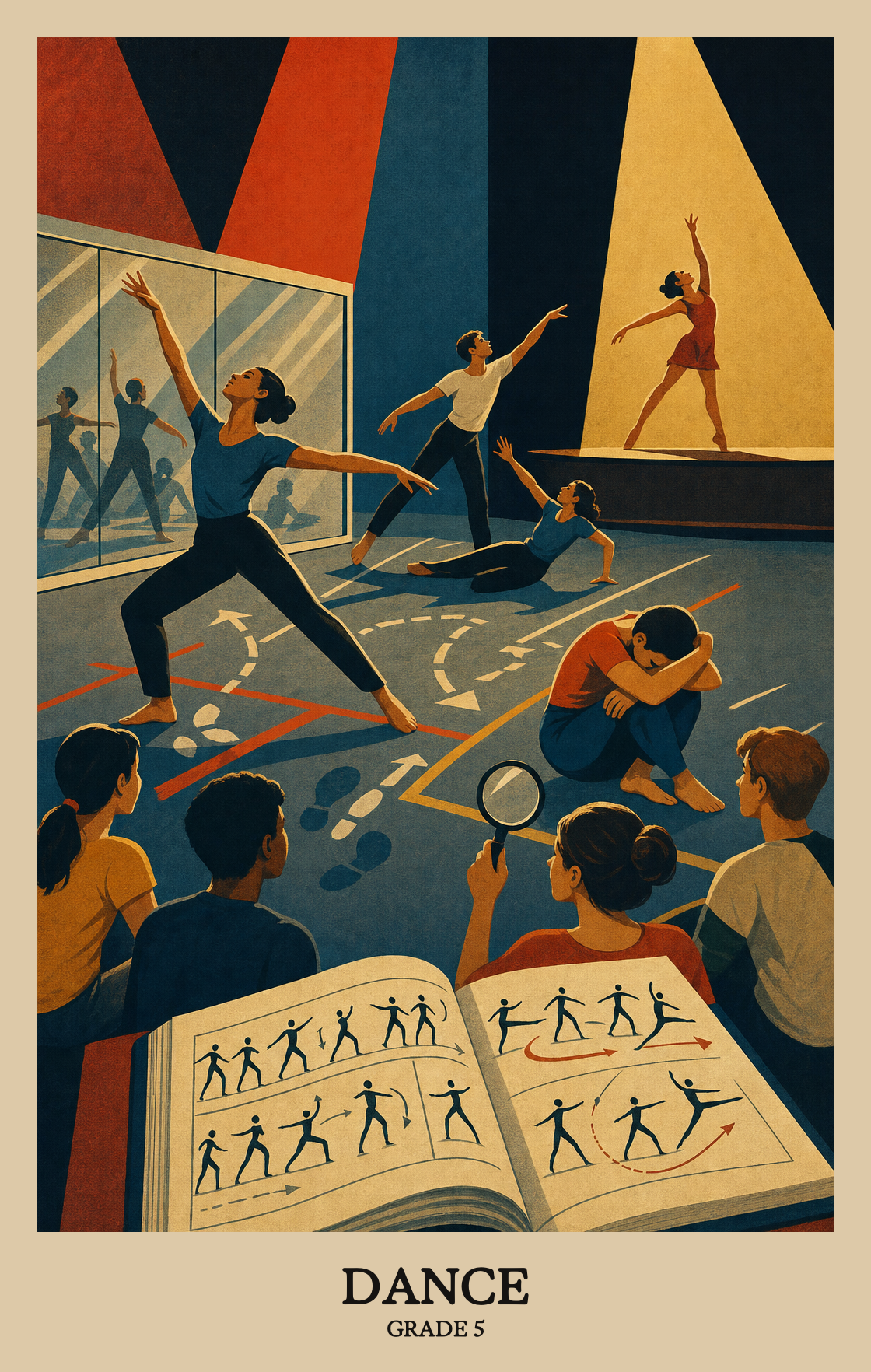
Students start the year by turning their own experiences, stories, and observations into movement. Parents may hear them describe a dance they made up about a memory or a feeling from home.
Students take rough movement ideas and build them into short dances with a clear beginning, middle, and end. They try different orders and pick the version that works best.
Students sharpen their technique and rehearse the pieces they will share. They work on balance, timing with music, and making each movement readable from across a room.
Students perform dances that carry a clear idea or message. They learn how facial expression, energy, and stillness help an audience understand what the dance is about.
Students watch dances from different cultures and time periods and talk about what they notice. They use simple criteria to give feedback on their own work and the work of classmates.
Students connect something from their own life to a dance they create or perform. A memory, feeling, or outside idea shapes the choices they make in the movement.
Students connect a dance to the time, place, or culture it came from, explaining what the movement reveals about the people who made it.
| Standard | Definition | Code |
|---|---|---|
| Making art from your own life | Students connect something from their own life to a dance they create or perform. A memory, feeling, or outside idea shapes the choices they make in the movement. | CA-DA:Cn10.5.5 |
| Dance history and culture in context | Students connect a dance to the time, place, or culture it came from, explaining what the movement reveals about the people who made it. | CA-DA:Cn11.5.5 |
Students brainstorm and develop original ideas for a dance, deciding what movement, theme, or story they want to explore before they start choreographing.
Students take their movement ideas and shape them into a short dance, making choices about how to order, adjust, and connect the parts so the piece holds together.
Students revise a dance they have been making, fixing sections that aren't working and polishing the piece until it feels finished and ready to share.
| Standard | Definition | Code |
|---|---|---|
| Coming up with dance ideas | Students brainstorm and develop original ideas for a dance, deciding what movement, theme, or story they want to explore before they start choreographing. | CA-DA:Cr1.5.5 |
| Turning dance ideas into a finished piece | Students take their movement ideas and shape them into a short dance, making choices about how to order, adjust, and connect the parts so the piece holds together. | CA-DA:Cr2.5.5 |
| Finishing and polishing a dance | Students revise a dance they have been making, fixing sections that aren't working and polishing the piece until it feels finished and ready to share. | CA-DA:Cr3.5.5 |
Students choose which dances to perform and explain why those pieces show their skills and ideas clearly.
Students practice and improve a dance piece until it's ready to share with an audience. That means cleaning up movements, sharpening timing, and making the work feel finished.
Students rehearse and perform a dance to share a clear idea or feeling with an audience. The choices they make, from movement to timing, are meant to communicate something specific.
| Standard | Definition | Code |
|---|---|---|
| Choosing dances worth performing | Students choose which dances to perform and explain why those pieces show their skills and ideas clearly. | CA-DA:Pr4.5.5 |
| Refine a dance for performance | Students practice and improve a dance piece until it's ready to share with an audience. That means cleaning up movements, sharpening timing, and making the work feel finished. | CA-DA:Pr5.5.5 |
| Perform a dance that says something | Students rehearse and perform a dance to share a clear idea or feeling with an audience. The choices they make, from movement to timing, are meant to communicate something specific. | CA-DA:Pr6.5.5 |
Students watch a dance and explain what they notice, describing how the movements, timing, and shape of the piece work together to create meaning.
Students watch a dance and explain what the choreographer was trying to say. They support their reading of the movement with specific details from what they saw.
Students watch a dance and use specific criteria, like whether the movement matches the music or the idea behind the piece, to explain what works and what could be stronger.
| Standard | Definition | Code |
|---|---|---|
| Reading dance with your eyes | Students watch a dance and explain what they notice, describing how the movements, timing, and shape of the piece work together to create meaning. | CA-DA:Re7.5.5 |
| Reading what a dance is saying | Students watch a dance and explain what the choreographer was trying to say. They support their reading of the movement with specific details from what they saw. | CA-DA:Re8.5.5 |
| Judging what makes a dance work | Students watch a dance and use specific criteria, like whether the movement matches the music or the idea behind the piece, to explain what works and what could be stronger. | CA-DA:Re9.5.5 |
Students create short dances, perform them for classmates, and talk about what they see in other dancers' work. They start using ideas from their own lives, stories they've read, or events in history as a starting point for movement.
No. The focus is on making and shaping movement, not on technique from a studio. Students who have never taken a class can do everything that's expected, as long as they're willing to try ideas and revise them.
Clear a small space in the living room and let students show a short dance they made at school. Ask what the dance is about and what part they want to change. Five minutes of attention does more than any class outside of school.
Start with generating ideas and short movement studies, then move into shaping and refining longer pieces. Save formal performance and peer feedback for the second half of the year, once students have language for talking about movement.
Revision is the hardest part. Students often want their first draft of a dance to be the final version. Building short, regular cycles of perform, give feedback, and adjust helps more than any single lesson on choreography.
Give them a small set of words for movement, such as speed, level, shape, and energy, and use those words every time a dance is shown. By spring, students should be able to point to a specific moment in a dance and say what it meant to them.
A student can take an idea from a story or experience, build a short dance from it, refine it after feedback, and perform it with intent. They can also watch a classmate's dance and explain what worked and why.
Grades come from things that can be observed, such as whether a dance has a clear idea, whether the student revised it after feedback, and whether the performance matches the intent. Personal taste is not the measure.