Place value and decimals
Students extend place value into the thousandths. They read, write, compare, and round decimals, and notice what happens to numbers when they are multiplied or divided by 10, 100, or 1,000.
This is the year math moves past whole numbers and into decimals and fractions as real tools. Students learn what each digit means in a number like 3.475, multiply and divide bigger numbers, and add fractions with different bottoms. They also start working with fractions of fractions and find the volume of boxes by counting cubes inside. By spring, students can add 2/3 and 1/4, multiply 1.6 by 2.5, and locate a point like (3, 5) on a grid.
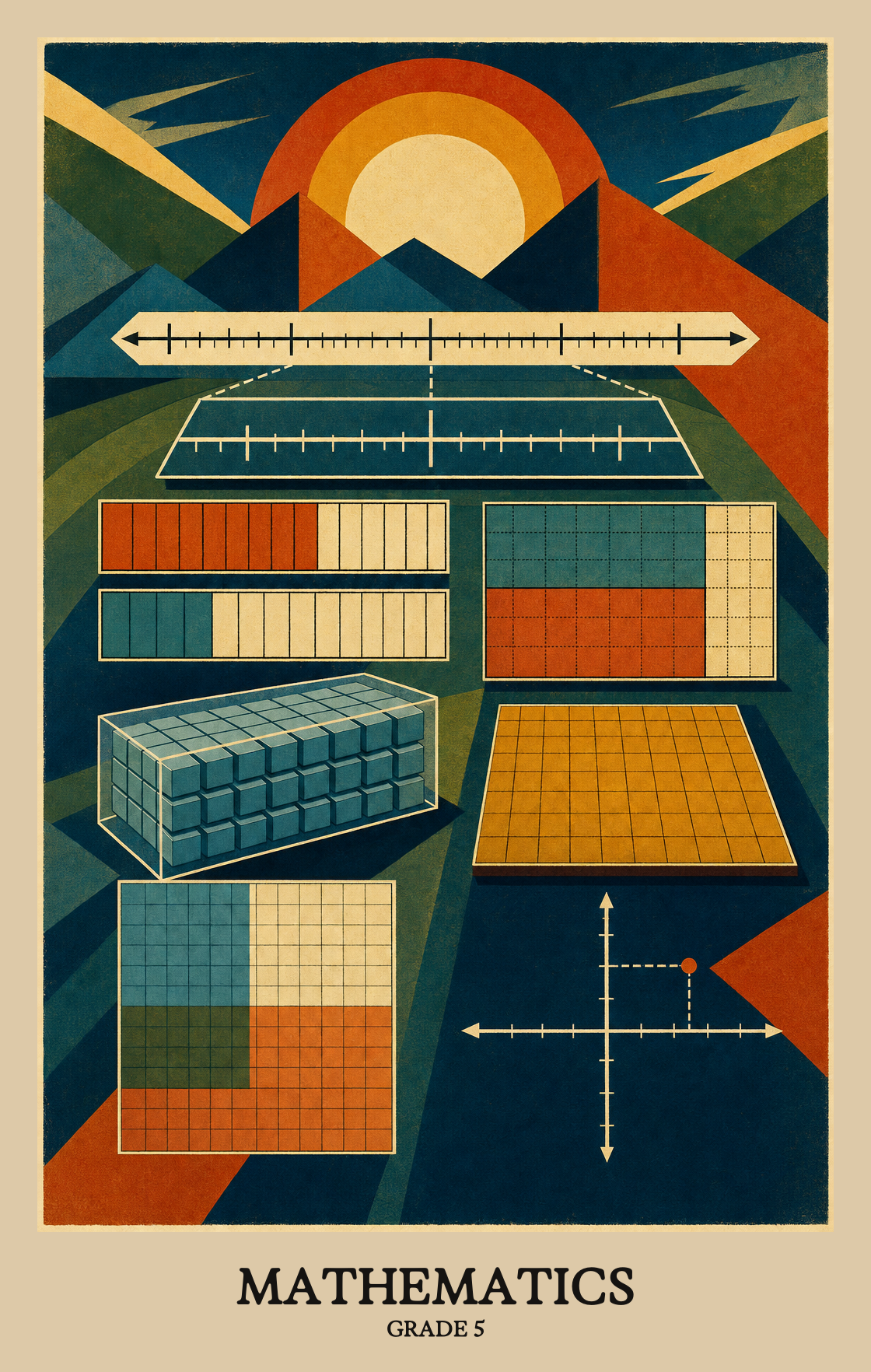
Students extend place value into the thousandths. They read, write, compare, and round decimals, and notice what happens to numbers when they are multiplied or divided by 10, 100, or 1,000.
Students multiply larger whole numbers using the standard method and divide with two-digit divisors. They also add, subtract, multiply, and divide decimals to the hundredths place, like amounts of money.
Students add and subtract fractions and mixed numbers with different bottom numbers, such as one-third plus one-fourth. They check whether answers make sense using fractions they already know well, like one-half.
Students multiply fractions by whole numbers and by other fractions, and start dividing with unit fractions like one-fourth. They see a fraction as a division problem and use pictures of rectangles to find areas with fractional sides.
Students measure the space inside boxes by counting unit cubes and find volume in cubic inches and cubic centimeters. They also convert between units like meters and centimeters and read line plots that use fractions.
Students write and read number expressions using parentheses without solving them. They plot points on a grid using ordered pairs and sort shapes like squares and rectangles by their properties.
Students learn to read and plot points on a grid using two numbers, like (3, 5). The first number says how far to move across, the second says how far to move up.
Students plot points on a graph using two numbers (like 3 across, 5 up) to show real-world information, then read the graph to answer questions about it. They also sort flat shapes into groups based on their sides and angles.
Shapes that belong to a group inherit every rule of that group. Since squares are a type of rectangle, they automatically have all four right angles, just like every other rectangle does.
Students use shapes, graphs, and drawings to show how math works in real-life situations. They connect what they already know about numbers to solve new kinds of problems.
Students choose the right tool for the job, whether that means a ruler, a protractor, or a number line, and explain why that tool fits the problem they are solving.
Students use precise math vocabulary to describe and discuss expressions and equations, choosing words and symbols carefully so their reasoning is clear and accurate.
Students plot points and identify shapes on a coordinate grid, using the x- and y-axes to describe exact locations and geometric relationships.
| Standard | Definition | Code |
|---|---|---|
| Use a pair of perpendicular number lines, called axes, to define a coordinate… | Students learn to read and plot points on a grid using two numbers, like (3, 5). The first number says how far to move across, the second says how far to move up. | CA-5.G.1 |
| Represent real-world and mathematical problems by graphing points in the first… | Students plot points on a graph using two numbers (like 3 across, 5 up) to show real-world information, then read the graph to answer questions about it. They also sort flat shapes into groups based on their sides and angles. | CA-5.G.2 |
| Understand that attributes belonging to a category of two-dimensional figures… | Shapes that belong to a group inherit every rule of that group. Since squares are a type of rectangle, they automatically have all four right angles, just like every other rectangle does. | CA-5.G.3 |
| Model with mathematics | Students use shapes, graphs, and drawings to show how math works in real-life situations. They connect what they already know about numbers to solve new kinds of problems. | CA-5.G.4 |
| Use appropriate tools strategically | Students choose the right tool for the job, whether that means a ruler, a protractor, or a number line, and explain why that tool fits the problem they are solving. | CA-5.G.5 |
| Attend to precision. Expressions and Equations | Students use precise math vocabulary to describe and discuss expressions and equations, choosing words and symbols carefully so their reasoning is clear and accurate. | CA-5.G.6 |
| Look for and make use of structure | Students plot points and identify shapes on a coordinate grid, using the x- and y-axes to describe exact locations and geometric relationships. | CA-5.G.7 |
Converting measurements means changing a length, weight, or liquid amount from one unit to another within the same system, like turning centimeters into meters or ounces into pounds. Students then use those conversions to solve real-world problems with multiple steps.
Students collect measurements given in fractions, plot them on a number line, and use that chart to solve problems, like figuring out how to split a total amount evenly across several containers.
Students learn that volume measures how much space a solid shape takes up. They count how many small unit cubes fit inside a box or other solid figure, with no gaps, to find its volume in cubic units.
Students measure the space inside a box or container by counting how many small cubes fit inside it. Those cubes can be standard sizes like cubic inches or cubic centimeters, or any same-size cube that fits the job.
| Standard | Definition | Code |
|---|---|---|
| Convert among different-sized standard measurement units within a given… | Converting measurements means changing a length, weight, or liquid amount from one unit to another within the same system, like turning centimeters into meters or ounces into pounds. Students then use those conversions to solve real-world problems with multiple steps. | CA-5.MD.1 |
| Make a line plot to display a data set of measurements in fractions of a unit | Students collect measurements given in fractions, plot them on a number line, and use that chart to solve problems, like figuring out how to split a total amount evenly across several containers. | CA-5.MD.2 |
| Recognize volume as an attribute of solid figures and understand concepts of… | Students learn that volume measures how much space a solid shape takes up. They count how many small unit cubes fit inside a box or other solid figure, with no gaps, to find its volume in cubic units. | CA-5.MD.3 |
| Measure volumes by counting unit cubes, using cubic cm, cubic in, cubic ft | Students measure the space inside a box or container by counting how many small cubes fit inside it. Those cubes can be standard sizes like cubic inches or cubic centimeters, or any same-size cube that fits the job. | CA-5.MD.4 |
Each position in a number is worth ten times more than the spot to its right. So the 4 in 400 is worth ten times the 4 in 40, and one-tenth of the 4 in 4,000.
Multiplying by 10, 100, or 1,000 shifts every digit left and adds zeros. Dividing does the opposite. Students explain why that happens and write powers of 10 using exponents like 10² instead of writing out all the zeros.
Students read, write, and compare decimal numbers out to the thousandths place, like 347.392. They also break a decimal apart by place value and use greater-than and less-than symbols to show which of two decimals is bigger.
Students round decimal numbers to a chosen place, such as the nearest tenth or whole number, then add, subtract, multiply, and divide with large whole numbers and decimals down to the hundredths place.
Students practice multiplying large whole numbers by hand using the step-by-step method taught in school. By the end of fifth grade, they should be able to work through these problems accurately and without help.
Students divide large numbers (up to four digits) by a two-digit number and show how they got the answer using drawings, arrays, or equations. The work connects division back to what students already know about multiplication.
Students add, subtract, multiply, and divide decimal numbers like 3.47 or 12.86. They use drawings or place-value thinking to work through the math, then explain in writing why their method works.
| Standard | Definition | Code |
|---|---|---|
| Recognize that in a multi-digit number, a digit in one place represents 10… | Each position in a number is worth ten times more than the spot to its right. So the 4 in 400 is worth ten times the 4 in 40, and one-tenth of the 4 in 4,000. | CA-5.NBT.1 |
| Explain patterns in the number of zeros of the product when multiplying a… | Multiplying by 10, 100, or 1,000 shifts every digit left and adds zeros. Dividing does the opposite. Students explain why that happens and write powers of 10 using exponents like 10² instead of writing out all the zeros. | CA-5.NBT.2 |
| Read, write, and compare decimals to thousandths | Students read, write, and compare decimal numbers out to the thousandths place, like 347.392. They also break a decimal apart by place value and use greater-than and less-than symbols to show which of two decimals is bigger. | CA-5.NBT.3 |
| Use place value understanding to round decimals to any place | Students round decimal numbers to a chosen place, such as the nearest tenth or whole number, then add, subtract, multiply, and divide with large whole numbers and decimals down to the hundredths place. | CA-5.NBT.4 |
| Fluently multiply multi-digit whole numbers using the standard algorithm | Students practice multiplying large whole numbers by hand using the step-by-step method taught in school. By the end of fifth grade, they should be able to work through these problems accurately and without help. | CA-5.NBT.5 |
| Find whole-number quotients of whole numbers with up to four-digit dividends… | Students divide large numbers (up to four digits) by a two-digit number and show how they got the answer using drawings, arrays, or equations. The work connects division back to what students already know about multiplication. | CA-5.NBT.6 |
| Add, subtract, multiply | Students add, subtract, multiply, and divide decimal numbers like 3.47 or 12.86. They use drawings or place-value thinking to work through the math, then explain in writing why their method works. | CA-5.NBT.7 |
Adding and subtracting fractions when the bottom numbers don't match, like 1/2 + 1/3. Students rewrite each fraction so both share the same bottom number, then add or subtract the top numbers.
Students add and subtract fractions with different denominators to solve word problems, then check whether their answer makes sense by comparing it to a familiar fraction like 1/2 or 1 whole.
Students learn that a fraction is just a division problem written differently. 3 divided by 4 people equals 3/4 of the whole, so students use that idea to solve word problems where sharing something equally leaves a fraction or mixed number as the answer.
Students multiply fractions together and by whole numbers, then use rectangle diagrams to show why the math works. For example, a rectangle that is 2/3 of a foot wide and 4/5 of a foot long has an area students can find by multiplying those two fractions.
Multiplying by a fraction changes the size of a number without calculating the exact answer. Students recognize that multiplying by a fraction bigger than 1 grows a number, and multiplying by a fraction smaller than 1 shrinks it.
Multiplying fractions and mixed numbers to solve real problems. Students figure out questions like how much paint covers half of a wall that is already two-thirds painted, using diagrams or equations to find the answer.
Dividing a fraction by a whole number means splitting a fraction into equal groups. Students find what one share looks like when, say, one-third of a pizza is divided among four people, and connect the answer back to multiplication to check it.
| Standard | Definition | Code |
|---|---|---|
| Add and subtract fractions with unlike denominators | Adding and subtracting fractions when the bottom numbers don't match, like 1/2 + 1/3. Students rewrite each fraction so both share the same bottom number, then add or subtract the top numbers. | CA-5.NF.1 |
| Solve word problems involving addition and subtraction of fractions referring… | Students add and subtract fractions with different denominators to solve word problems, then check whether their answer makes sense by comparing it to a familiar fraction like 1/2 or 1 whole. | CA-5.NF.2 |
| Interpret a fraction as division of the numerator by the denominator | Students learn that a fraction is just a division problem written differently. 3 divided by 4 people equals 3/4 of the whole, so students use that idea to solve word problems where sharing something equally leaves a fraction or mixed number as the answer. | CA-5.NF.3 |
| Apply and extend previous understandings of multiplication to multiply a… | Students multiply fractions together and by whole numbers, then use rectangle diagrams to show why the math works. For example, a rectangle that is 2/3 of a foot wide and 4/5 of a foot long has an area students can find by multiplying those two fractions. | CA-5.NF.4 |
| Interpret multiplication as scaling | Multiplying by a fraction changes the size of a number without calculating the exact answer. Students recognize that multiplying by a fraction bigger than 1 grows a number, and multiplying by a fraction smaller than 1 shrinks it. | CA-5.NF.5 |
| Solve real-world problems involving multiplication of fractions and mixed… | Multiplying fractions and mixed numbers to solve real problems. Students figure out questions like how much paint covers half of a wall that is already two-thirds painted, using diagrams or equations to find the answer. | CA-5.NF.6 |
| Apply and extend previous understandings of division to divide unit fractions… | Dividing a fraction by a whole number means splitting a fraction into equal groups. Students find what one share looks like when, say, one-third of a pizza is divided among four people, and connect the answer back to multiplication to check it. | CA-5.NF.7 |
Students learn to read and solve math expressions that use parentheses or brackets to group numbers. The grouping symbols act like road signs, telling students which part of the problem to solve first.
Students translate word descriptions into math expressions using parentheses and multiplication, and read an expression like 3 x (450 + 12) to see it is three times 450 + 12 without doing the full calculation.
Students create two number sequences using different rules, then compare them to spot a pattern. They plot the pairs of numbers on a grid and explain what they notice about how the two sequences relate.
| Standard | Definition | Code |
|---|---|---|
| Use parentheses, brackets | Students learn to read and solve math expressions that use parentheses or brackets to group numbers. The grouping symbols act like road signs, telling students which part of the problem to solve first. | CA-5.OA.1 |
| Write simple expressions that record calculations with numbers | Students translate word descriptions into math expressions using parentheses and multiplication, and read an expression like 3 x (450 + 12) to see it is three times 450 + 12 without doing the full calculation. | CA-5.OA.2 |
| Generate two numerical patterns using two given rules | Students create two number sequences using different rules, then compare them to spot a pattern. They plot the pairs of numbers on a grid and explain what they notice about how the two sequences relate. | CA-5.OA.3 |
The grade 5 math test in the CAASPP suite. Adaptive computer-based questions plus a performance task covering the Common Core grade 5 math standards.
The state test for students with the most significant cognitive disabilities. Replaces Smarter Balanced math in grades 3-8 and 11 for the small group of students whose IEP teams qualify them.
Students should add and subtract fractions with different bottom numbers, multiply and divide with decimals, and divide larger numbers by two-digit numbers. They should also find the volume of a box and plot points on a grid.
Cook together and double or halve a recipe. Ask questions like what is half of three-quarters of a cup, or how many quarter cups fit in two cups. Real measuring cups make the math click faster than worksheets.
Yes, it will slow almost everything down this year. Long division, fraction work, and decimal multiplication all lean on quick recall of times tables. Spend five minutes a day on flashcards or a facts app until they are automatic.
Use cereal boxes, tissue boxes, or shoeboxes. Have students measure the length, width, and height in inches, then multiply the three numbers to get the volume in cubic inches. Stacking sugar cubes inside a small box also makes the idea concrete.
Start with place value into the thousandths and decimal operations, since that work supports everything else. Move to adding and subtracting fractions with unlike denominators, then multiplying and dividing with fractions. Save volume and the coordinate grid for later in the year.
Finding common denominators, dividing a whole number by a unit fraction, and lining up decimals when adding or subtracting. Plan short spiral review sessions for these three all year, not just during the unit.
They can divide fractions in simple cases, multiply and divide multi-digit decimals, and explain why a procedure works using place value or a model. If they can solve a multi-step word problem and check whether the answer is reasonable, they are ready.
It is a grid with two number lines that lets students plot points using two numbers, like (3, 4). At home, play battleship or graph a simple table of values. This sets up most of middle school algebra.