Place value and big numbers
Students read, write, and compare numbers into the hundred thousands. They round to any place and start to see that each spot in a number is ten times the one to its right.
This is the year math stretches into bigger numbers and fractions feel like real quantities. Students multiply and divide larger numbers, find factors, and solve multi-step word problems. They learn that two fractions can look different but mean the same amount, and they start writing fractions as decimals like 0.62. By spring, students can add and subtract fractions with the same bottom number and measure an angle with a protractor.
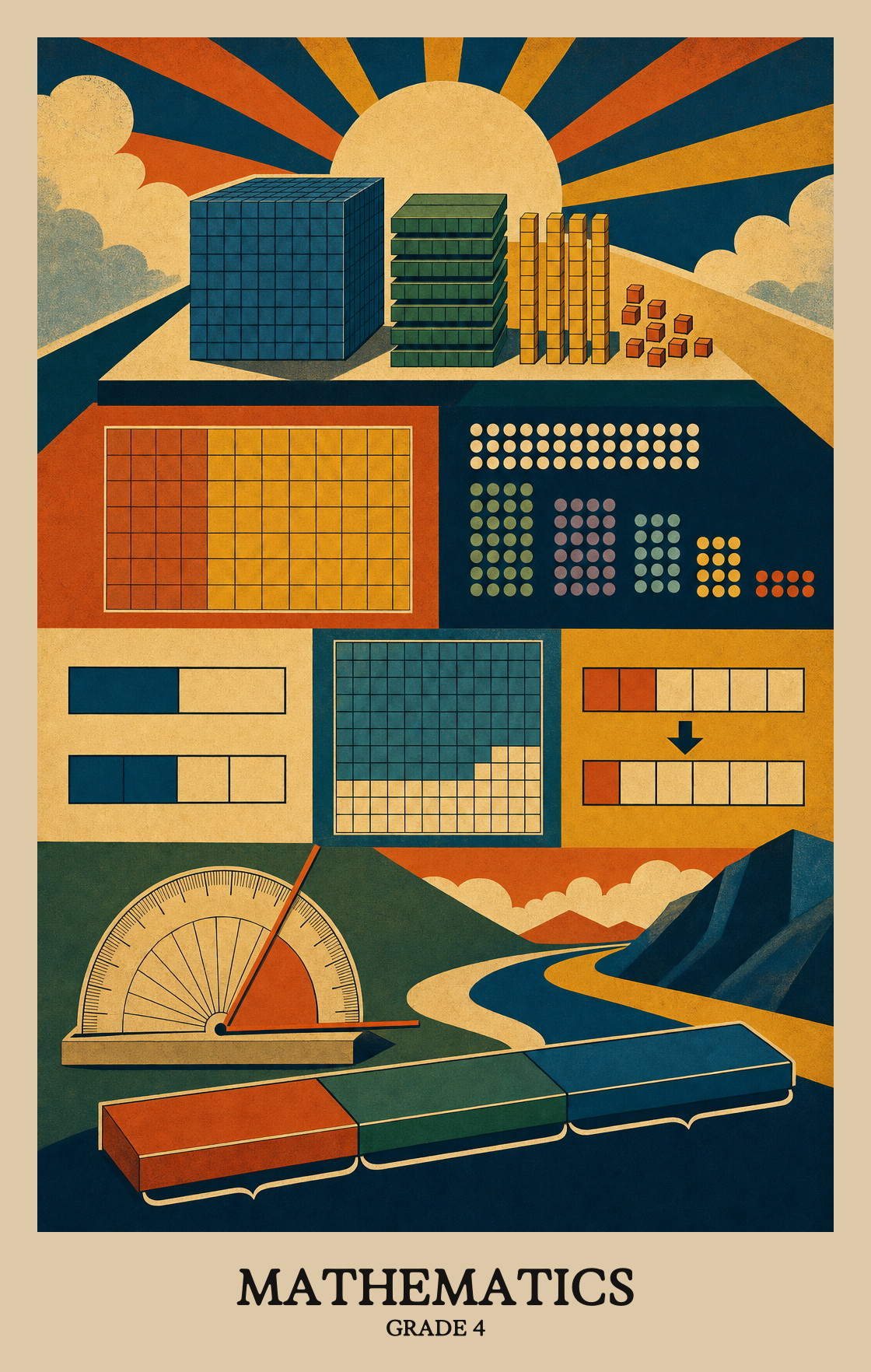
Students read, write, and compare numbers into the hundred thousands. They round to any place and start to see that each spot in a number is ten times the one to its right.
Students add and subtract using the standard method, then multiply up to four-digit numbers by one digit and divide with remainders. Multi-step word problems show up, and students learn to check if an answer makes sense.
Students find factor pairs for numbers up to 100 and decide whether a number is prime or composite. They also build number and shape patterns from a rule and notice what the pattern does.
Students find equivalent fractions, compare fractions with different denominators, and add and subtract fractions with the same bottom number. They also start writing fractions like 62/100 as decimals such as 0.62.
Students convert between units like feet and inches or meters and centimeters, and use the area and perimeter formulas for rectangles. They measure angles with a protractor and add angle pieces to find a missing part.
Students draw and name points, lines, rays, and different kinds of angles. They sort triangles and four-sided shapes by their sides and angles, and spot parallel and perpendicular lines in everyday figures.
Students draw and name basic parts of geometry: points, lines, line segments, rays, and angles. They also spot where lines cross at right angles or run side by side in flat shapes.
Students sort flat shapes by their sides and corners, deciding whether sides run parallel, meet at a right angle, or both. Right triangles get their own category.
Students identify lines of symmetry in two-dimensional shapes, explaining why a fold matches both halves. They practice spotting symmetry in everyday shapes like letters, flags, and simple figures.
Students use fraction models like number lines and area diagrams to show how fractions work. They connect the math they write to pictures and real objects, checking that their representations make sense.
Students identify lines of symmetry in flat shapes, checking whether one half folds exactly onto the other. They sort shapes by the number of lines of symmetry they have.
Students sort flat shapes like squares, triangles, and rectangles into groups based on what they have in common, such as equal sides or right corners.
| Standard | Definition | Code |
|---|---|---|
| Draw points, lines, line segments, rays, angles | Students draw and name basic parts of geometry: points, lines, line segments, rays, and angles. They also spot where lines cross at right angles or run side by side in flat shapes. | CA-4.G.1 |
| Classify two-dimensional figures based on the presence or absence of parallel… | Students sort flat shapes by their sides and corners, deciding whether sides run parallel, meet at a right angle, or both. Right triangles get their own category. | CA-4.G.2 |
| Construct viable arguments and critique the Perform operations with… | Students identify lines of symmetry in two-dimensional shapes, explaining why a fold matches both halves. They practice spotting symmetry in everyday shapes like letters, flags, and simple figures. | CA-4.G.3 |
| Model with mathematics | Students use fraction models like number lines and area diagrams to show how fractions work. They connect the math they write to pictures and real objects, checking that their representations make sense. | CA-4.G.4 |
| Use appropriate tools strategically | Students identify lines of symmetry in flat shapes, checking whether one half folds exactly onto the other. They sort shapes by the number of lines of symmetry they have. | CA-4.G.5 |
| Look for and express regularity in repeated Measurement and Data reasoning | Students sort flat shapes like squares, triangles, and rectangles into groups based on what they have in common, such as equal sides or right corners. | CA-4.G.8 |
Students learn how units of measurement relate to each other, like knowing 1 foot equals 12 inches or 1 kilogram equals 1,000 grams. They convert between larger and smaller units and record the pairs in a table.
Students solve word problems involving measurements like hours, miles, gallons, and dollars, using addition, subtraction, multiplication, or division. They also convert larger units into smaller ones, like turning 2 hours into 120 minutes, and draw number lines to show their work.
Students use the area and perimeter formulas for rectangles to solve real problems, like finding a missing side length when they know the total area. The math connects multiplication to the shape of a room or a floor.
Students record measurements like half-inch or quarter-inch lengths on a line plot, then use that chart to add and subtract fractions. For example, they might find how much longer the longest leaf is than the shortest.
An angle is the opening between two straight lines that meet at a point. Students learn that a full circle has 360 degrees, use a protractor to measure angles in whole-number degrees, and draw angles of a given size.
When a large angle is split into smaller angles, the pieces add up to the whole. Students find missing angle sizes by adding or subtracting the known parts, the way they would find a missing piece of a puzzle.
| Standard | Definition | Code |
|---|---|---|
| Know relative sizes of measurement units within one system of units including… | Students learn how units of measurement relate to each other, like knowing 1 foot equals 12 inches or 1 kilogram equals 1,000 grams. They convert between larger and smaller units and record the pairs in a table. | CA-4.MD.1 |
| Use the four operations to solve word problems involving distances, intervals… | Students solve word problems involving measurements like hours, miles, gallons, and dollars, using addition, subtraction, multiplication, or division. They also convert larger units into smaller ones, like turning 2 hours into 120 minutes, and draw number lines to show their work. | CA-4.MD.2 |
| Apply the area and perimeter formulas for rectangles in real-world and… | Students use the area and perimeter formulas for rectangles to solve real problems, like finding a missing side length when they know the total area. The math connects multiplication to the shape of a room or a floor. | CA-4.MD.3 |
| Make a line plot to display a data set of measurements in fractions of a unit | Students record measurements like half-inch or quarter-inch lengths on a line plot, then use that chart to add and subtract fractions. For example, they might find how much longer the longest leaf is than the shortest. | CA-4.MD.4 |
| Recognize angles as geometric shapes that are formed wherever two rays share a… | An angle is the opening between two straight lines that meet at a point. Students learn that a full circle has 360 degrees, use a protractor to measure angles in whole-number degrees, and draw angles of a given size. | CA-4.MD.5 |
| Recognize angle measure as additive | When a large angle is split into smaller angles, the pieces add up to the whole. Students find missing angle sizes by adding or subtracting the known parts, the way they would find a missing piece of a puzzle. | CA-4.MD.7 |
Each spot in a number is worth ten times more than the spot to its right. A 7 in the hundreds place is worth ten 7s in the tens place.
Students read, write, and compare large numbers in three ways: as numerals, as words, and as expanded form (like 3,000 + 400 + 20 + 5). They also use the symbols >, =, and < to show which number is larger or smaller.
Students round large numbers to the nearest ten, hundred, or thousand by looking at which digits matter most. This builds the number sense they use when adding and subtracting bigger numbers by hand.
Students add and subtract large numbers quickly and accurately using the step-by-step method taught in class. Think carrying and borrowing across multiple columns, done reliably without a calculator.
Students multiply large numbers, like 1,234 times 6 or 47 times 23, by breaking them into smaller, easier pieces based on place value. They show how the math works using diagrams and equations, not just the answer.
Students divide numbers up to the thousands by a single digit and find what is left over. They show how they solved it using drawings, arrays, or equations.
| Standard | Definition | Code |
|---|---|---|
| Recognize that in a multi-digit whole number, a digit in one place represents… | Each spot in a number is worth ten times more than the spot to its right. A 7 in the hundreds place is worth ten 7s in the tens place. | CA-4.NBT.1 |
| Read and write multi-digit whole numbers using base-ten numerals, number names | Students read, write, and compare large numbers in three ways: as numerals, as words, and as expanded form (like 3,000 + 400 + 20 + 5). They also use the symbols >, =, and < to show which number is larger or smaller. | CA-4.NBT.2 |
| Use place value understanding to round multi-digit whole numbers to any place | Students round large numbers to the nearest ten, hundred, or thousand by looking at which digits matter most. This builds the number sense they use when adding and subtracting bigger numbers by hand. | CA-4.NBT.3 |
| Fluently add and subtract multi-digit whole numbers using the standard… | Students add and subtract large numbers quickly and accurately using the step-by-step method taught in class. Think carrying and borrowing across multiple columns, done reliably without a calculator. | CA-4.NBT.4 |
| Multiply a whole number of up to four digits by a one-digit whole number | Students multiply large numbers, like 1,234 times 6 or 47 times 23, by breaking them into smaller, easier pieces based on place value. They show how the math works using diagrams and equations, not just the answer. | CA-4.NBT.5 |
| Find whole-number quotients and remainders with up to four-digit dividends and… | Students divide numbers up to the thousands by a single digit and find what is left over. They show how they solved it using drawings, arrays, or equations. | CA-4.NBT.6 |
Students learn why 1/2 and 2/4 are the same amount, even though the pieces look different. They use diagrams to see how slicing a shape into more parts doesn't change the total, then use that idea to find and create equivalent fractions.
Students decide which of two fractions is larger, even when the bottom numbers don't match. They use symbols like > or < to record the comparison and explain their reasoning with a drawing or model.
Students work with fractions whose bottom numbers are limited to 2, 3, 4, 5, 6, 8, 10, 12, and 100. Fractions like one-half, three-fourths, and seven-tenths are fair game; anything with a bottom number outside that list is not covered yet.
Multiplying a fraction by a whole number. Students find out how many times a fraction fits into a larger amount, like figuring out how many quarter-miles make up three miles.
Students learn to rewrite a fraction like 3/10 as 30/100, then use that swap to add two fractions whose bottoms are 10 and 100. It builds the groundwork for working with decimals and cents.
Fractions with 10 or 100 on the bottom can be written as decimals. Students practice switching between forms, like seeing that 62/100 and 0.62 mean the same thing, then placing that number on a number line.
Students compare decimal numbers like 0.3 and 0.27, deciding which is larger or smaller using symbols like > and <. They back up their thinking with a number line or visual model.
| Standard | Definition | Code |
|---|---|---|
| Explain why a fraction a/b is equivalent to a fraction | Students learn why 1/2 and 2/4 are the same amount, even though the pieces look different. They use diagrams to see how slicing a shape into more parts doesn't change the total, then use that idea to find and create equivalent fractions. | CA-4.NF.1 |
| Compare two fractions with different numerators and different denominators… | Students decide which of two fractions is larger, even when the bottom numbers don't match. They use symbols like > or < to record the comparison and explain their reasoning with a drawing or model. | CA-4.NF.2 |
| Grade 4 expectations in this domain are limited to fractions with denominators… | Students work with fractions whose bottom numbers are limited to 2, 3, 4, 5, 6, 8, 10, 12, and 100. Fractions like one-half, three-fourths, and seven-tenths are fair game; anything with a bottom number outside that list is not covered yet. | CA-4.NF.3 |
| Students who can generate equivalent fractions can develop strategies for… | Multiplying a fraction by a whole number. Students find out how many times a fraction fits into a larger amount, like figuring out how many quarter-miles make up three miles. | CA-4.NF.4 |
| Express a fraction with denominator 10 as an equivalent fraction with… | Students learn to rewrite a fraction like 3/10 as 30/100, then use that swap to add two fractions whose bottoms are 10 and 100. It builds the groundwork for working with decimals and cents. | CA-4.NF.5 |
| Use decimal notation for fractions with denominators 10 or 100 | Fractions with 10 or 100 on the bottom can be written as decimals. Students practice switching between forms, like seeing that 62/100 and 0.62 mean the same thing, then placing that number on a number line. | CA-4.NF.6 |
| Compare two decimals to hundredths by reasoning about their size | Students compare decimal numbers like 0.3 and 0.27, deciding which is larger or smaller using symbols like > and <. They back up their thinking with a number line or visual model. | CA-4.NF.7 |
Students learn that multiplication equations describe "times as many" relationships. For example, 35 = 5 x 7 means 35 is five times as many as 7, and students translate that kind of statement into an equation.
Word problems ask students to figure out when one amount is a certain number of times bigger than another. Students choose whether to multiply or divide to find the missing number, and explain why that's different from simply asking how much more one amount is than another.
Students read multi-step word problems and solve them using addition, subtraction, multiplication, and division. They use a letter to stand for the unknown number, then check whether their answer makes sense by estimating or rounding.
Students find every pair of numbers that multiply to make a given number, then decide if that number is prime (only divisible by 1 and itself) or composite (divisible by more numbers). They also spot and extend number patterns.
Students follow a rule (like "add 3" or "double it") to build a number or shape pattern, then notice something the rule never mentioned, such as every other number being odd.
| Standard | Definition | Code |
|---|---|---|
| Interpret a multiplication equation as a comparison, e.g., interpret 35 = 5 × 7… | Students learn that multiplication equations describe "times as many" relationships. For example, 35 = 5 x 7 means 35 is five times as many as 7, and students translate that kind of statement into an equation. | CA-4.OA.1 |
| Multiply or divide to solve word problems involving multiplicative comparison… | Word problems ask students to figure out when one amount is a certain number of times bigger than another. Students choose whether to multiply or divide to find the missing number, and explain why that's different from simply asking how much more one amount is than another. | CA-4.OA.2 |
| Solve multistep word problems posed with whole numbers and having whole-number… | Students read multi-step word problems and solve them using addition, subtraction, multiplication, and division. They use a letter to stand for the unknown number, then check whether their answer makes sense by estimating or rounding. | CA-4.OA.3 |
| Find all factor pairs for a whole number in the range 1–100 | Students find every pair of numbers that multiply to make a given number, then decide if that number is prime (only divisible by 1 and itself) or composite (divisible by more numbers). They also spot and extend number patterns. | CA-4.OA.4 |
| Generate a number or shape pattern that follows a given rule | Students follow a rule (like "add 3" or "double it") to build a number or shape pattern, then notice something the rule never mentioned, such as every other number being odd. | CA-4.OA.5 |
The grade 4 math test in the CAASPP suite. Adaptive computer-based questions plus a performance task covering the Common Core grade 4 math standards.
The state test for students with the most significant cognitive disabilities. Replaces Smarter Balanced math in grades 3-8 and 11 for the small group of students whose IEP teams qualify them.
Big numbers, long multiplication and division, fractions, decimals to the hundredths, and the start of geometry with angles and shapes. Students also learn to measure angles with a protractor and solve word problems with money, time, and distance.
Quiz students on times tables up to 12 during car rides or while cooking. Once those are quick, give real problems like splitting 84 cookies among 6 friends or figuring out how many minutes are in 4 hours. Speed with basic facts makes the longer problems much easier.
Fractions are the bridge to decimals, percents, and most of middle school math. Students learn that 2/4 and 1/2 are the same amount, compare fractions like 3/8 and 1/2, and add fractions with the same bottom number. Cooking and cutting pizza are great practice.
Students should add and subtract numbers in the thousands using the standard stacked method without counting on fingers or guessing. If a problem like 4,532 minus 1,879 still takes several minutes, more daily practice with regrouping will help.
Start with place value and multi-digit operations in the fall, since fractions and measurement lean on that fluency. Move to fractions and decimals in the winter, then angles, area, perimeter, and shape classification in the spring. Word problems should run through every unit.
Long division with remainders, comparing fractions with different bottom numbers, and reading a protractor are the common sticking points. Plan extra small-group time for these and revisit them in warm-ups even after the unit ends.
Most word-problem trouble is reading trouble, not math trouble. Read the problem out loud together, ask what the question is actually asking, and have students draw a quick picture or write the equation before solving. Two or three problems a few nights a week builds confidence fast.
Students can multiply a three-digit number by a one-digit number, divide with remainders, add and subtract fractions with the same bottom number, write decimals like 0.7 and 0.34, and measure an angle with a protractor. They can also solve two-step word problems and explain their thinking.
Ready students handle multi-digit multiplication and division without panic, can compare and add simple fractions, and read decimals to the hundredths place. If any of those are still shaky in May, a short summer review pack focused on those skills makes a real difference.