Imagining stories and characters
Students warm up by inventing characters and story ideas drawn from books, memories, and things they notice at home and school. They start to see how their own experiences can spark a scene.
This is the year theater work gets more deliberate. Students build characters and scenes from their own experiences and from stories tied to history or culture, then revise their choices instead of settling for the first idea. They practice voice, movement, and timing to make meaning clear for an audience. By spring, students can rehearse a short scene, explain why they made specific acting choices, and offer thoughtful feedback on a classmate's performance.
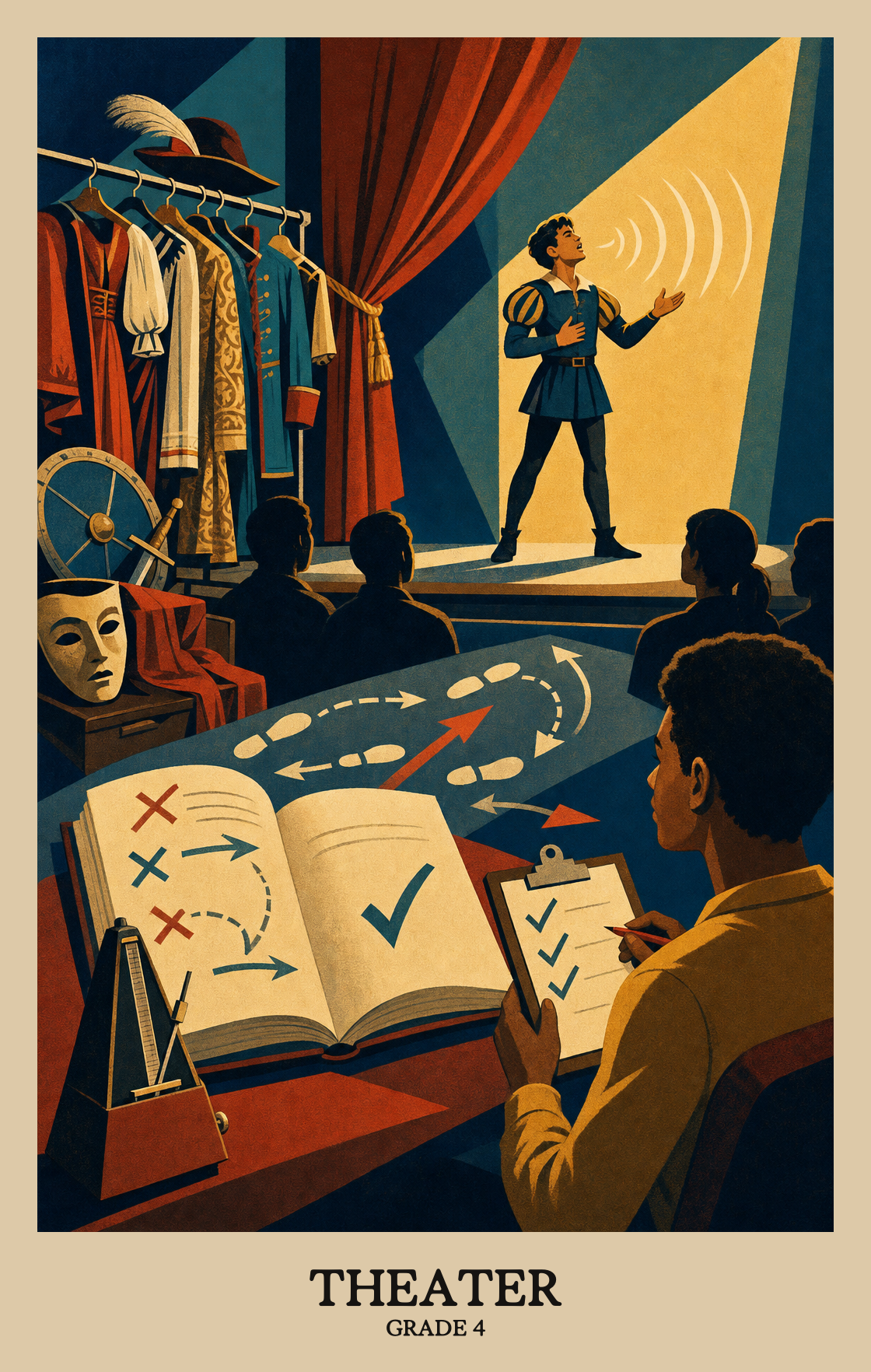
Students warm up by inventing characters and story ideas drawn from books, memories, and things they notice at home and school. They start to see how their own experiences can spark a scene.
Students take rough ideas and shape them into short scenes with classmates. They decide who the characters are, what they want, and how the scene starts and ends.
Students watch performances and short clips and talk about what the story meant. They learn to point to specific moments, like a line or a gesture, that gave them a clue.
Students rehearse, take notes from classmates, and try a scene again with changes. By the end, they perform for an audience and use a simple checklist to talk about what worked.
Students connect something they know or have lived through to a character, scene, or story choice in their theater work. Personal experience shapes how they perform and create.
Students look at a play, a performance, or a character and connect it to the time period or culture it came from. That connection helps them understand why the story matters and what it meant to real people.
| Standard | Definition | Code |
|---|---|---|
| Using your own life to make theater | Students connect something they know or have lived through to a character, scene, or story choice in their theater work. Personal experience shapes how they perform and create. | CA-TH:Cn10.4.4 |
| Theater and its place in history | Students look at a play, a performance, or a character and connect it to the time period or culture it came from. That connection helps them understand why the story matters and what it meant to real people. | CA-TH:Cn11.4.4 |
Students brainstorm characters, settings, and story ideas for a short play or scene. They take a rough idea and shape it into something that could actually be performed.
Students take their ideas for a scene or character and shape them into something ready to perform, making choices about what to keep, cut, or change along the way.
Students revisit a scene or short play they have drafted, then make specific changes to dialogue, movement, or character choices to make the piece work better before performing it.
| Standard | Definition | Code |
|---|---|---|
| Coming up with ideas for a play | Students brainstorm characters, settings, and story ideas for a short play or scene. They take a rough idea and shape it into something that could actually be performed. | CA-TH:Cr1.4.4 |
| Turning a theater idea into a scene | Students take their ideas for a scene or character and shape them into something ready to perform, making choices about what to keep, cut, or change along the way. | CA-TH:Cr2.4.4 |
| Finish and polish a theater piece | Students revisit a scene or short play they have drafted, then make specific changes to dialogue, movement, or character choices to make the piece work better before performing it. | CA-TH:Cr3.4.4 |
Students choose a scene or character to perform and explain why it fits the story and what they want the audience to feel.
Students practice a scene or monologue more than once, making small adjustments to voice, movement, or timing until the performance is ready to share with an audience.
Students perform a scene or monologue and make clear choices, like tone of voice or movement, so the audience understands the story or feeling being communicated.
| Standard | Definition | Code |
|---|---|---|
| Choosing plays and scenes worth performing | Students choose a scene or character to perform and explain why it fits the story and what they want the audience to feel. | CA-TH:Pr4.4.4 |
| Rehearse and polish a performance | Students practice a scene or monologue more than once, making small adjustments to voice, movement, or timing until the performance is ready to share with an audience. | CA-TH:Pr5.4.4 |
| Perform to share a story or idea | Students perform a scene or monologue and make clear choices, like tone of voice or movement, so the audience understands the story or feeling being communicated. | CA-TH:Pr6.4.4 |
Students watch a short performance and explain what choices the actor or playwright made and why those choices shape how the story feels.
Students look at a scene or performance and explain what the performer was trying to show, using details from the acting, movement, or design to back up their thinking.
Students look at a scene or performance and decide what's working and what isn't, using a clear set of criteria. They explain their thinking with specific reasons, not just "I liked it" or "I didn't."
| Standard | Definition | Code |
|---|---|---|
| Reading a performance like an audience | Students watch a short performance and explain what choices the actor or playwright made and why those choices shape how the story feels. | CA-TH:Re7.4.4 |
| Reading what a play is trying to say | Students look at a scene or performance and explain what the performer was trying to show, using details from the acting, movement, or design to back up their thinking. | CA-TH:Re8.4.4 |
| Judging what makes a performance work | Students look at a scene or performance and decide what's working and what isn't, using a clear set of criteria. They explain their thinking with specific reasons, not just "I liked it" or "I didn't." | CA-TH:Re9.4.4 |
Students build short scenes, play characters, and tell stories on their feet. They also watch performances and talk about what worked and why. The year focuses on making choices on purpose, not just goofing around in a skit.
Watch a short scene from a movie or play together and ask why a character did what they did. Encourage students to act out stories they read or make up, using different voices and bodies for each character. Five minutes of pretend play still counts at this age.
Most fourth grade theater work happens in small groups or pairs, not solo on a stage. Students often start by reading lines at their seats or playing quick warm-up games. Confidence builds slowly through low-pressure practice.
Start with ensemble games and basic story structure so students learn to listen and react. Move into building short original scenes and interpreting written ones. End the year with a small presentation where students rehearse, refine, and respond to feedback.
Students can take an idea, shape it into a short scene with a beginning and end, rehearse it with a partner, and perform it for classmates. They can also watch a peer's scene and give a specific reason it worked or did not.
Use scenes built around stories from reading class or moments from social studies. Fourth graders are ready to connect a character's choices to a real historical setting or cultural background. This also gives the performance work something real to be about.
Some short lines, yes, but full scripts are not the goal yet. Most work uses improvised dialogue or a few rehearsed lines from a short scene. Practicing a small part out loud at home a few times is plenty.
Students should be able to build a short scene with a partner, stay in character through it, and explain a choice they made as an actor. They should also be able to watch a classmate perform and say something specific about it beyond liked it or did not.