Moving and exploring the body
Students start the year discovering how their bodies move. They try big and small motions, fast and slow, and learn that dance is a way to play with movement.
This is the year students discover that their bodies can tell stories. Students try out simple movements, copy shapes they see, and start linking how a dance feels to the music or the moment. They watch others move and share what they noticed. By spring, students can make up a short movement of their own and perform it for a small group.
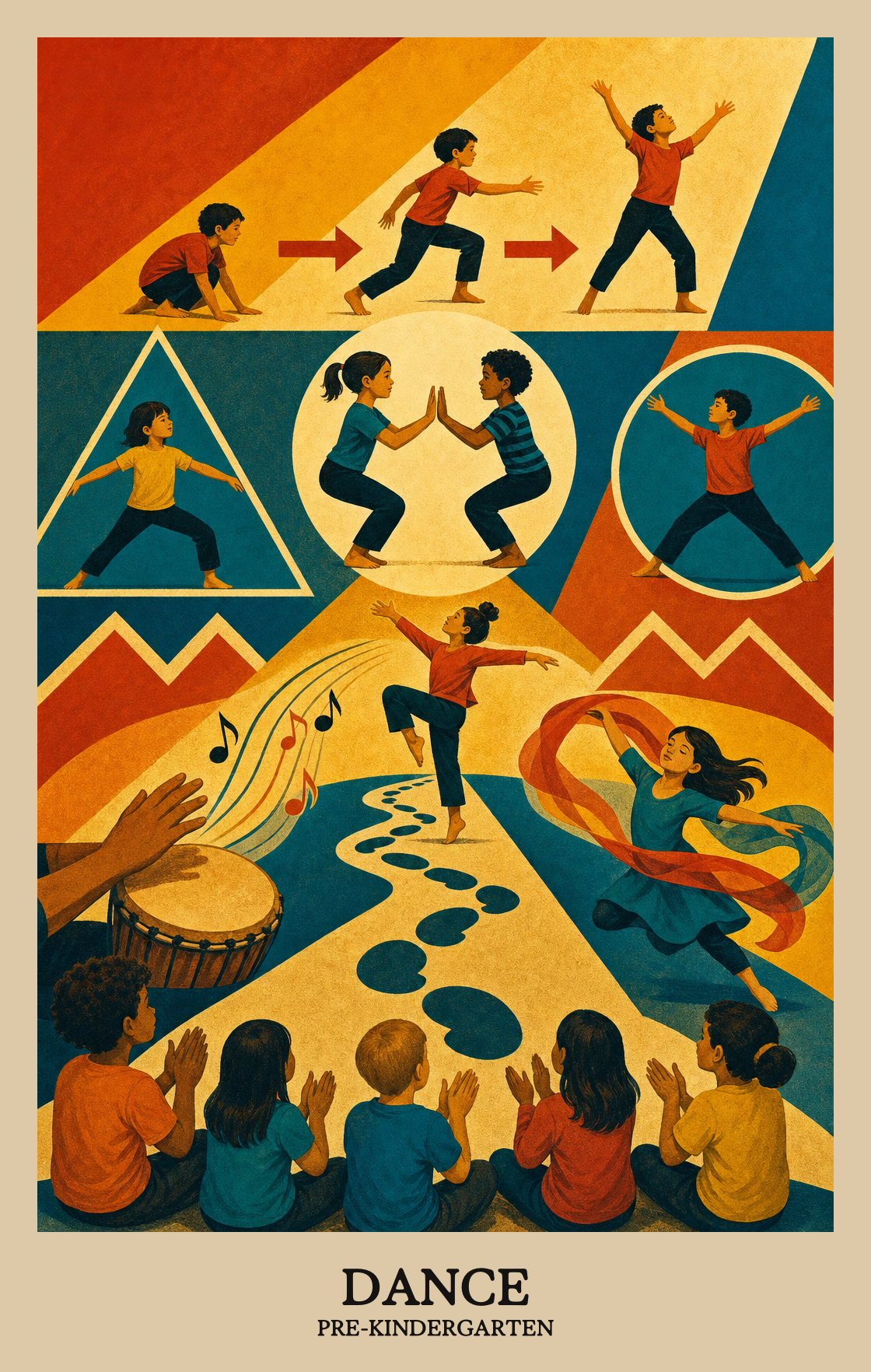
Students start the year discovering how their bodies move. They try big and small motions, fast and slow, and learn that dance is a way to play with movement.
Students begin inventing simple movements of their own. They turn ideas, feelings, and things they have seen into short dances they can show a partner or the class.
Students practice a short dance and get ready to perform it. They learn to repeat steps, listen for music cues, and show their dance to others.
Students watch classmates dance and notice what they see. They talk about what a dance might be about and connect it to stories, music, or moments from their own lives.
Students connect something from their own life to what they make in dance. A memory, a feeling, or something they saw at home becomes part of how they move.
Students connect a dance or song to where it comes from, such as a celebration, a place, or a tradition their family or community shares.
| Standard | Definition | Code |
|---|---|---|
| Making art from what you know and feel | Students connect something from their own life to what they make in dance. A memory, a feeling, or something they saw at home becomes part of how they move. | CA-DA:Cn10.pk.PK |
| Dance from different cultures and times | Students connect a dance or song to where it comes from, such as a celebration, a place, or a tradition their family or community shares. | CA-DA:Cn11.pk.PK |
Students come up with their own movement ideas, deciding how their bodies can move to make something new in dance.
Students arrange simple movements into a short sequence, deciding what comes first and what comes next.
Students revisit a short dance they made, adjust a move or two, and then perform it from start to finish.
| Standard | Definition | Code |
|---|---|---|
| Coming up with dance ideas | Students come up with their own movement ideas, deciding how their bodies can move to make something new in dance. | CA-DA:Cr1.pk.PK |
| Making dances from your own ideas | Students arrange simple movements into a short sequence, deciding what comes first and what comes next. | CA-DA:Cr2.pk.PK |
| Finish a dance and make it better | Students revisit a short dance they made, adjust a move or two, and then perform it from start to finish. | CA-DA:Cr3.pk.PK |
Students pick a movement or short dance to show others, thinking about which one they like best or feels right to share.
Students practice a dance move until they can do it more smoothly, then show it to others.
Students share a dance or movement to show an idea or feeling, like being a tree in wind or a slow, heavy elephant.
| Standard | Definition | Code |
|---|---|---|
| Choosing which dances to show others | Students pick a movement or short dance to show others, thinking about which one they like best or feels right to share. | CA-DA:Pr4.pk.PK |
| Practice moves for a dance show | Students practice a dance move until they can do it more smoothly, then show it to others. | CA-DA:Pr5.pk.PK |
| Sharing what a dance means | Students share a dance or movement to show an idea or feeling, like being a tree in wind or a slow, heavy elephant. | CA-DA:Pr6.pk.PK |
Students look at or watch a dance and talk about what they notice, such as how the dancer moves or what the dance makes them feel.
Students look at a dance or movement and talk about what they think the dancer is feeling or trying to show.
Students look at a dance or movement and say what they notice, like whether it was fast or slow, big or small. They start learning to say why they liked something or what they would change.
| Standard | Definition | Code |
|---|---|---|
| Watching and thinking about dance | Students look at or watch a dance and talk about what they notice, such as how the dancer moves or what the dance makes them feel. | CA-DA:Re7.pk.PK |
| What dances are trying to say | Students look at a dance or movement and talk about what they think the dancer is feeling or trying to show. | CA-DA:Re8.pk.PK |
| Deciding what makes a dance good | Students look at a dance or movement and say what they notice, like whether it was fast or slow, big or small. They start learning to say why they liked something or what they would change. | CA-DA:Re9.pk.PK |
Dance at this age is about exploring how the body moves. Students try out big and small movements, copy shapes and animals, and move to music. It is playful and physical, not a recital routine.
Put on music and move together for five minutes. Ask students to show how a cat stretches, how a tree sways, or how a robot walks. Take turns being the leader so students practice making up their own moves.
No. The goal is comfort with movement, not technique. Free dancing in the living room, copying moves in a song, or acting out a story with the body all count.
Start with body awareness and basic movements like walk, jump, freeze, and sway. Move into exploring space, speed, and energy. End the year with short movement pieces students make up and share with the class.
Focus on body parts, personal space, and following simple movement cues. Students need to know where their body is before they can shape what it does. Spend real time on stop and go, high and low, and fast and slow.
Students pick a feeling or idea, like happy, sleepy, or stormy, and show it with movement. Ask what the dance was about after watching. Short answers in plain words are the goal.
By the end of the year, students should move with control, copy a short sequence, and make up a few movements of their own. They should also be able to watch a peer dance and say something about it.
Start side by side instead of face to face. Use props like scarves or stuffed animals so the focus is on the object, not the body. Most shy students warm up once dancing becomes part of the regular routine.