Finding ideas to move
Students start the year by turning personal experiences, images, and questions into movement ideas. Parents may hear about journals, brainstorms, and short solos that try out a feeling or a story.
This is the year dance becomes a way to say something on purpose. Students build short pieces from their own ideas and experiences, then shape and rehearse them with real intent. They also learn to watch dance closely, talk about what a choreographer was going for, and judge a piece against clear criteria. By spring, students can perform a polished dance they helped create and explain the meaning behind it.
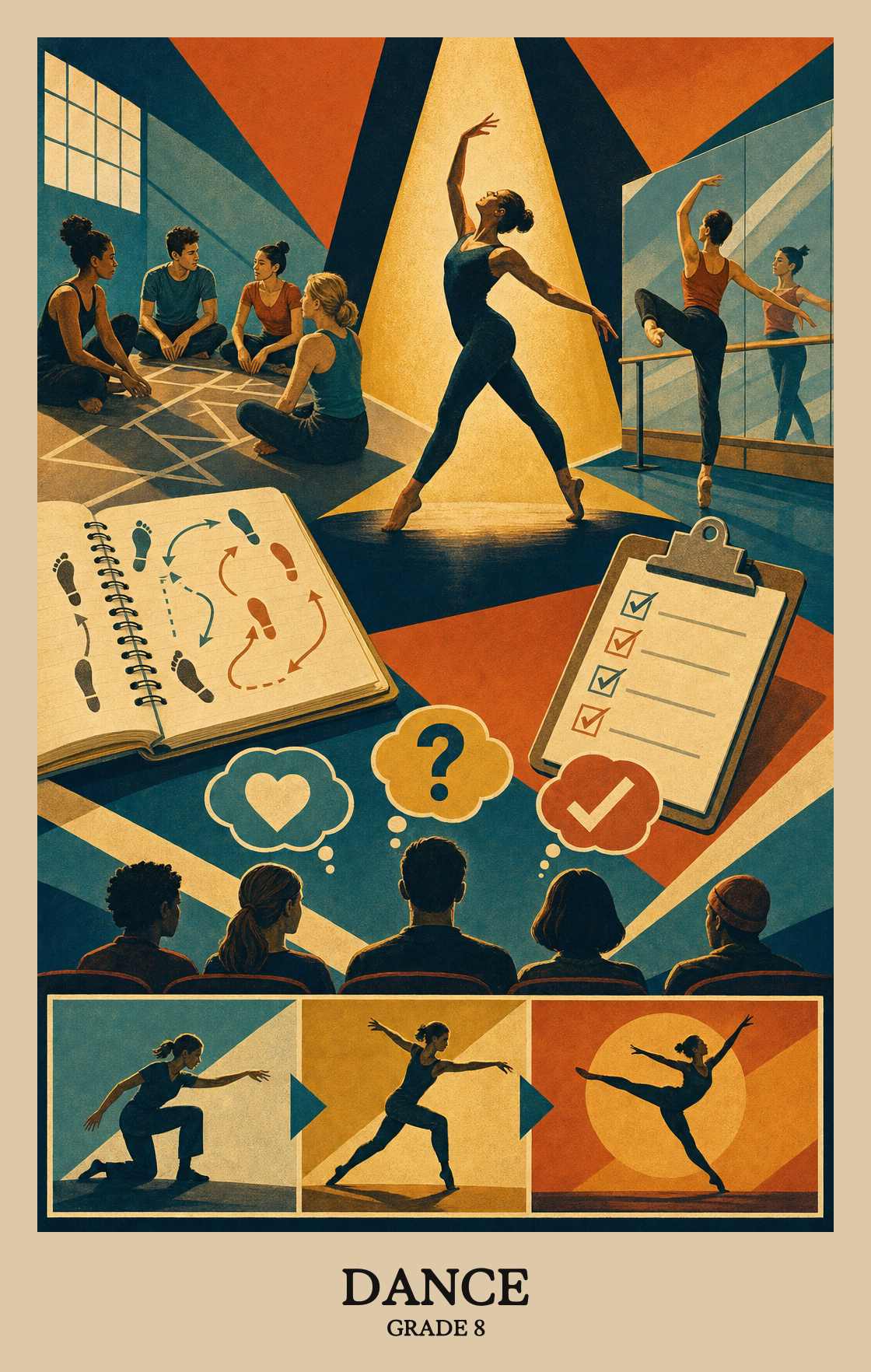
Students start the year by turning personal experiences, images, and questions into movement ideas. Parents may hear about journals, brainstorms, and short solos that try out a feeling or a story.
Students take rough ideas and build them into longer pieces with a clear beginning, middle, and end. They work with a partner or group to organize movement so it makes sense to a viewer.
Students focus on how the body moves: balance, control, timing, and clarity of shape. They rehearse the same passages many times to get cleaner and more confident on stage.
Students look at dances from different communities and time periods and discuss what those dances meant to the people who made them. They use this to inform their own choices as makers and performers.
By the end of the year, students give and receive specific feedback using shared criteria. They watch each other's work, name what is and is not landing, and revise their own pieces before a final showing.
Students connect their own experiences, emotions, or observations to the dances they create or study. Personal history shapes the choices they make as artists.
Students look at a dance piece and connect it to the time period, culture, or community it came from. Understanding that context changes how the work reads and what it means.
| Standard | Definition | Code |
|---|---|---|
| Connecting life experience to dance | Students connect their own experiences, emotions, or observations to the dances they create or study. Personal history shapes the choices they make as artists. | DA:Cn10.8 |
| Dance and its cultural history | Students look at a dance piece and connect it to the time period, culture, or community it came from. Understanding that context changes how the work reads and what it means. | DA:Cn11.8 |
Students brainstorm and develop original ideas for a dance piece, exploring movement choices before settling on a direction for their work.
Students take movement ideas from earlier drafts and shape them into a more complete, rehearsable piece, making deliberate choices about structure, transitions, and how the dance will look to an audience.
Students revisit a dance they've been building, make specific changes to improve how it looks and feels, and bring it to a finished, performance-ready state.
| Standard | Definition | Code |
|---|---|---|
| Coming up with ideas for a dance | Students brainstorm and develop original ideas for a dance piece, exploring movement choices before settling on a direction for their work. | DA:Cr1.8 |
| Develop your own dance ideas | Students take movement ideas from earlier drafts and shape them into a more complete, rehearsable piece, making deliberate choices about structure, transitions, and how the dance will look to an audience. | DA:Cr2.8 |
| Finishing and polishing a dance | Students revisit a dance they've been building, make specific changes to improve how it looks and feels, and bring it to a finished, performance-ready state. | DA:Cr3.8 |
Students choose which dances to perform and explain why each piece is worth presenting, considering how well it reflects their skills and artistic intent.
Students rehearse and polish a dance piece until it's ready to perform in front of others, making specific adjustments to timing, spacing, and movement quality along the way.
Students choose how to perform a dance so the audience understands what the piece is about. Every technical choice, from timing to spacing, supports that meaning.
| Standard | Definition | Code |
|---|---|---|
| Choosing dances worth performing | Students choose which dances to perform and explain why each piece is worth presenting, considering how well it reflects their skills and artistic intent. | DA:Pr4.8 |
| Refining dance work for performance | Students rehearse and polish a dance piece until it's ready to perform in front of others, making specific adjustments to timing, spacing, and movement quality along the way. | DA:Pr5.8 |
| Perform a dance that means something | Students choose how to perform a dance so the audience understands what the piece is about. Every technical choice, from timing to spacing, supports that meaning. | DA:Pr6.8 |
Students watch a dance performance and break down what they see: how the choreographer uses movement, timing, and space to build meaning. Then students explain what those choices do to the overall effect of the piece.
Students analyze a dance performance and explain what the choreographer was trying to say. They look at movement choices, use of space, and timing to build a supported interpretation.
Students use a set of criteria, like a checklist of what makes a dance work well, to judge a performance and explain what they see.
| Standard | Definition | Code |
|---|---|---|
| Reading dance with a critical eye | Students watch a dance performance and break down what they see: how the choreographer uses movement, timing, and space to build meaning. Then students explain what those choices do to the overall effect of the piece. | DA:Re7.8 |
| Reading meaning in a dance performance | Students analyze a dance performance and explain what the choreographer was trying to say. They look at movement choices, use of space, and timing to build a supported interpretation. | DA:Re8.8 |
| How to judge a dance performance | Students use a set of criteria, like a checklist of what makes a dance work well, to judge a performance and explain what they see. | DA:Re9.8 |
Students create their own short dances, learn and refine movement skills, perform for others, and discuss what they see in dance. They also connect dances to history, culture, and their own lives.
Ask students to show a short movement idea they worked on and explain what it means. Watching a dance clip together and talking about how it made you feel counts as practice too.
No. Class work builds from where students are and focuses on creating movement, refining it, and talking about it. Effort, willingness to try ideas, and thoughtful feedback matter more than past lessons.
Start with movement vocabulary and short solo studies, then move into group choreography with a clear intent. Save longer pieces and formal performances for later in the year, once students can refine work using feedback.
Students can take an idea, shape it into a short dance with deliberate choices, refine it after feedback, and perform it with clear intent. They can also describe what a dance is doing and judge it against shared criteria.
Two areas stall students most often: turning a vague concept into specific movement choices, and giving feedback that points to evidence in the dance rather than personal taste. Plan to revisit both across several units.
Push past the reaction with one question: what choice did the choreographer make that gave you that feeling? Naming the movement, music, or staging behind the reaction is exactly the kind of thinking class is building.
Grading usually looks at the work behind a piece, not just the final performance. That includes how students develop an idea, use feedback to revise it, perform with focus, and write or speak about dances they watch.