Building characters and ideas
Students start the year by inventing characters and story ideas drawn from their own lives. They try out scenes, take creative risks, and learn that a first idea is a starting point, not a finished one.
This is the year theater work gets personal and intentional. Students draw on their own lives and what they know about the world to build characters and scenes that mean something. They plan a piece from first idea to finished performance, then sharpen their acting choices through rehearsal and feedback. By spring, students can take a script or scene, shape a deliberate interpretation of it, and explain why their choices land for an audience.
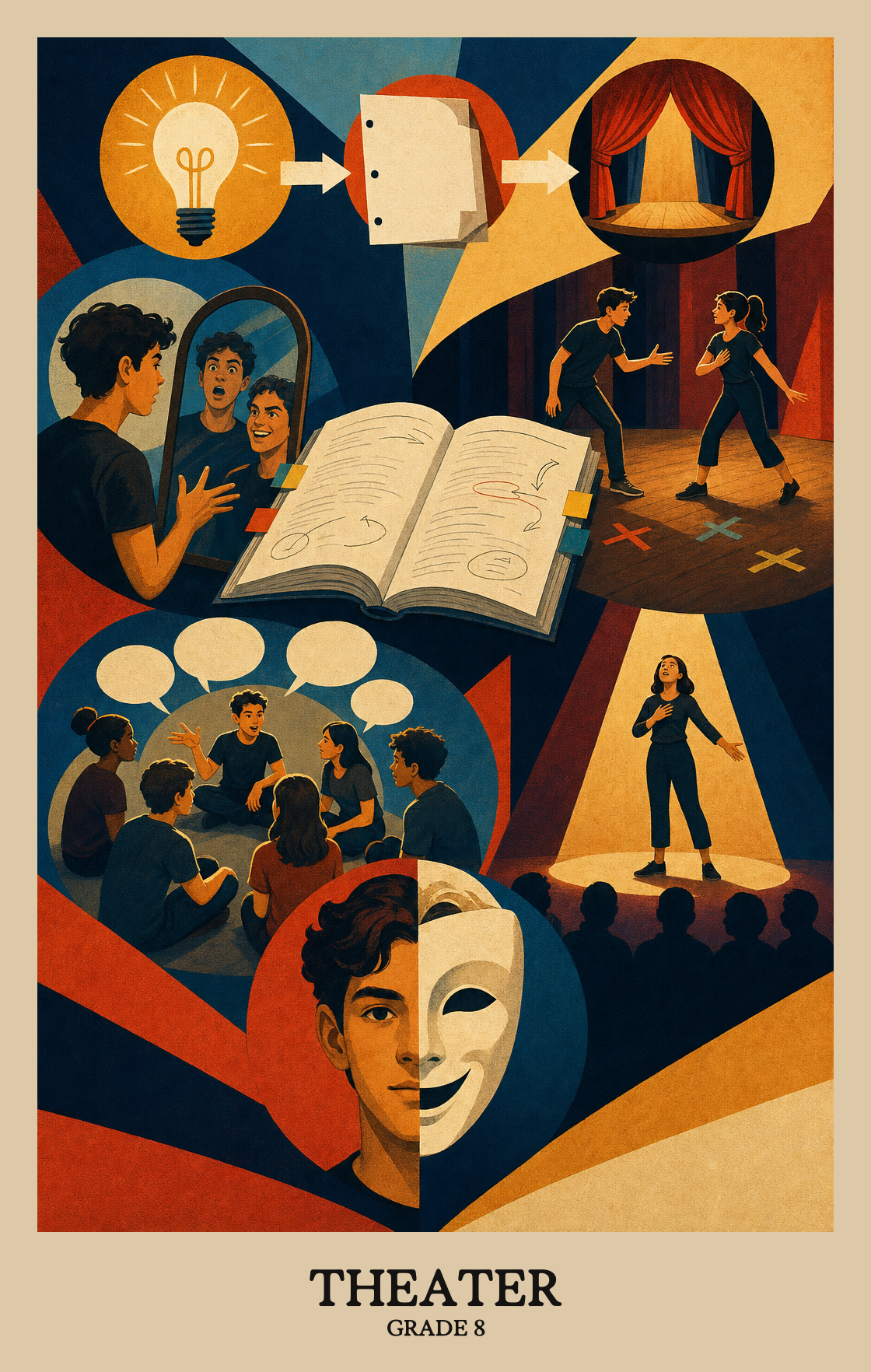
Students start the year by inventing characters and story ideas drawn from their own lives. They try out scenes, take creative risks, and learn that a first idea is a starting point, not a finished one.
Students take rough ideas and turn them into scenes with a clear shape. They organize what happens, sharpen the dialogue, and revise based on feedback from classmates and the teacher.
Students look at plays from different times and places and ask why the story mattered to its audience. They connect the work to history and culture, then bring those ideas back into their own scenes.
Students pick scenes to perform and work on voice, movement, and timing in rehearsal. They make choices about how a moment should land so the audience feels what the character feels.
Students present their work and respond to what they see in each other's performances. They use clear criteria to talk about what worked, what fell flat, and what they would try next time.
Students connect what they already know and have lived through to the theater work they create. Personal experience becomes raw material for writing, performing, and shaping scenes.
Students connect a play or performance to the time period, culture, or events that shaped it. Understanding that context helps them read the work more clearly and ask better questions about why it was made.
| Standard | Definition | Code |
|---|---|---|
| Using life experience to make theater | Students connect what they already know and have lived through to the theater work they create. Personal experience becomes raw material for writing, performing, and shaping scenes. | TH:Cn10.8 |
| Theater and its place in history | Students connect a play or performance to the time period, culture, or events that shaped it. Understanding that context helps them read the work more clearly and ask better questions about why it was made. | TH:Cn11.8 |
Students brainstorm original ideas for scenes or characters and develop those ideas into a plan for a performance. The focus is on where creative choices come from, not just the final result.
Students take a scene or script idea and shape it into something stageable, making deliberate choices about structure, character, and conflict until the work is ready to rehearse.
Students revise a scene or script based on feedback, making specific changes to dialogue, staging, or character choices until the work is ready to perform or share.
| Standard | Definition | Code |
|---|---|---|
| Coming up with original ideas for a scene | Students brainstorm original ideas for scenes or characters and develop those ideas into a plan for a performance. The focus is on where creative choices come from, not just the final result. | TH:Cr1.8 |
| Develop a scene from start to finish | Students take a scene or script idea and shape it into something stageable, making deliberate choices about structure, character, and conflict until the work is ready to rehearse. | TH:Cr2.8 |
| Finishing and polishing a theater piece | Students revise a scene or script based on feedback, making specific changes to dialogue, staging, or character choices until the work is ready to perform or share. | TH:Cr3.8 |
Students choose a scene or script to perform and explain why it suits the story they want to tell. That choice shapes how the audience experiences the work.
Students rehearse a scene or performance piece, then make deliberate changes to acting choices, blocking, or delivery until the work is ready to show an audience.
Students perform a scene or monologue with a clear intention, making deliberate choices about movement, voice, and expression so the audience understands what the piece is really about.
| Standard | Definition | Code |
|---|---|---|
| Choosing and analyzing work to perform | Students choose a scene or script to perform and explain why it suits the story they want to tell. That choice shapes how the audience experiences the work. | TH:Pr4.8 |
| Refine your work before performing | Students rehearse a scene or performance piece, then make deliberate changes to acting choices, blocking, or delivery until the work is ready to show an audience. | TH:Pr5.8 |
| Perform to make your point land | Students perform a scene or monologue with a clear intention, making deliberate choices about movement, voice, and expression so the audience understands what the piece is really about. | TH:Pr6.8 |
Students look closely at a scene or performance and break down what choices the actors, designers, and director made. They explain how those choices shape what the audience feels and understands.
Students explain what a scene, character, or design choice is meant to say and why the playwright or director made that call.
Students look at a scene or performance and judge how well it works, using specific criteria like character choices, use of space, or how clearly the story comes through.
| Standard | Definition | Code |
|---|---|---|
| Reading and analyzing a performance | Students look closely at a scene or performance and break down what choices the actors, designers, and director made. They explain how those choices shape what the audience feels and understands. | TH:Re7.8 |
| Reading what a performance is trying to say | Students explain what a scene, character, or design choice is meant to say and why the playwright or director made that call. | TH:Re8.8 |
| Judging what makes theater work | Students look at a scene or performance and judge how well it works, using specific criteria like character choices, use of space, or how clearly the story comes through. | TH:Re9.8 |
Students build short scenes from their own ideas and from scripts. They rehearse, give and take feedback, and perform for an audience. They also watch plays or recorded performances and talk about what the work meant and how the choices landed.
Ask students to tell the story of a scene they are working on and what their character wants. Run lines for ten minutes before bed. Watch a play, a film, or even a commercial together and ask what choices the actors and director made.
No. Plenty of strong theater students start out quiet. Small group work, partner scenes, and backstage roles like design and stage managing all count. Confidence grows over the year as students get more comfortable with the room and the work.
Yes, for most performance pieces. Short rehearsal at home helps a lot. Five or ten minutes a night across a week works better than one long cram session, and it gives students room to think about how the lines should sound.
Start with ensemble work and improvisation so students trust each other. Move into scene study and character work in the middle of the year. Save longer rehearsed pieces and a culminating performance for the back half, once students can give specific feedback to each other.
Specificity. Students often play a general mood instead of a clear objective. Reteach with simple questions: what does the character want, who are they talking to, and what just happened. Apply the same questions to design and tech choices.
Students read and watch plays from different times and communities, then talk about what the work meant to the people who first saw it. Pair a classic scene with a contemporary one on the same theme so students can compare the choices each playwright made.
Give them a short set of criteria before they watch, such as clarity of the story, believability of the character, and use of voice and body. Practice with low-stakes scenes first. Strong feedback names a specific moment and a specific choice.
By spring, students should be able to build a character with clear wants, take direction and adjust, and rehearse a piece from cold read to performance. They should also be able to watch a play and talk about what it meant and how the choices supported that meaning.