Moving with purpose
Students explore how their bodies move through space. They try out levels, speeds, and shapes, and start turning everyday ideas into short movement sequences.
This is the year dance starts to feel like a craft, not just play. Students turn an idea or a feeling into short movement pieces they shape, practice, and clean up before showing them. They also watch dances and start saying what they notice and what the movement might mean. By spring, students can perform a short dance they helped create and explain the idea behind it.
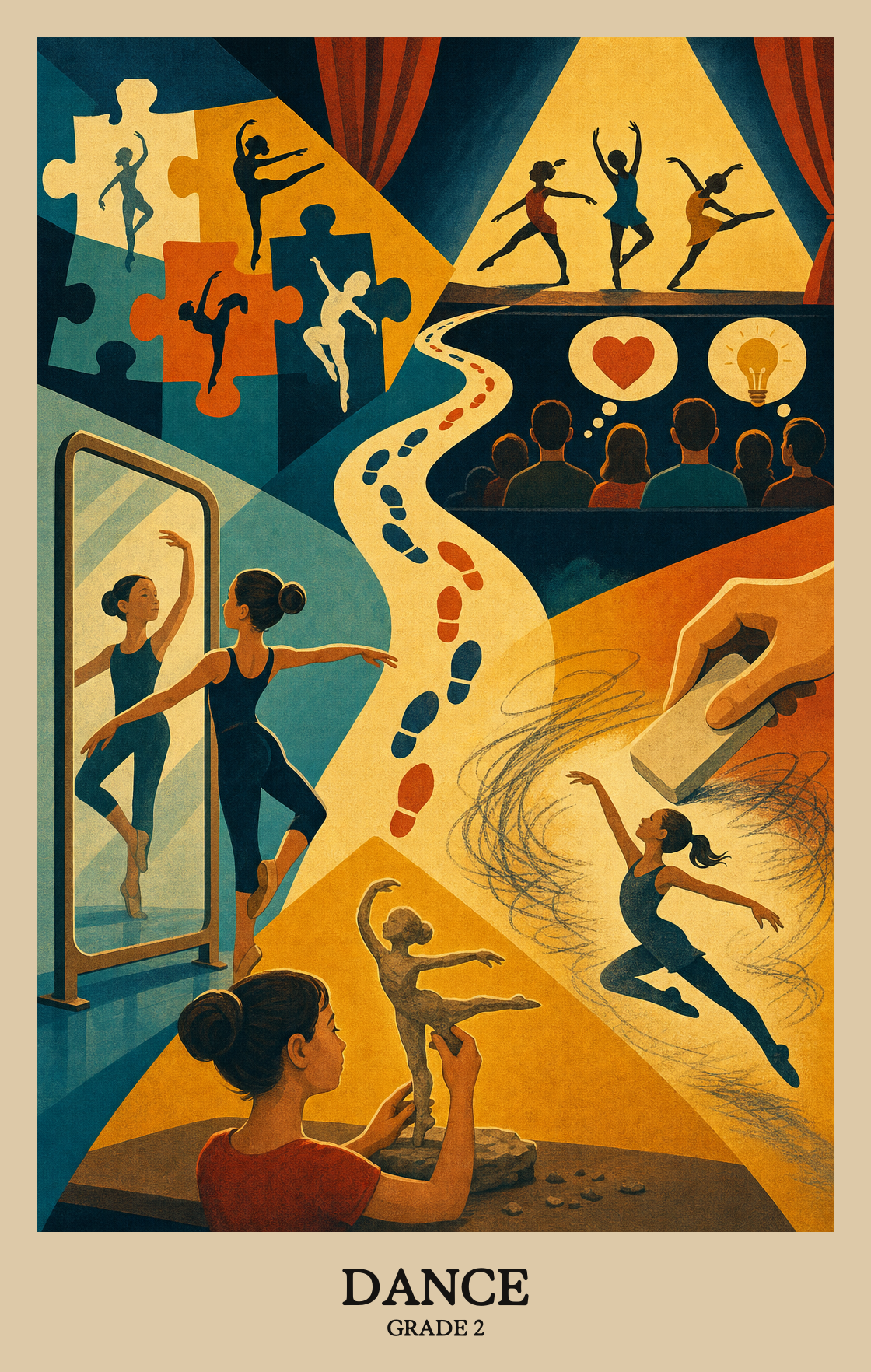
Students explore how their bodies move through space. They try out levels, speeds, and shapes, and start turning everyday ideas into short movement sequences.
Students take their movement ideas and put them in order. They practice beginning, middle, and end, and learn to repeat steps the same way each time.
Students watch and try dances from different cultures and times. They talk about what the dance might mean and connect it to their own experiences.
Students rehearse and perform short dances for classmates. They focus on showing meaning through their movement and giving thoughtful feedback to other dancers.
Students connect something from their own life to a dance they make or watch. A memory, a feeling, or something they know helps shape how they move or what the dance means to them.
Students look at a dance and talk about where it comes from: a country, a celebration, or a time in history. Connecting a dance to its background helps students understand why it moves the way it does.
| Standard | Definition | Code |
|---|---|---|
| Making dances from personal experiences | Students connect something from their own life to a dance they make or watch. A memory, a feeling, or something they know helps shape how they move or what the dance means to them. | DA:Cn10.2 |
| Dance from different times and places | Students look at a dance and talk about where it comes from: a country, a celebration, or a time in history. Connecting a dance to its background helps students understand why it moves the way it does. | DA:Cn11.2 |
Students brainstorm ideas for a new dance, then choose movements that express what they want to show. The focus is on where ideas come from and how students begin shaping them into something they could perform.
Students choose movements and arrange them into a short dance that expresses an idea or feeling. They experiment with how to sequence those movements so the dance makes sense from beginning to end.
Students revisit a dance they made, adjust moves that aren't working, and practice until the piece feels finished and ready to share.
| Standard | Definition | Code |
|---|---|---|
| Making up new dance ideas | Students brainstorm ideas for a new dance, then choose movements that express what they want to show. The focus is on where ideas come from and how students begin shaping them into something they could perform. | DA:Cr1.2 |
| Putting a dance idea together | Students choose movements and arrange them into a short dance that expresses an idea or feeling. They experiment with how to sequence those movements so the dance makes sense from beginning to end. | DA:Cr2.2 |
| Finishing a dance you made yourself | Students revisit a dance they made, adjust moves that aren't working, and practice until the piece feels finished and ready to share. | DA:Cr3.2 |
Students choose which dances to perform and explain why those pieces are worth sharing with an audience.
Students practice a dance phrase, notice what needs fixing, and adjust their movements before performing it for an audience.
Students perform a dance to share a feeling or idea with an audience, making clear choices about movement so the meaning comes through.
| Standard | Definition | Code |
|---|---|---|
| Picking dances to perform | Students choose which dances to perform and explain why those pieces are worth sharing with an audience. | DA:Pr4.2 |
| Practicing a dance until it's ready to share | Students practice a dance phrase, notice what needs fixing, and adjust their movements before performing it for an audience. | DA:Pr5.2 |
| Perform a dance to share an idea | Students perform a dance to share a feeling or idea with an audience, making clear choices about movement so the meaning comes through. | DA:Pr6.2 |
Students watch a dance and describe what they notice, such as how the dancer moves fast or slow, uses big or small shapes, or repeats a pattern. They start to explain why those choices stand out.
Students look at a dance and explain what they think the dancer is trying to say or show. They describe the mood, story, or feeling they see in the movement.
Students pick a dance they have seen or performed and explain what makes it work well, using simple ideas like clear shapes, steady beat, or smooth movement.
| Standard | Definition | Code |
|---|---|---|
| Watching and thinking about dance | Students watch a dance and describe what they notice, such as how the dancer moves fast or slow, uses big or small shapes, or repeats a pattern. They start to explain why those choices stand out. | DA:Re7.2 |
| What dances mean and why | Students look at a dance and explain what they think the dancer is trying to say or show. They describe the mood, story, or feeling they see in the movement. | DA:Re8.2 |
| What makes a dance work well | Students pick a dance they have seen or performed and explain what makes it work well, using simple ideas like clear shapes, steady beat, or smooth movement. | DA:Re9.2 |
Students make up short dances, learn movement from a teacher or a tradition, and watch each other perform. They practice using their bodies on purpose, with attention to shape, speed, energy, and space. Most of the year is hands-on movement, not worksheets.
A living room rug is plenty. Put on a song and ask students to show three different shapes, or to move like something heavy and then something light. Five minutes of trying out ideas counts as real practice.
No. The work is about making choices and explaining them, not about being graceful or flexible. A student who can show a clear shape and say why they picked it is doing exactly what the year asks.
Plan for short cycles of making, performing, and responding. Students invent movement from a prompt, shape it with a partner or small group, show it to classmates, and talk about what they saw. Connections to stories, cultures, and personal experience run through each cycle.
Start with exploring single elements like shape, level, and tempo, then move to combining two or three into short phrases. By winter, students should refine a phrase based on feedback. By spring, they can present a short dance and explain the choices behind it.
Ask what the dancers' bodies were doing, what feeling came across, and which part stood out. The goal is noticing specific moments, like a sudden stop or a low shape, rather than saying it was good or bad.
Two come up every year: holding a clear beginning and ending shape, and giving feedback that points to something specific instead of just liking or not liking a piece. Short, repeated practice with sentence stems helps more than long discussions.
By spring, students should be able to make a short movement phrase from a prompt, perform it with a clear start and finish, and say one thing they would change. They should also be able to describe what they saw a classmate do using movement words.