Exploring materials and their properties
Students sort and test everyday materials like wood, fabric, metal, and plastic. They figure out which materials work best for a job, like keeping something dry or holding weight.
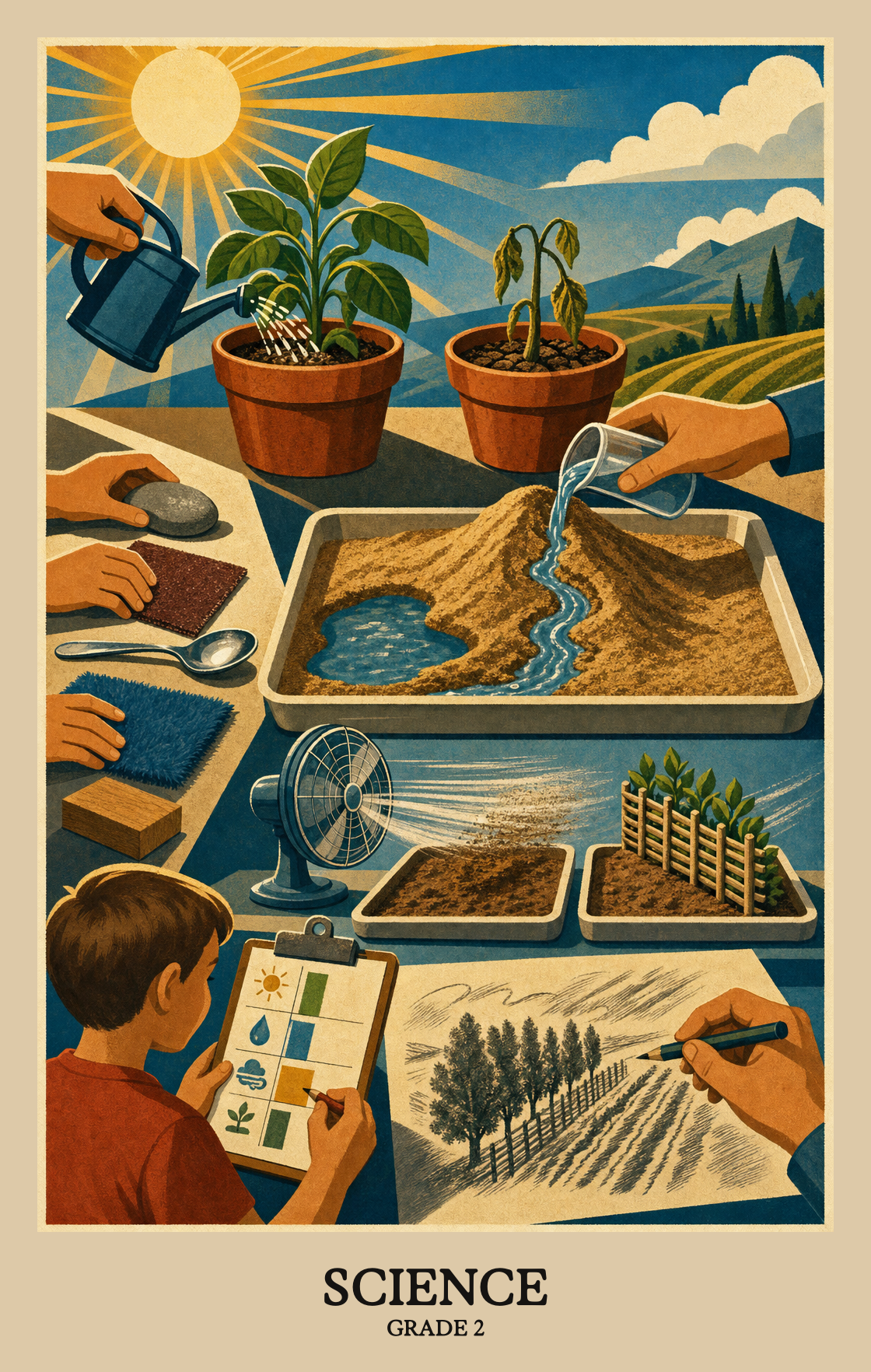
This is the year science becomes about testing ideas, not just watching. Students plan small experiments to see what plants need, sort materials by what they feel and look like, and build simple models of hills, ponds, and rivers. They also start sketching solutions to real problems, like keeping wind from blowing soil away. By spring, students can run a simple test, record what they see, and explain what the results show.
Students sort and test everyday materials like wood, fabric, metal, and plastic. They figure out which materials work best for a job, like keeping something dry or holding weight.
Students take small objects apart and rebuild them into something new. They also test what happens when things are heated or cooled, noticing which changes can be undone and which cannot.
Students grow plants to see what they need to stay healthy and watch how animals and plants help each other. They also compare what lives in a forest, a pond, or a desert.
Students map the hills, rivers, ponds, and shorelines around them. They learn that some Earth events happen fast, like a landslide, and others happen slowly over many years.
Students notice a problem, sketch an idea, and build a small model to test it. A common challenge is finding ways to keep wind or water from washing away the land.
Some Earth changes happen in seconds, like an earthquake or a flood. Others take thousands of years, like mountains forming. Students use books, photos, and videos to find examples of both and explain the difference.
Students look at different ways people try to stop wind or water from washing or blowing soil away, then compare which ones work better.
Students draw or build a simple map showing what the land and water in an area look like, such as hills, flat ground, rivers, or lakes.
| Standard | Definition | Code |
|---|---|---|
| Earth changes: fast and slow | Some Earth changes happen in seconds, like an earthquake or a flood. Others take thousands of years, like mountains forming. Students use books, photos, and videos to find examples of both and explain the difference. | 2-ESS1-1 |
| Stopping wind and water from eroding land | Students look at different ways people try to stop wind or water from washing or blowing soil away, then compare which ones work better. | 2-ESS2-1 |
| Maps of land and water | Students draw or build a simple map showing what the land and water in an area look like, such as hills, flat ground, rivers, or lakes. | 2-ESS2-2 |
Students study a real problem, such as a backpack that breaks or a tool that doesn't work well, then ask questions and gather information to describe exactly what needs to be fixed or improved.
Students sketch or build a simple model to show how an object's shape helps it do its job, like how a funnel's wide opening guides liquid into a narrow bottle.
| Standard | Definition | Code |
|---|---|---|
| Spot a problem, plan a fix | Students study a real problem, such as a backpack that breaks or a tool that doesn't work well, then ask questions and gather information to describe exactly what needs to be fixed or improved. | 2-ETS1-1 |
| Sketching shapes that solve problems | Students sketch or build a simple model to show how an object's shape helps it do its job, like how a funnel's wide opening guides liquid into a narrow bottle. | 2-ETS1-2 |
Students plan a simple test to find out what happens to plants without sunlight or water. They observe and record results to see what plants actually need to grow.
Plants need animals and animals need plants. Students draw or build a simple model showing how those two things are connected, like a bee visiting a flower or a rabbit eating grass.
Students look at plants and animals in places like ponds, forests, and deserts to see how living things differ from one habitat to the next.
| Standard | Definition | Code |
|---|---|---|
| Plants need sunlight and water to grow | Students plan a simple test to find out what happens to plants without sunlight or water. They observe and record results to see what plants actually need to grow. | 2-LS2-1 |
| How plants and animals need each other | Plants need animals and animals need plants. Students draw or build a simple model showing how those two things are connected, like a bee visiting a flower or a rabbit eating grass. | 2-LS2-2 |
| Comparing living things across habitats | Students look at plants and animals in places like ponds, forests, and deserts to see how living things differ from one habitat to the next. | 2-LS4-1 |
Students sort everyday materials like wood, metal, plastic, and fabric by what they can observe: how the material feels, looks, bends, or reacts to water. They plan a simple test and record what they find.
Students test materials like wood, metal, and fabric to figure out which one works best for a specific job. A raincoat needs to be waterproof; a window needs to let light through. Students use real results to explain their choice.
Students take apart a simple object, like a set of building blocks, and use the same pieces to build something new. This shows that materials can be rearranged without being lost or destroyed.
Heating and cooling can change materials, but not always in the same way. Students figure out which changes can be undone (melting ice back to water) and which cannot (a burnt piece of toast stays burnt).
| Standard | Definition | Code |
|---|---|---|
| Sorting materials by what you can observe | Students sort everyday materials like wood, metal, plastic, and fabric by what they can observe: how the material feels, looks, bends, or reacts to water. They plan a simple test and record what they find. | 2-PS1-1 |
| Testing materials for the right job | Students test materials like wood, metal, and fabric to figure out which one works best for a specific job. A raincoat needs to be waterproof; a window needs to let light through. Students use real results to explain their choice. | 2-PS1-2 |
| Taking apart objects to build new ones | Students take apart a simple object, like a set of building blocks, and use the same pieces to build something new. This shows that materials can be rearranged without being lost or destroyed. | 2-PS1-3 |
| Heating and cooling: reversible and permanent changes | Heating and cooling can change materials, but not always in the same way. Students figure out which changes can be undone (melting ice back to water) and which cannot (a burnt piece of toast stays burnt). | 2-PS1-4 |
The alternate state test for students with the most significant cognitive disabilities. NYSAA replaces the Grade 3-8 tests and Regents exams in ELA, math, and science for the small group of students whose IEP teams qualify them.
Students spend the year noticing the world and testing ideas about it. They watch how land and water change, grow plants to see what they need, sort materials by what they feel and look like, and figure out which changes from heating or cooling can be undone.
Go outside and ask what they notice. A puddle drying, a rock with cracks, ants on a sidewalk, ice melting in a cup. Ask why they think it happened and what they could test. Ten minutes of wondering out loud is worth more than a worksheet.
Not really. The point is observing carefully and explaining what they see with evidence. Words like habitat, material, and model come up, but students should be able to use them in their own sentences, not recite definitions.
Many teachers start with properties of materials in the fall, move to plants and animals when there is time to grow and observe living things, and save earth changes for spring when weather makes erosion easy to see. Engineering tasks fit inside each unit rather than standing alone.
Two come up every year. Distinguishing fast earth changes like landslides from slow ones like erosion, and understanding that some changes from heating or cooling reverse while others do not. Hands-on examples with ice, water, and clay help more than reading does.
Plant three bean seeds in three cups. Give one sun and water, one only water in a dark closet, and one sun but no water. Check every day for two weeks and draw what happens. This matches the kind of investigation done in class.
Plan two or three small design tasks tied to other units. Building a barrier to slow water on a sand tray, designing a shape that holds weight, or rebuilding something from a set of pieces. Each task should take a class period or two, not a full unit.
By June, students should be able to make a careful observation, suggest a reason for it, and back up the reason with something they saw or tested. They should also be able to draw a simple model of a place or process and explain what each part shows.
Yes. Drawing is how second graders show what they understand. A labeled sketch of a pond, a plant, or a rock formation is real science thinking at this age. Ask them to explain the drawing and you will hear the science underneath.