Getting back into music
Students return to playing, singing, and listening. They warm up old skills and start sharing musical ideas they care about, drawing on songs and styles from their own lives.
This is the year music gets personal and intentional. Students compose and arrange short pieces, then revise them based on feedback and their own ear. They rehearse music for performance, making real choices about tempo, dynamics, and expression to shape how a song feels. By spring, they can perform a prepared piece, explain why a composer or songwriter made certain choices, and back up their opinion of a song with specific reasons.
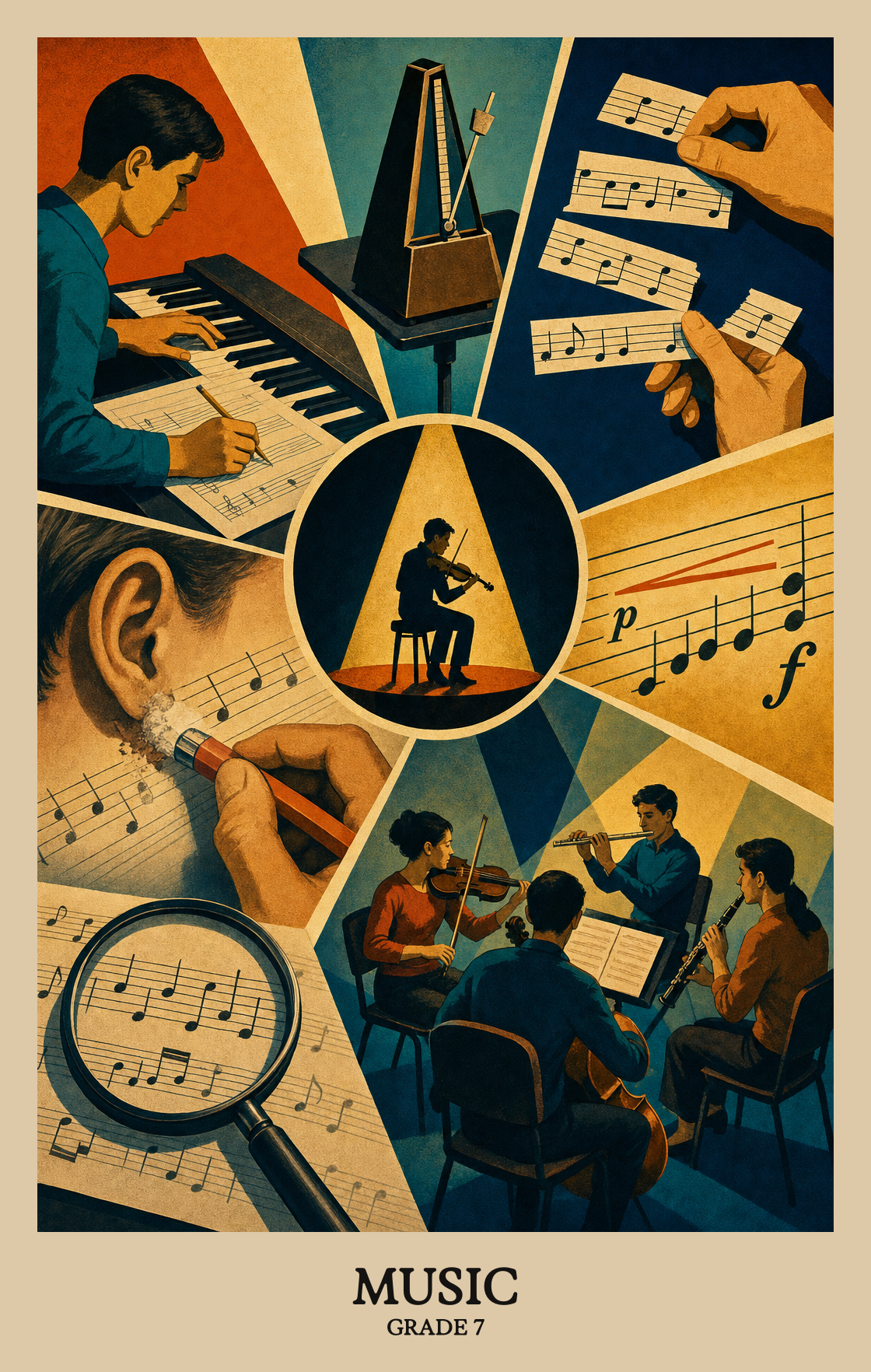
Students return to playing, singing, and listening. They warm up old skills and start sharing musical ideas they care about, drawing on songs and styles from their own lives.
Students take rough musical sketches and build them into something more finished. They make choices about rhythm, melody, and structure, then revise based on what sounds right.
Students pick music to perform and work on the parts that need the most practice. They focus on technique and on the feeling they want listeners to walk away with.
Students study how music is built and what it might mean. They use clear reasons to say what works in a piece and what they would change, including in their own playing.
Students connect what they perform and write to the time, place, and culture it comes from. They wrap up the year sharing a finished piece and talking about the choices behind it.
Students connect what they know and what they've lived through to the music they create or perform. Personal experience shapes the choices they make in a piece.
Students connect a piece of music to the time period, culture, or world events that shaped it, then explain how that context changes the way they hear or interpret the work.
| Standard | Definition | Code |
|---|---|---|
| Making music from personal experience | Students connect what they know and what they've lived through to the music they create or perform. Personal experience shapes the choices they make in a piece. | MU:Cn10.7 |
| Music and the world that made it | Students connect a piece of music to the time period, culture, or world events that shaped it, then explain how that context changes the way they hear or interpret the work. | MU:Cn11.7 |
Students brainstorm and develop original musical ideas, experimenting with melody, rhythm, or structure to start building a new piece or creative work.
Students take a musical idea they've started and shape it into something more complete, adjusting rhythm, melody, or structure until the piece feels intentional and finished.
Students revise a piece of music based on feedback, then finish it in a form ready to share or perform.
| Standard | Definition | Code |
|---|---|---|
| Coming up with musical ideas | Students brainstorm and develop original musical ideas, experimenting with melody, rhythm, or structure to start building a new piece or creative work. | MU:Cr1.7 |
| Develop and shape your musical ideas | Students take a musical idea they've started and shape it into something more complete, adjusting rhythm, melody, or structure until the piece feels intentional and finished. | MU:Cr2.7 |
| Finishing and polishing a musical piece | Students revise a piece of music based on feedback, then finish it in a form ready to share or perform. | MU:Cr3.7 |
Students choose a piece of music to perform, then study it closely enough to make deliberate decisions about how to play or sing it.
Students practice and improve a piece of music before performing it, refining their technique, timing, and expression until the work is ready to share with an audience.
Students perform a piece of music with a clear intention, making choices about dynamics, tempo, and tone to express a specific feeling or idea to the audience.
| Standard | Definition | Code |
|---|---|---|
| Choosing music worth performing | Students choose a piece of music to perform, then study it closely enough to make deliberate decisions about how to play or sing it. | MU:Pr4.7 |
| Rehearse and refine music for performance | Students practice and improve a piece of music before performing it, refining their technique, timing, and expression until the work is ready to share with an audience. | MU:Pr5.7 |
| Perform music with meaning and intention | Students perform a piece of music with a clear intention, making choices about dynamics, tempo, and tone to express a specific feeling or idea to the audience. | MU:Pr6.7 |
Students listen to a piece of music and break down what they hear, noticing how melody, rhythm, and structure work together to shape the overall sound.
Students explain what a piece of music means to them and back it up with specific details from the music itself, like a repeated rhythm or a shift in tempo.
Students use a set of criteria, like tone, rhythm, or structure, to judge a piece of music and explain why it succeeds or falls short.
| Standard | Definition | Code |
|---|---|---|
| Listening closely to music and analyzing it | Students listen to a piece of music and break down what they hear, noticing how melody, rhythm, and structure work together to shape the overall sound. | MU:Re7.7 |
| Reading meaning in music | Students explain what a piece of music means to them and back it up with specific details from the music itself, like a repeated rhythm or a shift in tempo. | MU:Re8.7 |
| Judging music with your own criteria | Students use a set of criteria, like tone, rhythm, or structure, to judge a piece of music and explain why it succeeds or falls short. | MU:Re9.7 |
Students do four kinds of work: making their own music, performing pieces, listening and reacting to music, and connecting songs to history and their own lives. Most classes mix two or three of these. A student might write a short melody one week and rehearse a group piece the next.
Set aside 10 or 15 minutes a few times a week for practice and ask students to play or sing one part for you. Asking what was hard and what got easier helps more than correcting notes. A quiet room and a music stand go a long way.
No. Singing, drumming, keyboard, guitar, and music software all count. Students choose tools that fit the class, and the skills travel between them. What matters is steady practice and thinking about the sound.
Most teachers run all three threads in parallel rather than as separate units. A common pattern is a short composing project, a performance cycle, and a listening study tied to the same musical idea, like rhythm or mood. Returning to each thread keeps skills warm.
Students can draft a short original piece, revise it based on feedback, and perform something they have rehearsed with attention to expression. They can also explain why a piece sounds the way it does and judge their own work against clear criteria.
Revision is the hardest part. Students often want to finish a piece on the first try instead of reworking a weak section. Building in structured peer feedback and a second draft step, with a simple rubric, tends to move this faster than more direct instruction.
Shrink the task. Ask for one line, one measure, or one section instead of the whole piece. Listening together to a recording of a song they like and naming what the musicians did is also useful, and it counts as real music thinking.
Ready students can rehearse a piece on their own for a short stretch, take a note from a teacher or peer and try it, and talk about a piece of music using terms like tempo, dynamics, and mood. A small portfolio of drafts and recordings shows this clearly.