Thinking like a historian
Students learn how to ask good questions about the past and weigh different kinds of evidence. They practice spotting bias in maps, photos, and old documents, and they figure out how to tell a fact from an opinion.
This is the year students travel across the Eastern Hemisphere and start thinking like historians. They study early civilizations in places like Africa, Asia, and the Middle East, asking how geography, resources, and leaders shaped daily life. Students learn to read maps, weigh sources, and spot bias in what people wrote. By spring, they can pick an event from an ancient civilization and explain what caused it and what changed because of it.
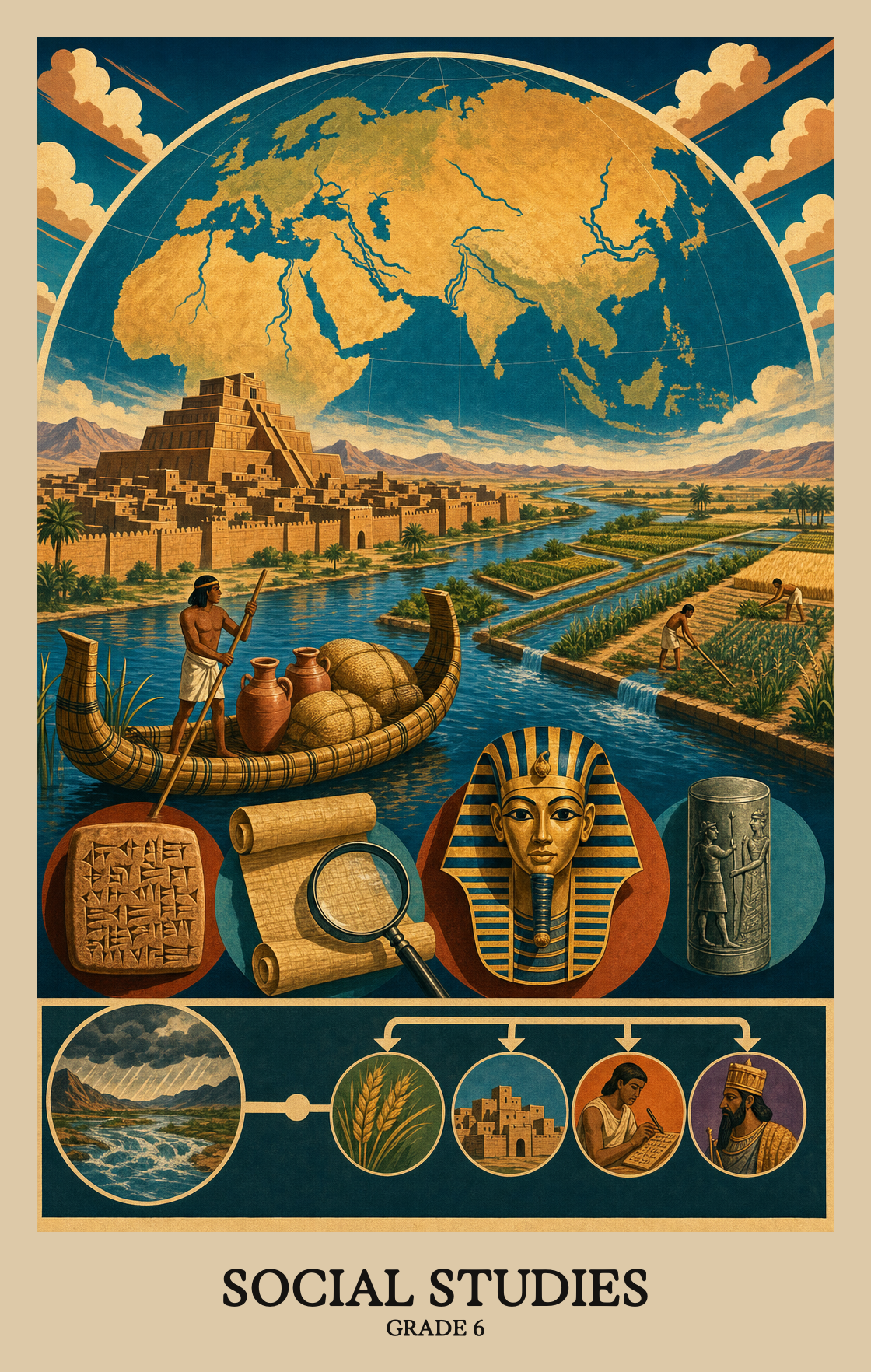
Students learn how to ask good questions about the past and weigh different kinds of evidence. They practice spotting bias in maps, photos, and old documents, and they figure out how to tell a fact from an opinion.
Students map out the regions they will study all year, from rivers and mountains to cities and trade routes. They look at how the land shapes where people settle, what they grow, and how they move goods.
Students walk through the rise of early societies in places like Mesopotamia, Egypt, China, and India. They build timelines, sort causes from effects, and look for the moments that changed daily life for a lot of people.
Students compare different ways societies have organized power, from kings and empires to councils and assemblies. They look at the rights and duties of regular people and practice debating ideas without shutting each other down.
Students see how scarcity, jobs, and trade routes shaped the choices societies made. They compare market economies with other systems and trace how a single resource, like salt or silk, could change a whole region.
Students tie what they learned to current events in the same regions. They pick a local issue somewhere in the Eastern Hemisphere, look at it from several sides, and suggest what people might do about it.
Students practice asking questions about historical events in Africa, Asia, and Europe that they can actually answer by looking at sources and evidence.
Students practice choosing the right kind of source for a question, then dig into what that source actually shows. That means reading a map, studying a photograph, or comparing a firsthand account with a historian's summary to figure out what happened and why.
Students look at a source, like a map, article, or speech, and ask who made it, why they made it, and who it was made for. That helps students spot when a source might be one-sided.
Students read or listen to someone else's position on a topic and explain, in their own words, what that person is arguing and why.
Students read a source and figure out what the author means but never directly says. With some guidance, they explain their thinking using clues from the text.
Students read arguments about history or geography topics, figure out what evidence backs each one up, and look at the same issue from more than one point of view.
Students put events in order and explain how earlier events connect to later ones. The focus is on time relationships, not just timelines.
Students use math to count years, decades, and centuries on a timeline, and figure out how long ago events happened using B.C.E. and C.E. dates. They also read timelines to make sense of the order and distance between historical events.
Students look at an event and explain what caused it and what happened as a result. This skill applies to current news stories and to events from ancient history.
Students practice tracing how several events or decisions led to several outcomes at once. They learn to sort causes and effects into patterns rather than treating every event as a single chain.
Students sort the causes of a historical or current event into two groups: what sparked it right away and what had been building for years. They do the same for effects, separating quick results from changes that played out over time.
Students look at how life, society, or government stayed the same or shifted over a stretch of history, then pinpoint the moments when a major event pushed things in a new direction.
Students compare timelines from different regions to see how the same era looks different depending on where you are. Choosing where to "start the clock" shapes which events seem important and which get left out.
Students look at how things stayed the same or shifted over time and connect those patterns to bigger historical events. A trade route that lasted centuries, or a government that collapsed, both tell part of a larger story.
Historians divide the past into named chunks of time, like "ancient" or "medieval," to make big stretches of history easier to study and compare. Students learn why those dividing lines exist and how historians decide where to draw them.
Students pick a region in the Eastern Hemisphere, name what its places share (a climate, a religion, a language), and explain how that region differs from another.
Students read about a single historical event and sort out why different groups saw it differently. They judge which perspectives matter most and explain what each group had at stake.
Students look at two or more historical events from different places in the Eastern Hemisphere and explain what those events have in common and how they differ, using time period and location as part of the comparison.
Students explain how a place's location, resources, and past events shape why things happened there. In grade 6, that focus lands on the Eastern Hemisphere.
Students place a historical event, like the rise of a trade route or the fall of an empire, into its time and place, then explain how it connected to bigger changes happening across the region or the world.
Students compare two ancient civilizations from the same era, looking at shared traits like government, trade, or geography. A teacher helps students decide which characteristics are worth comparing.
Students use maps, photos, and satellite images to find places in the Eastern Hemisphere, describe how those places connect to each other, and explain why certain locations are better suited for specific activities.
Students sort what humans built or changed (roads, farms, cities) from what nature made (rivers, mountains, weather) across the Eastern Hemisphere. Then they explain how those two things affect each other.
Students study real places in Europe, Asia, and Africa to explain how geography shapes the way people live, and how people in turn change the land, water, and climate around them.
Students look at a region's geography, economy, and culture to explain why its history unfolded the way it did. A river valley, a trade route, or a shared language can shape what a society builds, fights over, or leaves behind.
Students explain how farming, building, or industry changes the land and environment in places across Africa, Asia, Europe, and Oceania.
Students look at how a place is laid out and ask why it ended up that way. They consider how borders were drawn by people over time, and how those decisions shaped who has power, who has land, and who belongs where.
Scarcity means there is never enough of everything people want, so choices have to be made. Students look at real examples from history and today to see how those choices came with trade-offs, and what was gained or lost when a society picked one option over another.
Students sort the workers, tools, and raw materials behind everyday products and explain why each piece matters. From a factory floor to a farm, they trace what it takes to make something and get it to people who need it.
Students compare how different countries in the Eastern Hemisphere run their economies, looking at who controls prices, businesses, and resources in a market system versus other systems like command or mixed economies.
Students learn why people and regions focus on doing a few things well, then trade with others for the rest. They trace how that pattern shaped economies across Asia, Africa, and Europe from ancient times to today.
Students identify real examples of how economies grow or struggle, looking at things like rising prices, job loss, and total output in countries across Africa, Asia, Europe, and the Middle East.
Students look at real examples from countries in Asia, Africa, or Europe to explain how a government's choices about taxes, trade, or spending can shape how a country's economy works.
Students listen to classmates' opinions in discussions and debates, even when they disagree. They think about other viewpoints before responding, not just their own.
Students pick a real problem in a country from Africa, Europe, Asia, or Australia and take some kind of action, like writing a letter, holding a discussion, or presenting a solution to classmates.
Students look at how different societies in the Eastern Hemisphere have been governed, from monarchies to republics, and examine what ordinary people and powerful groups could actually do within those systems.
Students look at how ordinary people got involved in their communities and governments across history and around the world, from ancient civilizations to modern societies in Africa, Asia, and Europe.
Students practice working through disagreements by finding middle ground, giving up something to reach an agreement both sides can accept.
Students look at a real-world problem that crosses national borders, explain why it matters, and propose a practical step someone could take to help address it.
Students study how leaders and rulers in places like Africa, Asia, and Europe have shaped people's rights over time. They look at how people in power today still make decisions that can expand or limit what citizens are allowed to do.
Students name the rights people hold (like voting or practicing a religion) and the duties they carry (like following laws or paying taxes) in countries across Africa, Asia, Europe, and Australia.
Students examine how countries, communities, and people around the world depend on each other, then take action on a real issue that crosses borders.
| Standard | Definition | Code |
|---|---|---|
| Asking questions about Eastern Hemisphere history | Students practice asking questions about historical events in Africa, Asia, and Europe that they can actually answer by looking at sources and evidence. | NY-SS.6.A.1 |
| Reading maps, photos, and primary sources | Students practice choosing the right kind of source for a question, then dig into what that source actually shows. That means reading a map, studying a photograph, or comparing a firsthand account with a historian's summary to figure out what happened and why. | NY-SS.6.A.2 |
| Reading sources for bias and purpose | Students look at a source, like a map, article, or speech, and ask who made it, why they made it, and who it was made for. That helps students spot when a source might be one-sided. | NY-SS.6.A.3 |
| Summarizing other people's arguments | Students read or listen to someone else's position on a topic and explain, in their own words, what that person is arguing and why. | NY-SS.6.A.4 |
| Reading between the lines with support | Students read a source and figure out what the author means but never directly says. With some guidance, they explain their thinking using clues from the text. | NY-SS.6.A.5 |
| Arguments and evidence in social studies | Students read arguments about history or geography topics, figure out what evidence backs each one up, and look at the same issue from more than one point of view. | NY-SS.6.A.6 |
| How events connect across time | Students put events in order and explain how earlier events connect to later ones. The focus is on time relationships, not just timelines. | NY-SS.6.B.1 |
| Measuring time on a timeline | Students use math to count years, decades, and centuries on a timeline, and figure out how long ago events happened using B.C.E. and C.E. dates. They also read timelines to make sense of the order and distance between historical events. | NY-SS.6.B.2 |
| Causes and effects in history and current events | Students look at an event and explain what caused it and what happened as a result. This skill applies to current news stories and to events from ancient history. | NY-SS.6.B.3 |
| Causes and effects in history | Students practice tracing how several events or decisions led to several outcomes at once. They learn to sort causes and effects into patterns rather than treating every event as a single chain. | NY-SS.6.B.4 |
| Causes and effects: long-term vs. immediate | Students sort the causes of a historical or current event into two groups: what sparked it right away and what had been building for years. They do the same for effects, separating quick results from changes that played out over time. | NY-SS.6.B.5 |
| How history changes over time | Students look at how life, society, or government stayed the same or shifted over a stretch of history, then pinpoint the moments when a major event pushed things in a new direction. | NY-SS.6.B.6 |
| Comparing timelines across the Eastern Hemisphere | Students compare timelines from different regions to see how the same era looks different depending on where you are. Choosing where to "start the clock" shapes which events seem important and which get left out. | NY-SS.6.B.7 |
| How history changes and stays the same | Students look at how things stayed the same or shifted over time and connect those patterns to bigger historical events. A trade route that lasted centuries, or a government that collapsed, both tell part of a larger story. | NY-SS.6.B.8 |
| How historians divide history into periods | Historians divide the past into named chunks of time, like "ancient" or "medieval," to make big stretches of history easier to study and compare. Students learn why those dividing lines exist and how historians decide where to draw them. | NY-SS.6.B.9 |
| Comparing regions by shared characteristics | Students pick a region in the Eastern Hemisphere, name what its places share (a climate, a religion, a language), and explain how that region differs from another. | NY-SS.6.C.1 |
| Comparing different views on one historical event | Students read about a single historical event and sort out why different groups saw it differently. They judge which perspectives matter most and explain what each group had at stake. | NY-SS.6.C.2 |
| Comparing events across places and time | Students look at two or more historical events from different places in the Eastern Hemisphere and explain what those events have in common and how they differ, using time period and location as part of the comparison. | NY-SS.6.C.3 |
| How place and economy shape history | Students explain how a place's location, resources, and past events shape why things happened there. In grade 6, that focus lands on the Eastern Hemisphere. | NY-SS.6.C.4 |
| Placing Eastern Hemisphere events in time and place | Students place a historical event, like the rise of a trade route or the fall of an empire, into its time and place, then explain how it connected to bigger changes happening across the region or the world. | NY-SS.6.C.5 |
| Comparing civilizations across time and place | Students compare two ancient civilizations from the same era, looking at shared traits like government, trade, or geography. A teacher helps students decide which characteristics are worth comparing. | NY-SS.6.C.6 |
| Reading maps of the Eastern Hemisphere | Students use maps, photos, and satellite images to find places in the Eastern Hemisphere, describe how those places connect to each other, and explain why certain locations are better suited for specific activities. | NY-SS.6.D.1 |
| Human-made vs. natural features | Students sort what humans built or changed (roads, farms, cities) from what nature made (rivers, mountains, weather) across the Eastern Hemisphere. Then they explain how those two things affect each other. | NY-SS.6.D.2 |
| How humans and environments shape each other | Students study real places in Europe, Asia, and Africa to explain how geography shapes the way people live, and how people in turn change the land, water, and climate around them. | NY-SS.6.D.3 |
| How geography shaped Eastern Hemisphere societies | Students look at a region's geography, economy, and culture to explain why its history unfolded the way it did. A river valley, a trade route, or a shared language can shape what a society builds, fights over, or leaves behind. | NY-SS.6.D.4 |
| How humans change places and regions | Students explain how farming, building, or industry changes the land and environment in places across Africa, Asia, Europe, and Oceania. | NY-SS.6.D.5 |
| How places are organized and why boundaries change | Students look at how a place is laid out and ask why it ended up that way. They consider how borders were drawn by people over time, and how those decisions shaped who has power, who has land, and who belongs where. | NY-SS.6.D.6 |
| Scarcity and economic decision making | Scarcity means there is never enough of everything people want, so choices have to be made. Students look at real examples from history and today to see how those choices came with trade-offs, and what was gained or lost when a society picked one option over another. | NY-SS.6.E.1 |
| What resources make goods and services possible | Students sort the workers, tools, and raw materials behind everyday products and explain why each piece matters. From a factory floor to a farm, they trace what it takes to make something and get it to people who need it. | NY-SS.6.E.2 |
| Market economies vs. other economic systems | Students compare how different countries in the Eastern Hemisphere run their economies, looking at who controls prices, businesses, and resources in a market system versus other systems like command or mixed economies. | NY-SS.6.E.3 |
| Job specialization and trade in the Eastern Hemisphere | Students learn why people and regions focus on doing a few things well, then trade with others for the rest. They trace how that pattern shaped economies across Asia, Africa, and Europe from ancient times to today. | NY-SS.6.E.4 |
| How Eastern Hemisphere economies grow and struggle | Students identify real examples of how economies grow or struggle, looking at things like rising prices, job loss, and total output in countries across Africa, Asia, Europe, and the Middle East. | NY-SS.6.E.5 |
| How governments shape economies | Students look at real examples from countries in Asia, Africa, or Europe to explain how a government's choices about taxes, trade, or spending can shape how a country's economy works. | NY-SS.6.E.6 |
| Respecting other views in debate | Students listen to classmates' opinions in discussions and debates, even when they disagree. They think about other viewpoints before responding, not just their own. | NY-SS.6.F.1 |
| Local problem-solving in Eastern Hemisphere countries | Students pick a real problem in a country from Africa, Europe, Asia, or Australia and take some kind of action, like writing a letter, holding a discussion, or presenting a solution to classmates. | NY-SS.6.F.2 |
| Political systems and who holds power | Students look at how different societies in the Eastern Hemisphere have been governed, from monarchies to republics, and examine what ordinary people and powerful groups could actually do within those systems. | NY-SS.6.F.3 |
| How individuals shape societies across history | Students look at how ordinary people got involved in their communities and governments across history and around the world, from ancient civilizations to modern societies in Africa, Asia, and Europe. | NY-SS.6.F.4 |
| Resolving disagreements through compromise | Students practice working through disagreements by finding middle ground, giving up something to reach an agreement both sides can accept. | NY-SS.6.F.5 |
| Global problems that need our action | Students look at a real-world problem that crosses national borders, explain why it matters, and propose a practical step someone could take to help address it. | NY-SS.6.F.6 |
| How leaders shape rights and freedom | Students study how leaders and rulers in places like Africa, Asia, and Europe have shaped people's rights over time. They look at how people in power today still make decisions that can expand or limit what citizens are allowed to do. | NY-SS.6.F.7 |
| Citizen rights and responsibilities across the Eastern | Students name the rights people hold (like voting or practicing a religion) and the duties they carry (like following laws or paying taxes) in countries across Africa, Asia, Europe, and Australia. | NY-SS.6.F.8 |
| Taking action in a connected world | Students examine how countries, communities, and people around the world depend on each other, then take action on a real issue that crosses borders. | NY-SS.6.F.9 |
The end-of-course exam students take after the second year of high school global history, usually in grade 10. Counts toward the social studies credits Regents diplomas require.
Students study the early civilizations and societies of the Eastern Hemisphere, including parts of Asia, Africa, Europe, and the Middle East. They look at how geography shaped daily life, how governments and economies worked, and how cultures changed over long stretches of time.
Connect the past to something students can see. Cook a dish from a region being studied, find the country on a map app, or watch a short documentary clip together. Five minutes of real curiosity at home often does more than an hour of review.
Students should look at an old photo, map, artifact, or letter and ask who made it, when, and why. They learn to spot point of view and bias, and to use the source as evidence when they explain an idea.
Most teachers move roughly in chronological order through major regions, starting with early river civilizations and working forward. Anchor each unit in geography first, then layer in government, economy, and culture so students can compare societies side by side.
Cause and effect across long time spans, and reading sources for bias. Students often name a single cause for a big event or accept a source at face value. Plan to revisit both skills in every unit, not just at the start of the year.
Some anchor dates and places help, but the focus is bigger. Students need to place events in order, see why one event led to another, and explain how a place shaped the people living there. Quick map quizzes at home are useful in small doses.
They read about the same event from different perspectives, such as a ruler and a worker, or a trader and a farmer. At home, ask students who else was there and what that person might have thought. That single question builds the habit.
Students can compare two civilizations from the Eastern Hemisphere using geography, government, and economy. They can use a source as evidence, identify bias, and explain a chain of causes and effects. They can also hold a respectful discussion when classmates disagree.
Seventh grade shifts to the Western Hemisphere and United States history, so the habits matter more than the content. Strong readers of maps, timelines, and sources go in ready. Keep reading nonfiction over the summer and talking about current events at dinner.