Sketchbooks and personal ideas
Students start the year building a habit of brainstorming and sketching. They pull ideas from their own lives, memories, and interests to plan original artwork instead of copying a picture.
This is the year art class shifts from making things to thinking like an artist. Students plan a piece on purpose, work through drafts, and explain the choices behind the final version. They look at art from other times and places and connect it to their own lives. By spring, they can show a finished piece and talk about what it means and why they made it that way.
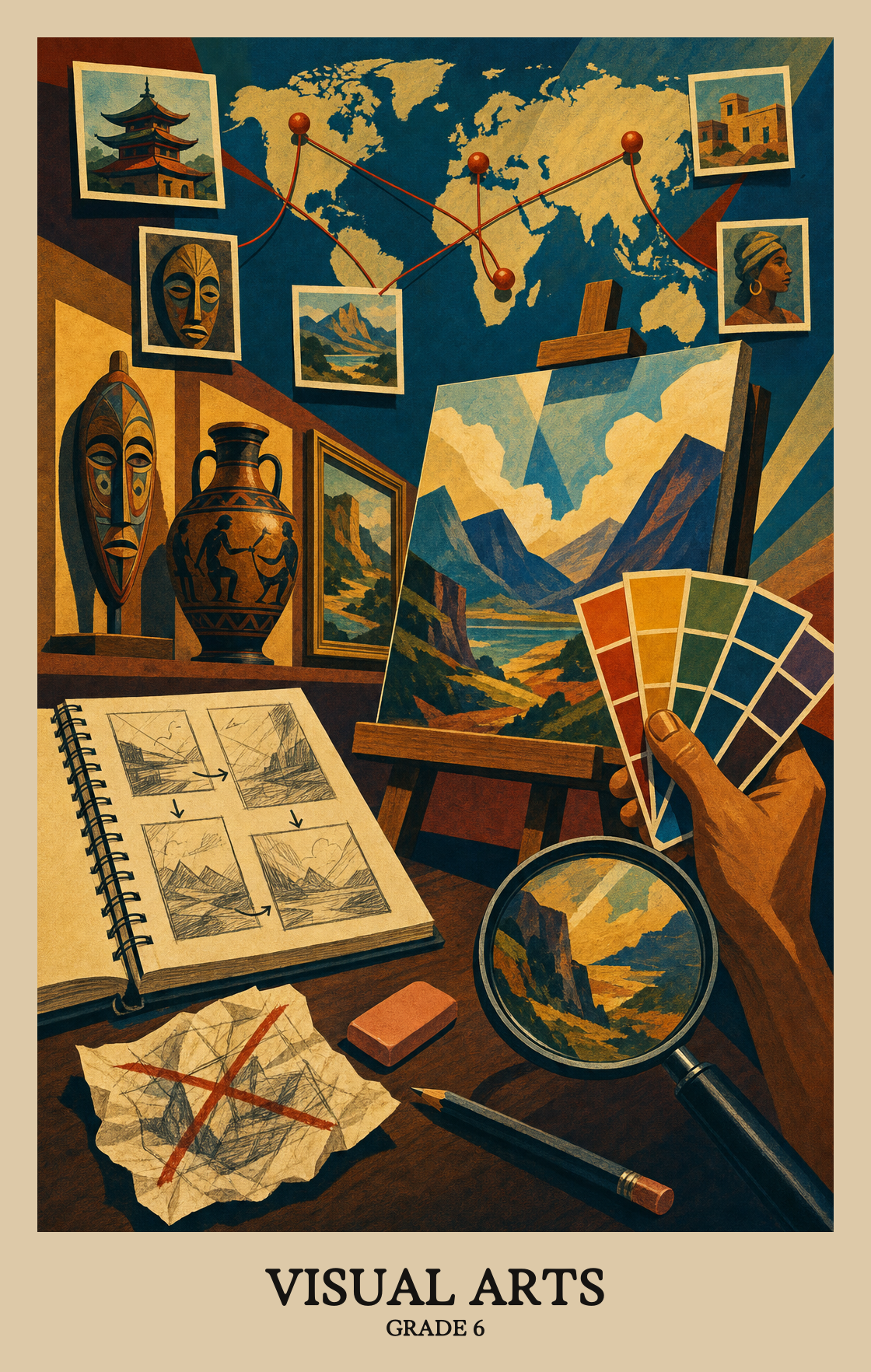
Students start the year building a habit of brainstorming and sketching. They pull ideas from their own lives, memories, and interests to plan original artwork instead of copying a picture.
Students practice techniques with pencil, paint, clay, or digital tools. They learn to organize a piece, fix mistakes, and revise a draft before calling it finished.
Students slow down to study artworks closely. They describe what they notice, guess what the artist meant, and back up their ideas with details from the piece itself.
Students connect artworks to the people and times that made them. They look at how culture, history, and community shape what an artist chooses to make and show.
Students finish pieces and prepare them for an audience. They decide which works to show, how to display them, and what they want viewers to take away.
Students draw on what they already know and what they've lived through to make choices in their artwork. Personal experience and outside knowledge both shape what gets made and why.
Students look at a piece of art and connect it to the time, place, or culture it came from. That context helps them understand why the work looks the way it does and what the artist was responding to.
| Standard | Definition | Code |
|---|---|---|
| Making art from personal experience | Students draw on what they already know and what they've lived through to make choices in their artwork. Personal experience and outside knowledge both shape what gets made and why. | VA:Cn10.6 |
| Art in its time and place | Students look at a piece of art and connect it to the time, place, or culture it came from. That context helps them understand why the work looks the way it does and what the artist was responding to. | VA:Cn11.6 |
Students brainstorm ideas for original artwork, then decide which ones are worth developing into a finished piece.
Students take their early sketches or ideas and refine them into a finished piece, making deliberate choices about composition, materials, and technique along the way.
Students review their own artwork, make deliberate changes based on what's working and what isn't, and decide when a piece is finished.
| Standard | Definition | Code |
|---|---|---|
| Coming up with ideas for your art | Students brainstorm ideas for original artwork, then decide which ones are worth developing into a finished piece. | VA:Cr1.6 |
| Develop and organize your artistic ideas | Students take their early sketches or ideas and refine them into a finished piece, making deliberate choices about composition, materials, and technique along the way. | VA:Cr2.6 |
| Finishing and refining your artwork | Students review their own artwork, make deliberate changes based on what's working and what isn't, and decide when a piece is finished. | VA:Cr3.6 |
Students look at a collection of their own artwork, think about what each piece shows or means, and choose which ones are strong enough to share with an audience.
Students revise and improve their artwork before it goes on display, making deliberate choices about technique, materials, and finish so the final piece is ready for an audience.
Students choose how to display or share their artwork so viewers understand what the work is about and why it matters.
| Standard | Definition | Code |
|---|---|---|
| Choosing art to display and why | Students look at a collection of their own artwork, think about what each piece shows or means, and choose which ones are strong enough to share with an audience. | VA:Pr4.6 |
| Refine artwork before sharing it | Students revise and improve their artwork before it goes on display, making deliberate choices about technique, materials, and finish so the final piece is ready for an audience. | VA:Pr5.6 |
| Sharing art that says something | Students choose how to display or share their artwork so viewers understand what the work is about and why it matters. | VA:Pr6.6 |
Students look closely at a piece of art and describe what they notice, then explain how the artist's choices, like color, shape, or composition, create meaning.
Students look closely at an artwork and explain what the artist was trying to say and why specific choices, like color, shape, or subject matter, support that idea.
Students look at a piece of art and judge it using a clear set of criteria, explaining why it succeeds or falls short. The focus is on using specific reasons, not just personal taste.
| Standard | Definition | Code |
|---|---|---|
| Reading and analyzing art | Students look closely at a piece of art and describe what they notice, then explain how the artist's choices, like color, shape, or composition, create meaning. | VA:Re7.6 |
| Reading meaning in artwork | Students look closely at an artwork and explain what the artist was trying to say and why specific choices, like color, shape, or subject matter, support that idea. | VA:Re8.6 |
| Judging what makes art work | Students look at a piece of art and judge it using a clear set of criteria, explaining why it succeeds or falls short. The focus is on using specific reasons, not just personal taste. | VA:Re9.6 |
Students move through four big habits: making their own art, sharing it with others, looking closely at art, and connecting art to life and history. Expect sketchbooks, longer projects, and real conversations about why an artist made the choices they did.
Keep simple supplies around like pencils, scrap paper, and a sketchbook, and give students quiet time to draw from observation. Visit a local museum or look at art online together and ask what the artist might be saying. Praise effort and revision, not just the finished piece.
At this age students start comparing their work to peers and to images online, and confidence often dips. Remind students that artists practice the same drawing many times, and that copying from real objects is how skills grow. Short, regular sketching helps more than long, rare sessions.
Yes. Students learn to plan, revise, give feedback, and explain their thinking, which are the same habits used in writing and science. Art also asks students to read images carefully, which supports history and reading.
A common arc is to start with observation and skill-building, move into idea generation and planning, then run longer projects that require revision and an artist statement. End the year with a presentation or small exhibition so students practice selecting and explaining their work.
Generating original ideas from personal experience is often harder than the making itself, so plan extra time for brainstorming and reference gathering. Revision is the other sticking point, since students at this age tend to call a piece finished too early.
Plan for short, regular reflection: a few sentences in a sketchbook, a partner critique, or a one-paragraph artist statement at the end of a project. The goal is for students to name their choices and connect their work to an artist, a culture, or a personal experience.
By spring, students can take an idea from a sketch through planning, revision, and a finished piece, and explain the choices they made. They can also look at another artist's work and describe what it means and how it was made, using specific evidence from the image.