Moving with purpose
Students start the year exploring how their bodies move through space. They practice steady balance, clear shapes, and traveling steps that build the foundation for everything else.
This is the year dance becomes more thoughtful. Students start shaping movement on purpose, using their own ideas and what they see around them to build short pieces with a beginning, middle, and end. They also practice watching dance carefully, talking about what it means and what makes it work. By spring, students can perform a short dance they helped create and explain the choices behind it.
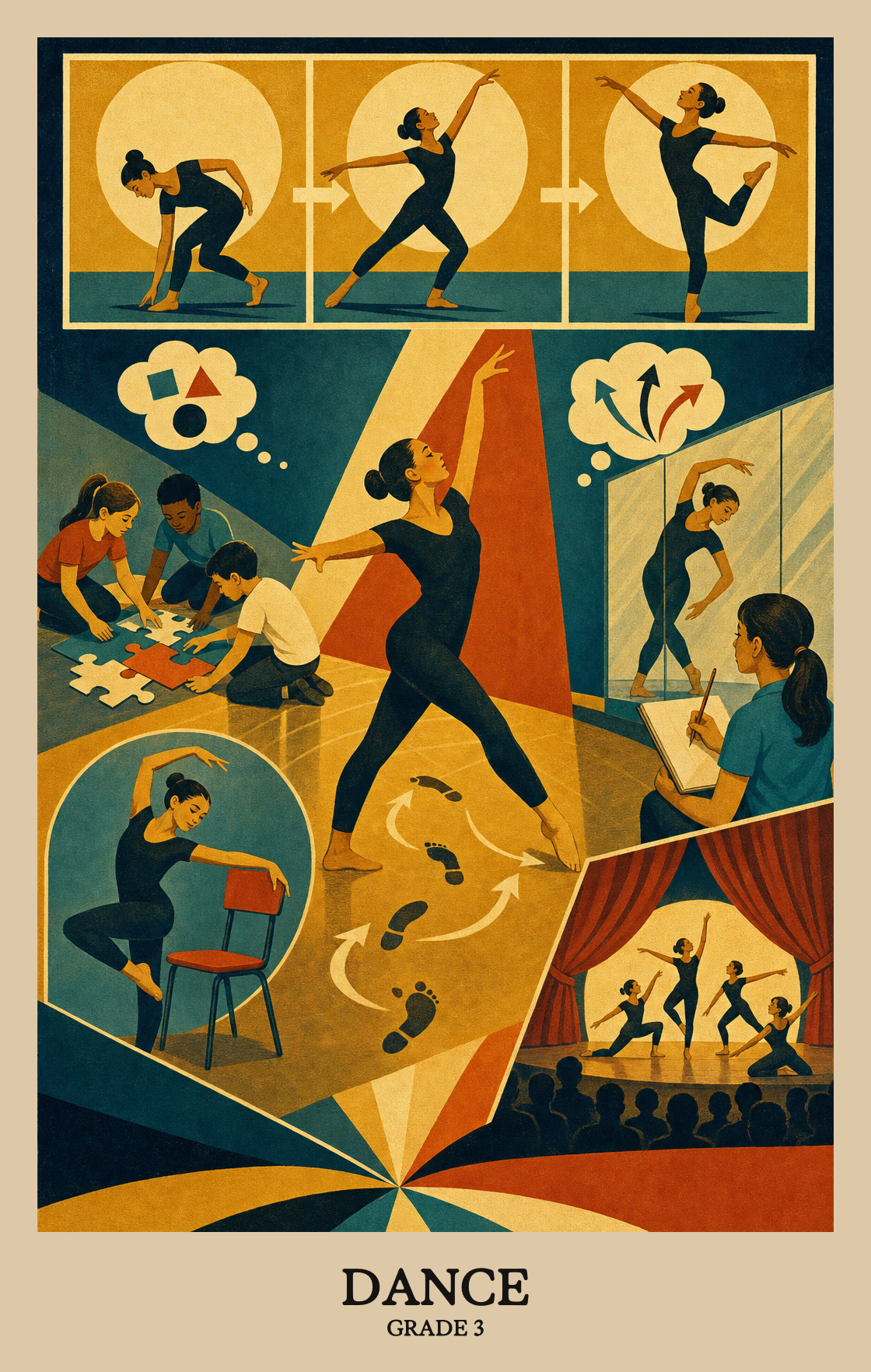
Students start the year exploring how their bodies move through space. They practice steady balance, clear shapes, and traveling steps that build the foundation for everything else.
Students use pictures, stories, and their own experiences to spark short dances. They learn that a feeling or memory can become movement an audience can see.
Students put movements in order, try different choices, and revise what is not working. They practice the same short dance more than once to make it stronger.
Students rehearse with focus and learn how to share a dance clearly. They think about what they want the audience to feel and adjust their performance to get it across.
Students watch their classmates and short dance clips, then talk about what they noticed and what the dance might mean. They use simple criteria to give kind, useful feedback.
Students connect what they know and what they've lived through to the dances they make. A memory, a feeling, or something learned in class can become the starting point for a new piece.
Students look at a dance and connect it to where it came from: a culture, a place in history, or a community's way of life. That context helps them understand why the dance was made and what it meant to real people.
| Standard | Definition | Code |
|---|---|---|
| Making dance from personal experience | Students connect what they know and what they've lived through to the dances they make. A memory, a feeling, or something learned in class can become the starting point for a new piece. | DA:Cn10.3 |
| Dance and its cultural history | Students look at a dance and connect it to where it came from: a culture, a place in history, or a community's way of life. That context helps them understand why the dance was made and what it meant to real people. | DA:Cn11.3 |
Students brainstorm and sketch out ideas for a dance, choosing movements that express a feeling or tell a story before they start practicing.
Students choose movements that fit together and arrange them into a short dance phrase, making decisions about what to keep, change, or try again.
Students revisit a dance they've been building, make changes based on feedback or their own observations, and bring it to a finished form ready to share.
| Standard | Definition | Code |
|---|---|---|
| Brainstorm new dance ideas | Students brainstorm and sketch out ideas for a dance, choosing movements that express a feeling or tell a story before they start practicing. | DA:Cr1.3 |
| Turning dance ideas into a full piece | Students choose movements that fit together and arrange them into a short dance phrase, making decisions about what to keep, change, or try again. | DA:Cr2.3 |
| Finishing a dance you made | Students revisit a dance they've been building, make changes based on feedback or their own observations, and bring it to a finished form ready to share. | DA:Cr3.3 |
Students choose a dance or movement piece to perform, then explain why it suits them and what they want to show the audience.
Students practice and improve a dance to get it ready to share with an audience. They work on technique, timing, and how the movement looks from the outside.
Students perform a dance for an audience and make choices, like where to move and when to pause, so the dance communicates something specific rather than just going through the motions.
| Standard | Definition | Code |
|---|---|---|
| Choosing dances worth performing | Students choose a dance or movement piece to perform, then explain why it suits them and what they want to show the audience. | DA:Pr4.3 |
| Practicing dance skills for performance | Students practice and improve a dance to get it ready to share with an audience. They work on technique, timing, and how the movement looks from the outside. | DA:Pr5.3 |
| Share a dance that means something | Students perform a dance for an audience and make choices, like where to move and when to pause, so the dance communicates something specific rather than just going through the motions. | DA:Pr6.3 |
Students look at a dance and describe what they notice, from the shape of a movement to how the whole piece fits together.
Students watch a dance and explain what they think the dancer is feeling or trying to say, using what they see in the movement and expression as evidence.
Students look at a dance performance and decide if it meets specific standards, like whether the moves match the music or tell a clear story. They explain what works and what could be stronger.
| Standard | Definition | Code |
|---|---|---|
| Watching and thinking about a dance | Students look at a dance and describe what they notice, from the shape of a movement to how the whole piece fits together. | DA:Re7.3 |
| What dances are trying to say | Students watch a dance and explain what they think the dancer is feeling or trying to say, using what they see in the movement and expression as evidence. | DA:Re8.3 |
| How to judge a dance performance | Students look at a dance performance and decide if it meets specific standards, like whether the moves match the music or tell a clear story. They explain what works and what could be stronger. | DA:Re9.3 |
Students make up short dances, practice steps and shapes with more control, perform for others, and talk about what they see in their own and others' dancing. They start connecting dances to ideas, feelings, and the world around them.
Push the furniture back and put on a song. Ask students to show a dance about something specific, like a thunderstorm or a busy street. Watching, clapping along, and asking what part they liked best is plenty.
Performing at this age is usually small and low-pressure, like sharing a short piece with classmates or family. Students practice picking which part of a dance to show and how to present it clearly. It builds confidence more than it tests it.
A common path is exploring movement ideas first, then shaping those ideas into short dances, then refining and performing them. Responding to dance, both their own and others', runs through the whole year and grows stronger as students build vocabulary.
Refining work is the hard part. Students can generate movement quickly but often want to stop there. Plan extra time for editing a dance, repeating a section with a small change, and using feedback from a peer.
Watch a short dance clip together and ask two questions: what did you notice, and what do you think it was about? Students this age are learning to back up opinions with something they actually saw, like a fast spin or a sudden stop.
Students can make a short original dance with a clear idea behind it, perform it with focus, and explain choices they made. They can also watch another dance and describe what it might mean and why, using specific moments as evidence.
Students link dances to stories, history, cultures, and personal experiences. A dance about a folktale, a season, or a community celebration is a good way to tie movement to reading, social studies, or science.