Imagining characters and stories
Students start the year by inventing characters and short story ideas for the stage. They pull from books they have read and moments from their own lives to spark the work.
This is the year theater becomes real work, not just pretend. Students invent characters and scenes on purpose, then rehearse and reshape them based on what feels true. They also start watching plays with a thinking eye, asking what a story means and why an actor made a certain choice. By spring, students can build a short scene, perform it for the class, and explain the choices behind it.
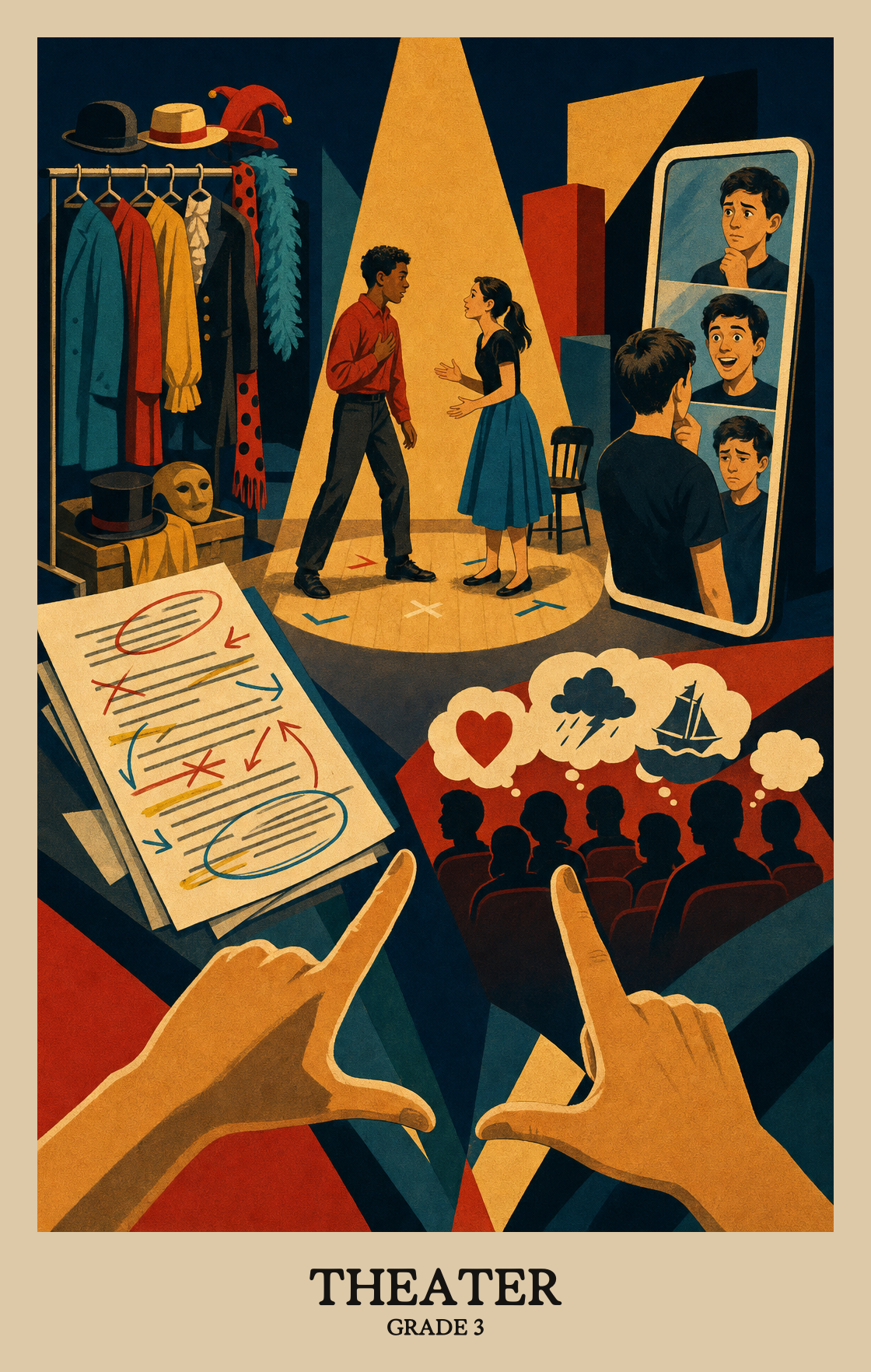
Students start the year by inventing characters and short story ideas for the stage. They pull from books they have read and moments from their own lives to spark the work.
Students work in small groups to shape their ideas into short scenes. They decide who the characters are, where the story happens, and what changes from the start of the scene to the end.
Students practice using their voice, face, and body to show what a character is feeling. They try out simple costumes, props, and stage spots to make the story clear to an audience.
Students polish a scene and perform it for classmates or family. They give feedback to other groups using simple questions about what worked and what the story was really about.
Students look at plays, shows, and stories from different cultures and time periods. They talk about why people tell these stories and what the stories say about the people who made them.
Students connect something from their own life to a scene or character they create, using what they know to make the story feel real.
Students look at a play or performance and ask where it came from. They connect what happens on stage to real events, traditions, or ways of life from a specific time or place.
| Standard | Definition | Code |
|---|---|---|
| Making art from what you know and feel | Students connect something from their own life to a scene or character they create, using what they know to make the story feel real. | TH:Cn10.3 |
| Theater and the world around us | Students look at a play or performance and ask where it came from. They connect what happens on stage to real events, traditions, or ways of life from a specific time or place. | TH:Cn11.3 |
Students brainstorm characters, settings, and story ideas they could turn into a short play or scene. They practice coming up with creative choices before any rehearsing begins.
Students take their ideas for a scene or character and shape them into something that can actually be performed. They make choices about what to keep, cut, or change until the piece works on stage.
Students look back at their script, puppet, or scene and make it better before sharing it. They decide what to fix, what to cut, and what to keep.
| Standard | Definition | Code |
|---|---|---|
| Invent ideas for a scene or play | Students brainstorm characters, settings, and story ideas they could turn into a short play or scene. They practice coming up with creative choices before any rehearsing begins. | TH:Cr1.3 |
| Turning ideas into a scene | Students take their ideas for a scene or character and shape them into something that can actually be performed. They make choices about what to keep, cut, or change until the piece works on stage. | TH:Cr2.3 |
| Finishing and polishing a scene | Students look back at their script, puppet, or scene and make it better before sharing it. They decide what to fix, what to cut, and what to keep. | TH:Cr3.3 |
Students pick a character or scene to perform and explain why it fits the story they want to tell.
Students practice a scene or monologue more than once, improving voice, movement, and timing so the final performance is ready for an audience.
Students perform a scene or character and make deliberate choices, like voice, movement, or expression, to help an audience understand the story's meaning.
| Standard | Definition | Code |
|---|---|---|
| Choosing a scene or story to perform | Students pick a character or scene to perform and explain why it fits the story they want to tell. | TH:Pr4.3 |
| Rehearse and improve a performance | Students practice a scene or monologue more than once, improving voice, movement, and timing so the final performance is ready for an audience. | TH:Pr5.3 |
| Perform a scene and mean it | Students perform a scene or character and make deliberate choices, like voice, movement, or expression, to help an audience understand the story's meaning. | TH:Pr6.3 |
Students look closely at a short play or scene and describe what they notice, like how a character moves, speaks, or reacts. Then they explain what those choices tell the audience about the story.
Students explain what they think a performer or character is feeling and why, using what they saw and heard in the play to back up their thinking.
Students look at a scene or performance and use a short checklist of questions to decide what works and what could improve.
| Standard | Definition | Code |
|---|---|---|
| Watching and thinking about a performance | Students look closely at a short play or scene and describe what they notice, like how a character moves, speaks, or reacts. Then they explain what those choices tell the audience about the story. | TH:Re7.3 |
| What a play is really saying | Students explain what they think a performer or character is feeling and why, using what they saw and heard in the play to back up their thinking. | TH:Re8.3 |
| How to judge a performance | Students look at a scene or performance and use a short checklist of questions to decide what works and what could improve. | TH:Re9.3 |
Students make up short scenes, take on characters, and act out stories. They also watch each other perform and talk about what worked. A lot of the work happens in small groups, and most of it is acted out on their feet rather than written down.
Ask students to act out a favorite scene from a book or movie, or to make up a short story with stuffed animals or puppets. Five minutes of pretend play counts. Watching a show together and talking about why a character made a choice is also great practice.
Not really at this age. Most scenes are made up on the spot or built from a simple plan, not a script. If students do learn a few lines for a class performance, short and steady practice at home is plenty.
No. Shy students can start by working in pairs, playing a small role, or helping with props and sound. Confidence usually builds across the year as students get used to trying ideas in front of classmates who are doing the same thing.
Start with pretend play, character work, and group trust before asking for polished scenes. Move into building short scenes with a clear beginning, middle, and end. Save sharing and feedback for later in each unit, once students have something they feel ready to show.
Staying in character when classmates laugh, and giving feedback that points at the work instead of the person. Plan to revisit both several times. Short warm-ups at the start of class are usually more effective than one long lesson.
Pick a story or historical moment students already know and have them act out a scene from a character's point of view. This pulls double duty: it deepens reading comprehension and gives students a ready-made situation to play. Classroom teachers are often happy to share what students are studying.
By spring, students should be able to build a short scene with a partner, stay in a character for a minute or two, and say something specific about a classmate's performance. Polished acting is not the goal. Willingness to try ideas and respond thoughtfully is.