Generating ideas for the stage
Students start the year by coming up with original ideas for scenes and characters. They draw from their own experiences and brainstorm with classmates to find stories worth telling.
This is the year theater moves from playing a role to shaping one. Students build characters with real choices behind them, drawing on their own lives and the world around the play. They rehearse with purpose, give each other honest notes, and rework scenes until the meaning comes through. By spring, students can perform a polished scene and explain why they made each acting choice.
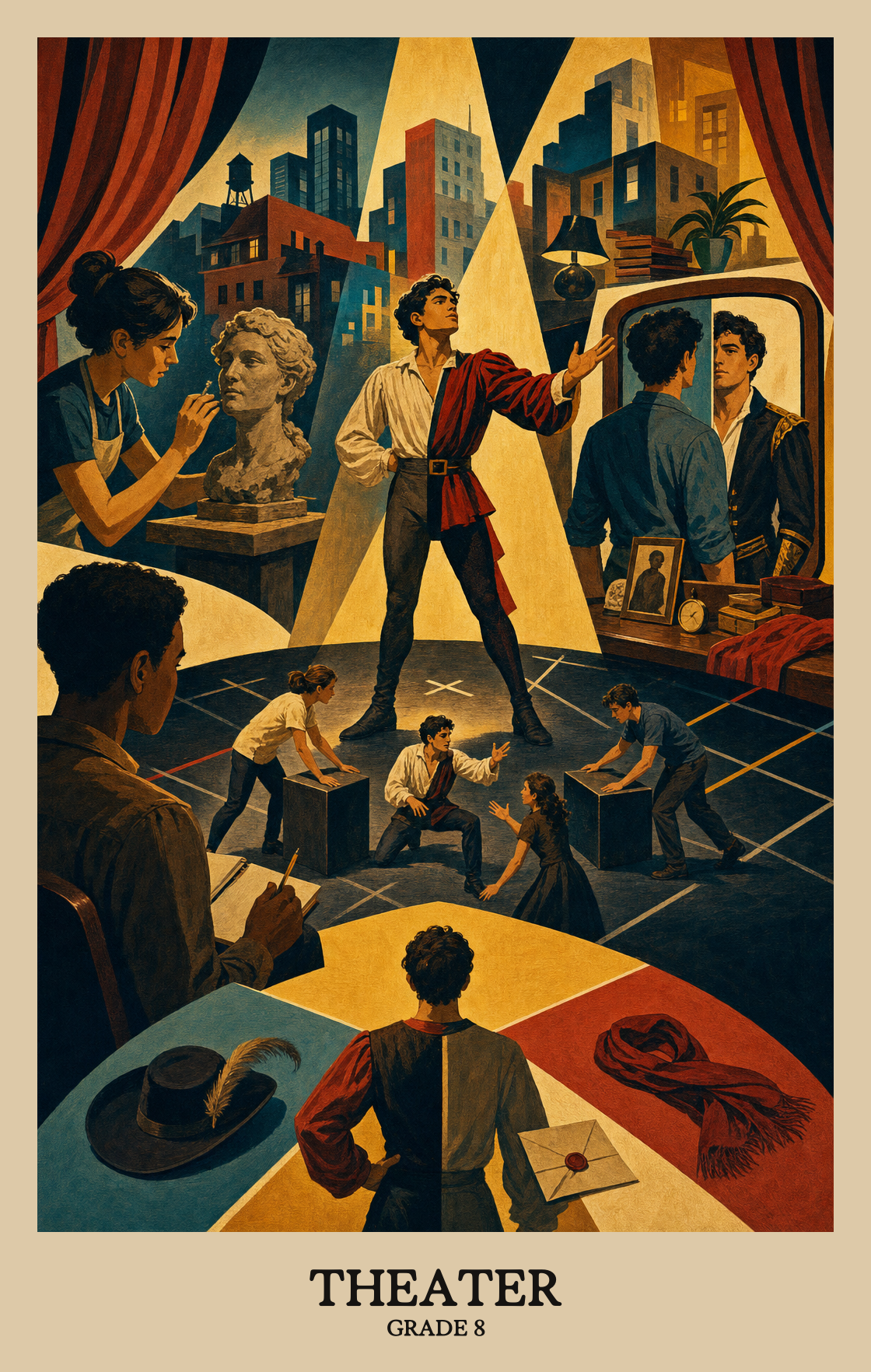
Students start the year by coming up with original ideas for scenes and characters. They draw from their own experiences and brainstorm with classmates to find stories worth telling.
Students shape rough ideas into full scenes. They develop characters, write or improvise dialogue, and make choices about what each moment should look like on stage.
Students rehearse, take notes, and rework parts that are not landing. They practice voice and movement techniques and polish their pieces for an audience.
Students present finished scenes or short plays. They make deliberate choices about how to deliver lines and movements so the meaning comes through clearly.
Students watch performances, including plays from other times and cultures, and talk about what the artists were trying to say. They use clear criteria to judge what worked and why.
Students draw on real memories, opinions, and outside subjects like history or literature to shape their theatrical choices. Personal experience becomes part of the performance.
Students look at a play or performance and explain how the time period, culture, or real-world events shaped it. Understanding the context behind a work helps students make sense of why it was made and what it meant to its audience.
| Standard | Definition | Code |
|---|---|---|
| Using life experience to make theater | Students draw on real memories, opinions, and outside subjects like history or literature to shape their theatrical choices. Personal experience becomes part of the performance. | CA-TH:Cn10.8.8 |
| Theater and its place in history | Students look at a play or performance and explain how the time period, culture, or real-world events shaped it. Understanding the context behind a work helps students make sense of why it was made and what it meant to its audience. | CA-TH:Cn11.8.8 |
Students brainstorm and develop original ideas for a theater piece, moving from a first spark of inspiration to a concept ready to shape into a scene or script.
Students take a theater idea from rough concept to a structured scene, making deliberate choices about character, dialogue, and staging that hold the piece together.
Students revisit a scene or script they drafted earlier, fix what isn't working, and shape it into a finished piece ready to perform or present.
| Standard | Definition | Code |
|---|---|---|
| Coming up with ideas for a scene or play | Students brainstorm and develop original ideas for a theater piece, moving from a first spark of inspiration to a concept ready to shape into a scene or script. | CA-TH:Cr1.8.8 |
| Develop and shape your theatrical ideas | Students take a theater idea from rough concept to a structured scene, making deliberate choices about character, dialogue, and staging that hold the piece together. | CA-TH:Cr2.8.8 |
| Finish and polish a scene | Students revisit a scene or script they drafted earlier, fix what isn't working, and shape it into a finished piece ready to perform or present. | CA-TH:Cr3.8.8 |
Students choose a scene or monologue to perform and explain why it fits their skills and the audience they're trying to reach.
Students rehearse a scene or monologue, then make specific improvements before performing it for an audience. The focus is on refining the actual craft: voice, movement, timing, and how the choices land on stage.
Students perform a scene or monologue with a clear intention, making choices about voice, movement, and timing so the audience understands what the character wants and feels.
| Standard | Definition | Code |
|---|---|---|
| Choosing and analyzing work to perform | Students choose a scene or monologue to perform and explain why it fits their skills and the audience they're trying to reach. | CA-TH:Pr4.8.8 |
| Refining a performance before the show | Students rehearse a scene or monologue, then make specific improvements before performing it for an audience. The focus is on refining the actual craft: voice, movement, timing, and how the choices land on stage. | CA-TH:Pr5.8.8 |
| Perform with intention and purpose | Students perform a scene or monologue with a clear intention, making choices about voice, movement, and timing so the audience understands what the character wants and feels. | CA-TH:Pr6.8.8 |
Students watch or read a scene and explain what specific choices (like an actor's movement or the set design) do to the meaning or mood of the whole piece.
Students explain what a scene, character, or design choice means and why the playwright or director likely made it. They connect those choices to the effect the work has on an audience.
Students use a set of standards or guidelines to judge a performance or production, explaining specifically why it works or falls short.
| Standard | Definition | Code |
|---|---|---|
| Reading theater to find the artist's choices | Students watch or read a scene and explain what specific choices (like an actor's movement or the set design) do to the meaning or mood of the whole piece. | CA-TH:Re7.8.8 |
| Reading what a performance is trying to say | Students explain what a scene, character, or design choice means and why the playwright or director likely made it. They connect those choices to the effect the work has on an audience. | CA-TH:Re8.8.8 |
| Judging what makes theater work | Students use a set of standards or guidelines to judge a performance or production, explaining specifically why it works or falls short. | CA-TH:Re9.8.8 |
Students build short scenes from their own ideas, rehearse with a group, and perform for an audience. They also watch plays and other performances, then talk and write about what worked and why. Expect a mix of making, performing, and responding all year.
Start small. Ask students to read a favorite book passage out loud with different voices, or act out a scene from a movie. Confidence grows when the audience is one trusted person on the couch, not a full classroom.
Yes, for most performance pieces. Short, regular practice works better than one long session. Five minutes after dinner, a few days in a row, will move lines into memory faster than an hour the night before.
Start with ensemble work and idea generation so students get comfortable creating together. Move into scene building and rehearsal in the middle of the year. Save formal performance and peer critique for later, once students trust each other and the process.
Students can take an idea from a rough concept to a rehearsed, performed scene. They can explain choices about character, staging, and meaning, and they can give specific feedback on a peer's work using shared criteria rather than just personal taste.
Theater asks students to read closely, interpret meaning, work in groups, and revise their work. Those are the same habits that show up in English, history, and group projects across every subject. The skills carry over even if students never perform again.
Giving useful feedback and revising based on it. Students often default to liked it or did not like it. Build in sentence stems tied to specific criteria, and model revision out loud so students see that a first attempt is supposed to change.
Through a mix of process and product. Rehearsal habits, written reflections, peer feedback, and the final performance all count. A student who struggles on stage can still show strong thinking through journals, design choices, or analysis of a play they watched.
They can read a short script, make choices about character and meaning, rehearse with a group, and perform without falling apart if something goes wrong. They can also watch a performance and say something specific about what the artists were trying to do.