Exploring how the body moves
Students try out different ways to move, like bending, stretching, twisting, and jumping. They notice how shapes and speeds feel different and start using their bodies as a tool for ideas.
This is the year dance becomes a way to tell short stories with the body. Students invent simple movement ideas, practice them, and shape them into a small piece they can share. They start to notice what a dance is about when they watch one, and use words like fast, slow, high, and low to describe it. By spring, they can perform a short dance with a clear beginning, middle, and end, and say what it means.
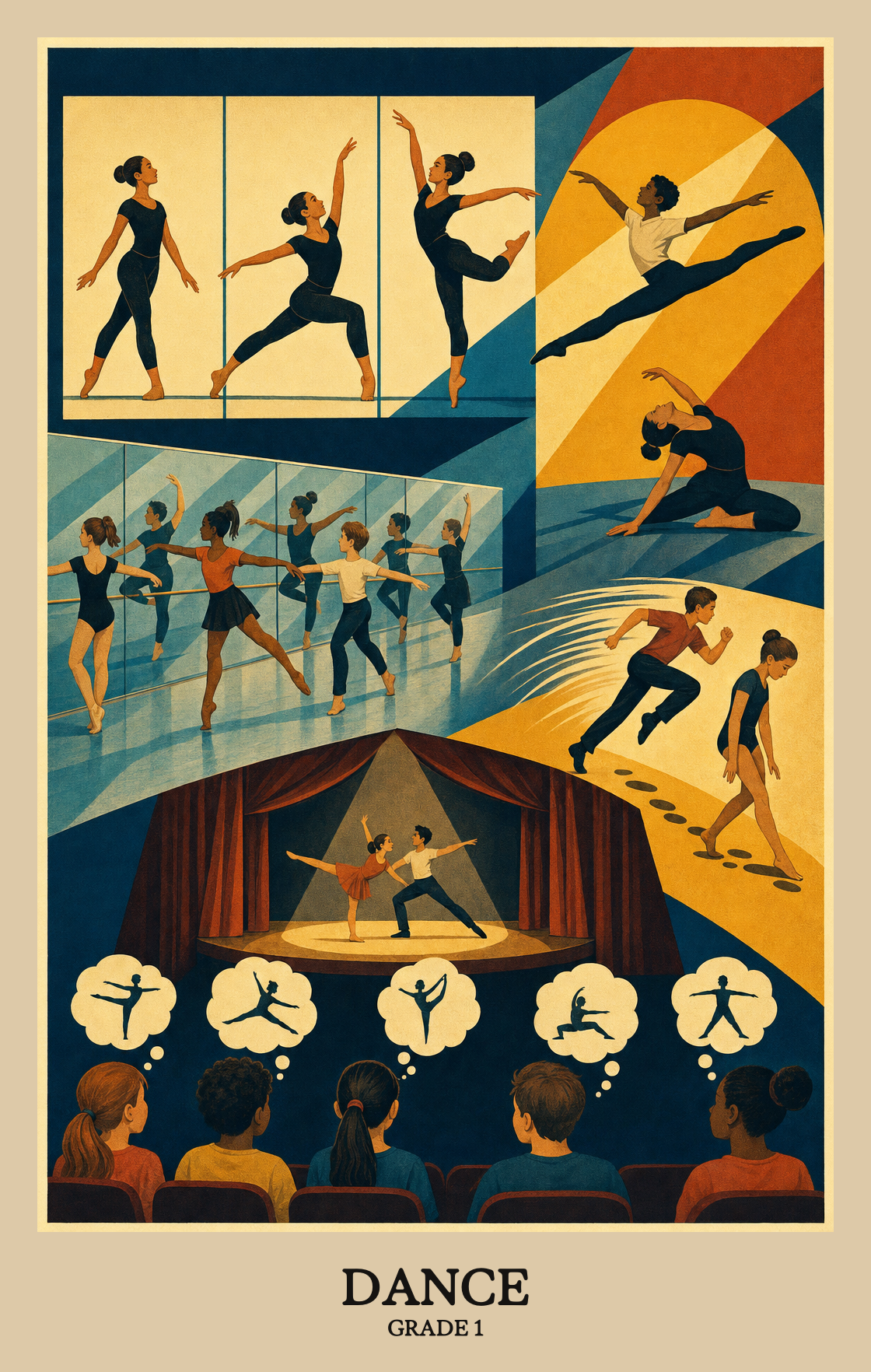
Students try out different ways to move, like bending, stretching, twisting, and jumping. They notice how shapes and speeds feel different and start using their bodies as a tool for ideas.
Students build simple dances from their own ideas. They pick movements on purpose, put them in an order, and practice the parts until the dance feels finished.
Students watch each other dance and watch dances from different places and times. They describe what they see and share what they think the dance is about.
Students rehearse and perform short dances for classmates or family. They work on staying focused, using space well, and showing the feeling behind the movement.
Students draw on things they have seen, felt, or done outside of school to shape their dancing. A memory, a feeling, or a moment from real life becomes the starting point for movement.
Students look at a dance and talk about where it comes from: the country, the people, or the time period behind it. Connecting a dance to its background helps students understand why it looks and feels the way it does.
| Standard | Definition | Code |
|---|---|---|
| Making dance from your own life | Students draw on things they have seen, felt, or done outside of school to shape their dancing. A memory, a feeling, or a moment from real life becomes the starting point for movement. | CA-DA:Cn10.1.1 |
| Dance from different times and places | Students look at a dance and talk about where it comes from: the country, the people, or the time period behind it. Connecting a dance to its background helps students understand why it looks and feels the way it does. | CA-DA:Cn11.1.1 |
Students come up with their own movement ideas and start turning them into a short dance. They explore how the body can move in different ways to express an idea or feeling.
Students choose movements that go together and arrange them into a short dance. They practice putting their ideas in order so the dance has a clear beginning and end.
Students revisit a short dance they made and improve it before sharing it with others.
| Standard | Definition | Code |
|---|---|---|
| Coming up with dance ideas | Students come up with their own movement ideas and start turning them into a short dance. They explore how the body can move in different ways to express an idea or feeling. | CA-DA:Cr1.1.1 |
| Making a dance from your own ideas | Students choose movements that go together and arrange them into a short dance. They practice putting their ideas in order so the dance has a clear beginning and end. | CA-DA:Cr2.1.1 |
| Finishing a dance you made | Students revisit a short dance they made and improve it before sharing it with others. | CA-DA:Cr3.1.1 |
Students choose a dance or movement to perform and think about why it fits what they want to show. They practice making that choice with purpose.
Students practice a dance move again and again until it looks the way they want it to, then get it ready to show an audience.
Students perform a dance for an audience and show what the movement is meant to express, whether that is a feeling, a story, or an idea.
| Standard | Definition | Code |
|---|---|---|
| Choosing dances to perform | Students choose a dance or movement to perform and think about why it fits what they want to show. They practice making that choice with purpose. | CA-DA:Pr4.1.1 |
| Moving and performing a dance | Students practice a dance move again and again until it looks the way they want it to, then get it ready to show an audience. | CA-DA:Pr5.1.1 |
| Show what a dance means to an audience | Students perform a dance for an audience and show what the movement is meant to express, whether that is a feeling, a story, or an idea. | CA-DA:Pr6.1.1 |
Students watch a dance and describe what they see, noticing how the dancer moves and what the movement makes them think or feel.
Students look at a dance and put into words what it makes them feel or what story they think it tells.
Students say what they liked about a dance and explain why, using simple words like "fast," "smooth," or "light." They start to understand that reasons make feedback more useful than just "good" or "bad."
| Standard | Definition | Code |
|---|---|---|
| Watching and thinking about a dance | Students watch a dance and describe what they see, noticing how the dancer moves and what the movement makes them think or feel. | CA-DA:Re7.1.1 |
| What a dance is trying to say | Students look at a dance and put into words what it makes them feel or what story they think it tells. | CA-DA:Re8.1.1 |
| Judging what makes a dance work | Students say what they liked about a dance and explain why, using simple words like "fast," "smooth," or "light." They start to understand that reasons make feedback more useful than just "good" or "bad." | CA-DA:Re9.1.1 |
Students explore moving in different ways: high and low, fast and slow, in straight lines or curves. They make up short dances based on ideas like animals, weather, or a favorite story. They also watch each other dance and talk about what they noticed.
Put on a song and ask students to show the music with their bodies. Try simple prompts like move like the wind, then like a rock. Five minutes of free movement in the living room builds the same body awareness they use in class.
Start side by side instead of face to face. Copy each other's moves, or take turns being the leader. Shyness usually fades once movement feels like a game rather than a performance, so keep it low pressure and skip the audience at first.
Begin with body parts and basic movements like bend, stretch, twist, and reach. Move into space and pathways, then add tempo and energy. By spring, students can combine these pieces into short made-up dances and talk about choices they made.
Students can make up a short dance with a clear beginning, middle, and end. They can perform it for classmates, watch others dance, and describe what they saw using simple movement words like fast, slow, smooth, or sharp.
Not at this age. The focus is on how the body moves, not on memorizing choreography. Students learn to control their movements, use the space around them, and connect movement to ideas and feelings.
Spatial awareness is the big one. Many students start the year bumping into classmates or sticking to one spot. Revisit personal space, pathways, and levels often, and pair movement with clear visual cues on the floor.
Students draw on stories, science topics, and their own experiences to create movement. A dance about the life cycle of a butterfly or a favorite picture book gives them a way to show understanding without writing or speaking.