Light and what we can see
Students explore how light helps us see objects. They test what happens when different materials block a beam of light, like cardboard, wax paper, or clear plastic.
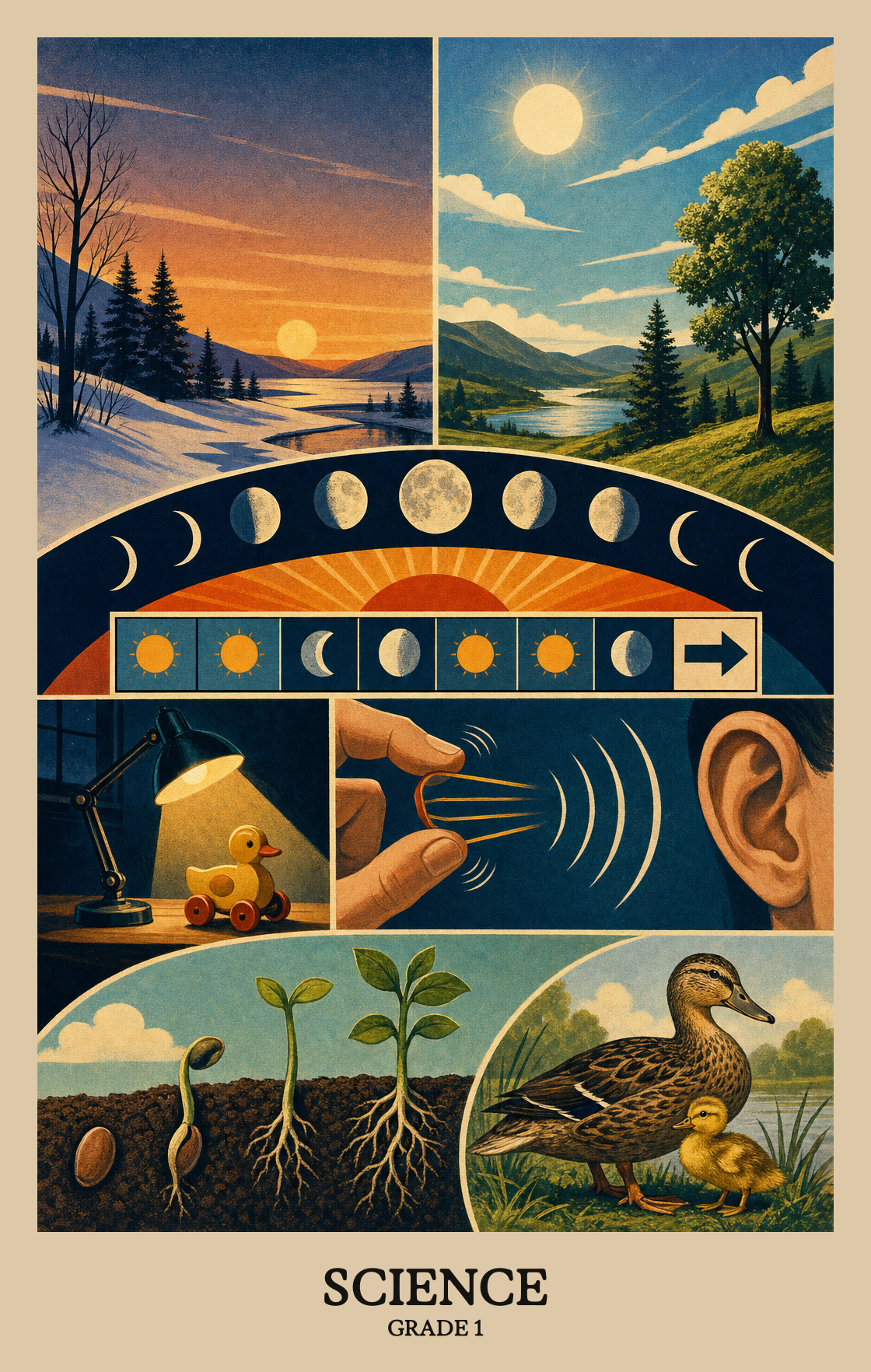
This is the year science becomes about patterns students can spot and test. Students watch the sun, moon, and stars to predict what comes next, and notice how daylight stretches and shrinks across the seasons. They run small experiments with sound and light, and study how baby plants and animals grow up resembling their parents. By spring, students can explain why a room needs light to see a toy and show how a plucked rubber band makes sound.
Students explore how light helps us see objects. They test what happens when different materials block a beam of light, like cardboard, wax paper, or clear plastic.
Students discover that sound comes from things that vibrate, and that sound can make other things vibrate back. They also design a simple tool that uses light or sound to send a message across the room.
Students look at how animals and plants use their parts to survive, like beaks, claws, leaves, and roots. They borrow ideas from nature to design a solution to an everyday problem.
Students notice patterns in how parents care for their babies and how baby animals act to stay safe and fed. They also see how young plants and animals look like their parents but are not identical.
Students watch the sun, moon, and stars to find patterns they can predict. They notice how daylight gets longer or shorter as the seasons change across the year.
Students watch the sun, moon, and stars and look for patterns in how they move and change. Those patterns repeat often enough that students can predict what comes next.
Students track how daylight changes through the year, noticing that summer days stay light longer and winter days get dark earlier.
| Standard | Definition | Code |
|---|---|---|
| Use observations of the sun, moon | Students watch the sun, moon, and stars and look for patterns in how they move and change. Those patterns repeat often enough that students can predict what comes next. | CA-1-ESS1-1.1 |
| Make observations at different times of year to relate the amount of daylight… | Students track how daylight changes through the year, noticing that summer days stay light longer and winter days get dark earlier. | CA-1-ESS1-2.1 |
Students look at how animals and plants use their body parts to survive, then use that idea to design something that solves a real human problem. A beaver's flat tail or a cactus spine becomes the starting point for their own invention.
Students look at books, videos, and pictures to find patterns in how parents and their young behave. The focus is on behaviors that help offspring survive, like a bird feeding its chicks or a cat teaching kittens to groom.
Young animals and plants resemble their parents but are not identical copies. Students observe and compare real living things to explain what traits get passed down and where the differences show up.
| Standard | Definition | Code |
|---|---|---|
| Use materials to design a solution to a human problem by mimicking how plants… | Students look at how animals and plants use their body parts to survive, then use that idea to design something that solves a real human problem. A beaver's flat tail or a cactus spine becomes the starting point for their own invention. | CA-1-LS1-1.1 |
| Read texts and use media to determine patterns in behavior of parents and… | Students look at books, videos, and pictures to find patterns in how parents and their young behave. The focus is on behaviors that help offspring survive, like a bird feeding its chicks or a cat teaching kittens to groom. | CA-1-LS1-2.1 |
| Make observations to construct an evidence-based account that young plants and… | Young animals and plants resemble their parents but are not identical copies. Students observe and compare real living things to explain what traits get passed down and where the differences show up. | CA-1-LS3-1.1 |
Students tap, shake, or pluck objects to discover that moving something back and forth fast makes sound, and that loud sound can make nearby objects shiver or shake.
Students learn that objects are visible only when light hits them. They observe what happens in a dark room versus a lit one, and use what they see to explain why light is needed to see anything at all.
Students shine a flashlight at objects made of different materials and watch what happens to the light. They find out which materials let light pass through, which block it, and which bend or scatter it.
Students build a simple device, like a flashlight signal or a small drum, that uses light or sound to send a message across a room or farther. The focus is on designing something that works, not just knowing how it works.
| Standard | Definition | Code |
|---|---|---|
| Plan and conduct investigations to provide evidence that vibrating materials… | Students tap, shake, or pluck objects to discover that moving something back and forth fast makes sound, and that loud sound can make nearby objects shiver or shake. | CA-1-PS4-1.1 |
| Make observations to construct an evidence-based account that objects can be… | Students learn that objects are visible only when light hits them. They observe what happens in a dark room versus a lit one, and use what they see to explain why light is needed to see anything at all. | CA-1-PS4-2.1 |
| Plan and conduct an investigation to determine the effect of placing objects… | Students shine a flashlight at objects made of different materials and watch what happens to the light. They find out which materials let light pass through, which block it, and which bend or scatter it. | CA-1-PS4-3.1 |
| Use tools and materials to design and build a device that uses light or sound… | Students build a simple device, like a flashlight signal or a small drum, that uses light or sound to send a message across a room or farther. The focus is on designing something that works, not just knowing how it works. | CA-1-PS4-4.1 |
The grade 5 science test in the CAASPP suite, based on the California Next Generation Science Standards. Online test covering Physical, Life, Earth and Space, and Engineering science.
The state science test for students with the most significant cognitive disabilities. Replaces the CAST in grades 5, 8, and once during high school for the small group of students whose IEP teams qualify them.
Students study light and sound, the sky and seasons, and how plants and animals survive. They watch the sun and moon, test how light passes through different materials, and look at how baby animals are like their parents. The work is mostly hands-on observation, not reading from a textbook.
Go outside together and notice things. Watch the moon over a week and draw what changes. Shine a flashlight through wax paper, foil, and a clear cup and talk about what happens. Five minutes of noticing and asking why is plenty.
Yes. Wondering out loud is the heart of first grade science. When a question comes up, try it instead of answering right away. Tap a bowl of water to see it ripple when something nearby makes a loud sound, or check the yard at the same time each evening to see when it gets dark.
Students should be able to describe patterns in the sky, explain that we need light to see objects, show that sound comes from things that vibrate, and give examples of how animals use body parts to survive. They should also notice that baby plants and animals look like their parents but are not identical.
Start with light and sound in the fall while students are still building observation habits, since the investigations are quick and concrete. Move to plants and animals in winter when offspring and survival behaviors are easier to read about. Save sky patterns and daylight for a year-long thread, with check-ins each season.
The idea that objects can only be seen when light hits them trips students up, because they assume eyes just work. The vibration-to-sound connection also needs repeated hands-on practice. Plan to revisit both with short investigations rather than one big lesson.
Most of it is hands-on. Students plan small investigations, build simple devices, and record what they observe. Reading and media come in mainly for animal behavior patterns, where firsthand observation is harder to set up in a classroom.
Students pick an animal or plant feature, like a duck's webbed foot or a cactus spine, and build something that copies the idea to solve a small problem. The build can be cardboard and tape. What matters is that students can explain which body part they copied and why.
Students are ready when they can ask a question, plan a simple way to test it, and describe what they noticed using evidence. They should be comfortable recording observations in pictures and short sentences, and willing to change their thinking when the evidence surprises them.