Finding ideas to move
Students start the year by turning their own experiences, stories, and observations into movement. Parents may see them sketching dance ideas at home or trying out shapes and gestures inspired by a memory or picture.
This is the year dance becomes thoughtful work, not just movement. Students shape their own short dances around an idea, then revise them based on feedback. They learn to perform with cleaner technique and clearer meaning, and to watch other dances and explain what the choreographer was trying to say. By spring, students can create a short dance with a clear beginning, middle, and end, perform it for an audience, and talk about what makes a dance work.
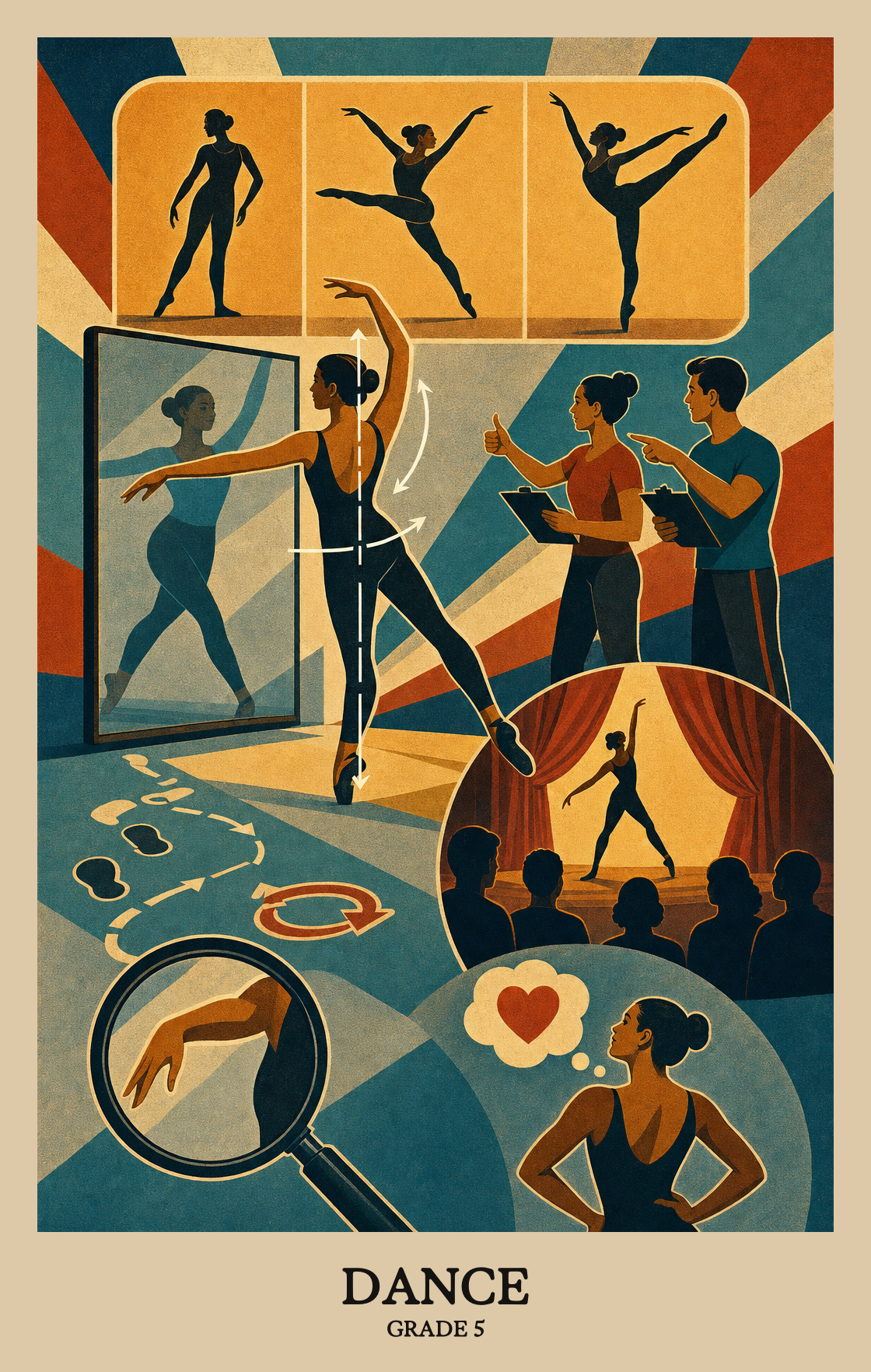
Students start the year by turning their own experiences, stories, and observations into movement. Parents may see them sketching dance ideas at home or trying out shapes and gestures inspired by a memory or picture.
Students shape rough ideas into real dances with a clear beginning, middle, and end. They practice choices like timing, levels, and pathways, then revise sections that feel unclear or rushed.
Students sharpen technique and rehearse dances they will show others. They focus on control, energy, and expression so the audience can feel what the dance is about, not just see the steps.
Students learn to watch dance carefully and talk about it with specific words. They share what a dance might mean, how it was put together, and what worked, using agreed-upon criteria instead of just liking or disliking it.
Students connect their own dances to dances from different places, communities, and time periods. They notice how movement carries history and ideas, and they use what they learn to enrich a final performance or project.
Students connect something from their own life to a dance they make or perform, using that personal experience to shape the movement and meaning of the piece.
Students look at a dance and ask where it came from, connecting the movement to a time period, a culture, or a historical event. That context helps explain why the dance looks and feels the way it does.
| Standard | Definition | Code |
|---|---|---|
| Using life experience to make dances | Students connect something from their own life to a dance they make or perform, using that personal experience to shape the movement and meaning of the piece. | DA:Cn10.5 |
| Dance and its cultural history | Students look at a dance and ask where it came from, connecting the movement to a time period, a culture, or a historical event. That context helps explain why the dance looks and feels the way it does. | DA:Cn11.5 |
Students brainstorm and develop original ideas for a dance, turning those ideas into a plan for movement they can actually perform.
Students take a dance idea and shape it into a full piece, choosing how movements fit together and deciding what to keep, change, or cut as the work grows.
Students revisit a dance they've been building, make specific changes to improve how it looks and feels, and bring it to a finished, shareable form.
| Standard | Definition | Code |
|---|---|---|
| Coming up with ideas for a dance | Students brainstorm and develop original ideas for a dance, turning those ideas into a plan for movement they can actually perform. | DA:Cr1.5 |
| Building a dance from your own ideas | Students take a dance idea and shape it into a full piece, choosing how movements fit together and deciding what to keep, change, or cut as the work grows. | DA:Cr2.5 |
| Finish and polish a dance | Students revisit a dance they've been building, make specific changes to improve how it looks and feels, and bring it to a finished, shareable form. | DA:Cr3.5 |
Students review dances they have created or learned, then choose which ones are ready to perform for an audience. They explain why a piece is worth presenting and what it communicates.
Students practice and improve a dance piece until it is ready to share with an audience. They focus on technique, such as timing and body control, and make changes based on feedback or their own observations.
Students perform a dance with a clear purpose, using movement choices to express a specific idea or feeling for an audience.
| Standard | Definition | Code |
|---|---|---|
| Choosing dances worth performing | Students review dances they have created or learned, then choose which ones are ready to perform for an audience. They explain why a piece is worth presenting and what it communicates. | DA:Pr4.5 |
| Refining a dance before performing it | Students practice and improve a dance piece until it is ready to share with an audience. They focus on technique, such as timing and body control, and make changes based on feedback or their own observations. | DA:Pr5.5 |
| Perform a dance that says something | Students perform a dance with a clear purpose, using movement choices to express a specific idea or feeling for an audience. | DA:Pr6.5 |
Students look at a dance performance and explain what they notice, describing how the movement choices create meaning or mood.
Students watch or perform a dance and explain what the choreographer was trying to say. They look for clues in the movement, timing, and shape of the piece to back up their thinking.
Students use a set of criteria, like technique or expression, to judge a dance and explain what makes it effective or where it falls short.
| Standard | Definition | Code |
|---|---|---|
| Analyzing a dance performance | Students look at a dance performance and explain what they notice, describing how the movement choices create meaning or mood. | DA:Re7.5 |
| Reading meaning in a dance performance | Students watch or perform a dance and explain what the choreographer was trying to say. They look for clues in the movement, timing, and shape of the piece to back up their thinking. | DA:Re8.5 |
| Judging what makes a dance work | Students use a set of criteria, like technique or expression, to judge a dance and explain what makes it effective or where it falls short. | DA:Re9.5 |
Students move beyond copying steps and start making their own short dances. They pull ideas from stories, feelings, and things they have seen, then shape those ideas into movement they can perform and talk about.
Clear a small space and play a song students like. Ask them to show a movement that matches the mood, then a different one that contrasts it. Five minutes of moving and talking about why they chose those shapes goes a long way.
No. Most of the work at this level is about making thoughtful choices, not technical training. Students who watch dance, try movements at home, and talk about what they see will do well.
Start with exploring movement and generating ideas, then move into shaping and refining short pieces. Save performance and peer feedback for the back half of the year, once students have language for what they are watching.
Refining work tends to be the hardest part. Students often want to call a first draft finished. Build in short revision cycles where they change one thing, such as timing or level, and notice what shifts.
Students look at where a dance comes from and what it meant to the people who made it. Watching a short clip of a folk dance or a historical piece and asking what story it tells is a good way to practice this at home or in class.
By the end of the year, students should be able to create a short dance with a clear idea behind it, perform it with control, and give specific feedback on a classmate's piece using shared criteria.
Ask what the dance seemed to be about and which movements gave that away. Questions about repeated shapes, fast and slow moments, or how dancers used the space help students practice the same thinking they use in class.