Building characters and stories
Students start the year by inventing characters and short scenes from their own lives, books, and imaginations. Parents may hear kids talking about a character they made up and what that character wants.
This is the year theater work becomes more deliberate. Students pull from their own lives and from history to shape characters and stories, then revise their choices instead of going with the first idea. They rehearse with real techniques for voice and movement, and they learn to give honest feedback using clear reasons. By spring, students can plan, rehearse, and perform a short scene, then explain why they made the choices they made.
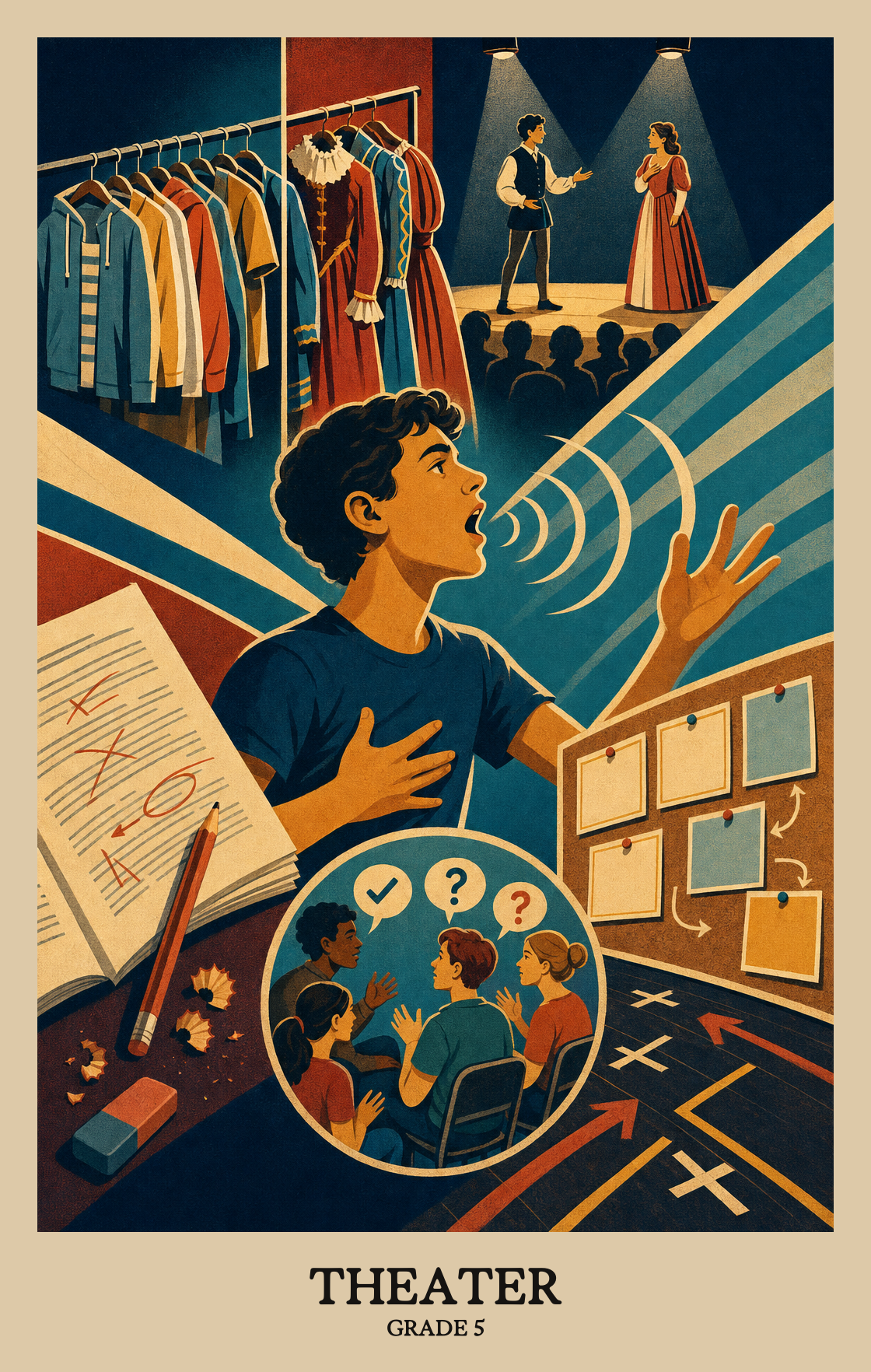
Students start the year by inventing characters and short scenes from their own lives, books, and imaginations. Parents may hear kids talking about a character they made up and what that character wants.
Students work in small groups to turn their ideas into scenes with a clear beginning, middle, and end. They try out different choices, give each other feedback, and revise the script or staging.
Students practice voice, movement, and timing to bring a scene to an audience. They pick which pieces to share and rehearse to make the meaning clear for the people watching.
Students watch plays and classmate performances and talk about what worked and why. They connect what they see on stage to history, culture, and their own experiences.
Students connect something from their own life to a character or story they're performing. That personal connection shapes the choices they make on stage.
Students look at a play or performance and connect it to the time period, culture, or community it came from. That context helps explain why the story was told and what it meant to the people who first saw it.
| Standard | Definition | Code |
|---|---|---|
| Using life experiences to make theater | Students connect something from their own life to a character or story they're performing. That personal connection shapes the choices they make on stage. | TH:Cn10.5 |
| Theater across time and culture | Students look at a play or performance and connect it to the time period, culture, or community it came from. That context helps explain why the story was told and what it meant to the people who first saw it. | TH:Cn11.5 |
Students brainstorm original ideas for a scene or performance, then shape those ideas into a plan they can actually use on stage.
Students take a theater idea, such as a character or scene, and shape it into something ready to perform. They make choices about what to say, how to move, and how the story fits together.
Students revise a scene or script based on feedback, then bring it to a finished, performable state.
| Standard | Definition | Code |
|---|---|---|
| Coming up with ideas for a scene | Students brainstorm original ideas for a scene or performance, then shape those ideas into a plan they can actually use on stage. | TH:Cr1.5 |
| Develop an original theater idea | Students take a theater idea, such as a character or scene, and shape it into something ready to perform. They make choices about what to say, how to move, and how the story fits together. | TH:Cr2.5 |
| Finishing and polishing a scene | Students revise a scene or script based on feedback, then bring it to a finished, performable state. | TH:Cr3.5 |
Students choose a scene or character to perform and explain why it fits the story and their own strengths as a performer.
Students rehearse a scene, take feedback, and make it better before performing for an audience. The focus is on practicing the craft, not just running lines.
Students rehearse and perform a scene with purpose, using voice, movement, and expression to make sure the audience understands the story or idea behind it.
| Standard | Definition | Code |
|---|---|---|
| Choosing the right play to perform | Students choose a scene or character to perform and explain why it fits the story and their own strengths as a performer. | TH:Pr4.5 |
| Rehearse and refine a scene for performance | Students rehearse a scene, take feedback, and make it better before performing for an audience. The focus is on practicing the craft, not just running lines. | TH:Pr5.5 |
| Perform a scene with purpose | Students rehearse and perform a scene with purpose, using voice, movement, and expression to make sure the audience understands the story or idea behind it. | TH:Pr6.5 |
Students watch a scene or performance and explain what choices the playwright or actor made, and why those choices affect how the story feels to an audience.
Students explain what a scene, character, or design choice is meant to say and why the playwright or director made that choice.
Students choose what makes a performance good (strong voice, clear movement, believable emotion) and use those reasons to judge what they watch or create.
| Standard | Definition | Code |
|---|---|---|
| Reading a play with a critical eye | Students watch a scene or performance and explain what choices the playwright or actor made, and why those choices affect how the story feels to an audience. | TH:Re7.5 |
| Reading what a play is really saying | Students explain what a scene, character, or design choice is meant to say and why the playwright or director made that choice. | TH:Re8.5 |
| How to judge a performance | Students choose what makes a performance good (strong voice, clear movement, believable emotion) and use those reasons to judge what they watch or create. | TH:Re9.5 |
Students invent characters and short scenes, then rehearse and perform them for classmates. They also watch plays or recorded performances and talk about what worked and why. The year moves through three big areas: making theater, performing it, and responding to it.
Start small. Read a picture book together and ask students to say one character's lines in that character's voice. Charades, puppet shows with stuffed animals, and acting out a favorite scene from a movie all build the same muscles without putting students on a stage.
Sometimes, but not always. By this grade, students often memorize short scenes or monologues for a class performance. Practicing five to ten minutes a night, with someone reading the other parts, is usually enough.
Most teachers start with short improv and character work in the fall, move into scene building and rehearsal in the winter, and finish with a performance project in the spring. Responding work, such as watching and discussing performances, runs alongside all three.
Students can build a believable character with specific choices about voice, body, and motivation. They can rehearse a scene, take a note, and try it again. They can also watch a performance and explain what the artists were trying to say.
Theater this year is not just acting. Students look at where a story comes from, who wrote it, and what was happening in the world at the time. This helps them understand why characters behave the way they do and gives their own performances more depth.
Giving and receiving feedback is the hardest part. Students often want to say a scene was good or bad instead of pointing to specific choices. Building a simple set of criteria early, and using it every time the class watches work, pays off all year.
Students should be able to read a short script, make choices about how to play a character, and rehearse with a small group without an adult running every minute. They should also be comfortable talking about a performance using specific examples from what they saw.