Mapping the Western Hemisphere
Students start the year getting to know the lands and waters from Canada down to the tip of South America. They use maps and photos to find places, compare regions, and notice what makes each one different.
This is the year the map widens beyond the United States to the whole Western Hemisphere. Students look at the people, places, and cultures of North, Central, and South America and the Caribbean, and trace how geography shaped their history. They start weighing evidence, spotting cause and effect, and noticing different sides of the same event. By spring, students can use a map and a timeline to explain how one country in the Americas changed over time.
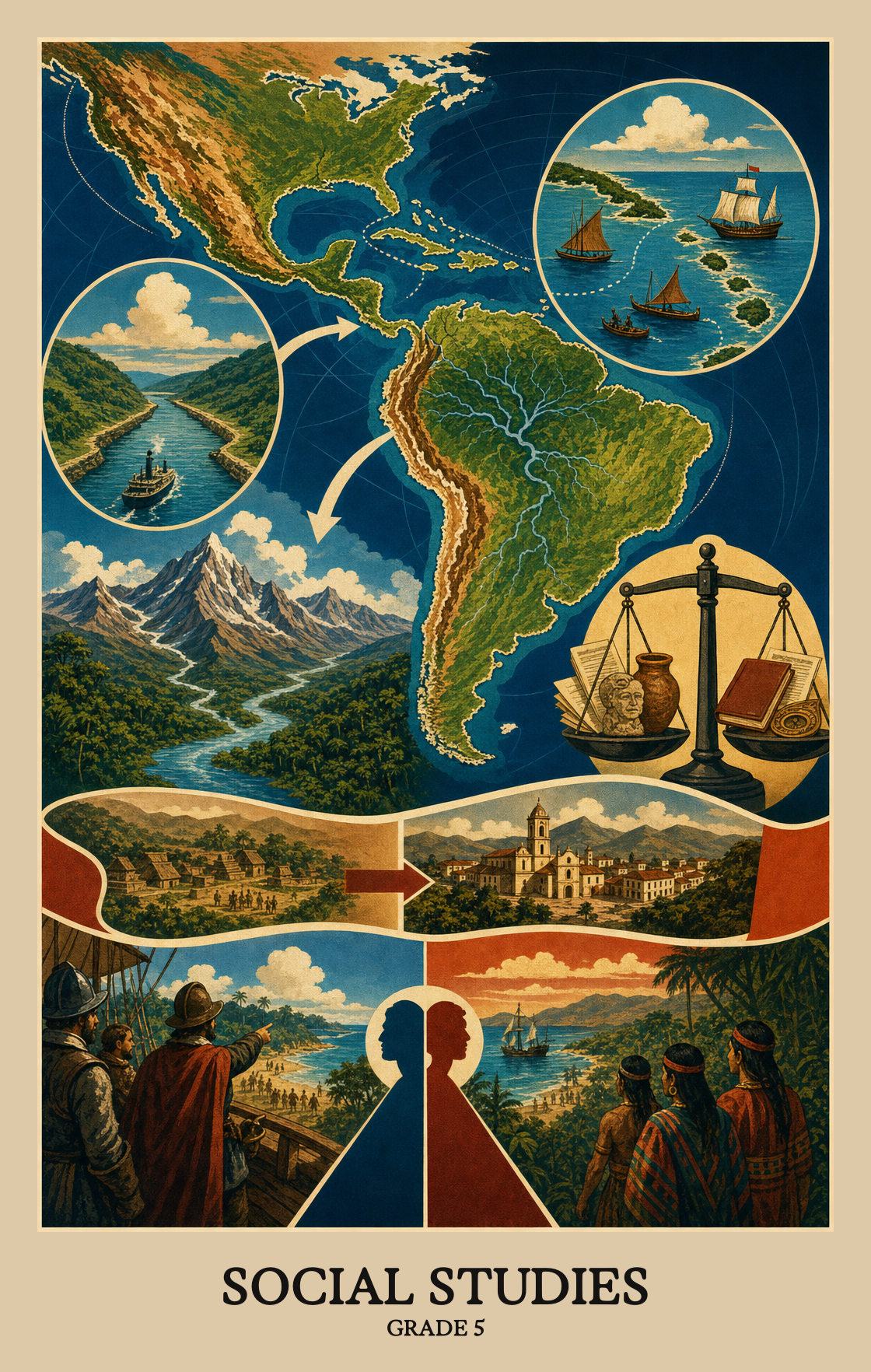
Students start the year getting to know the lands and waters from Canada down to the tip of South America. They use maps and photos to find places, compare regions, and notice what makes each one different.
Students learn about the first groups who lived across the Americas, from large empires to smaller communities. They look at how the land shaped daily life and how people used the resources around them.
Students follow what happened when people from Europe, Africa, and the Americas met. They sort out causes and effects, weigh different points of view, and see how one event can ripple out for years.
Students look at how countries in the hemisphere are run and how their economies work. They compare trading with money to trading goods directly, and talk about jobs, prices, and choices people make when resources are limited.
Students wrap up the year by looking at rights, responsibilities, and how neighbors across the hemisphere depend on each other. They practice listening to other views, working through disagreements, and suggesting fixes for real problems.
Students come up with their own questions about events in the Americas, then hunt for evidence to answer them. It's the starting point for thinking like a historian.
Students learn to tell the difference between firsthand sources (a letter written by a soldier, a photograph from the time) and secondhand sources (a textbook summary) and choose the right one to back up a historical claim.
Students look at a source, such as a map, article, or photograph, and ask who made it, why, and who it was made for. With teacher help, they also spot bias and explain how it might shape what the source says.
Students read or listen to someone's position on a topic and pick out the main point that person is trying to prove, along with the reasons they give to support it.
Students read between the lines of a source, using clues in the text to figure out what the author means but doesn't say directly. They get some guidance to help them form that conclusion.
Students read a source and spot the main argument the author is making, then point to the specific details or facts the author uses to back it up.
Students put historical events in order and explain how one event connects to, or leads to, another.
Students use math to measure spans of time in years and centuries, and learn the difference between dates before and after year one. They also read timelines to figure out when events happened and how far apart they were.
Students look at a historical event or news story and explain what led up to it and what happened as a result. This is the building block of understanding how one event sets off another.
Students look at a historical event and trace what caused it and what it led to, recognizing that most events have more than one cause and more than one result.
Students look at a historical or current event and separate the deep, slow-building causes from the immediate trigger that set things off. They do the same for effects, sorting out what happened right away from what unfolded over years.
Students look at how life stayed the same or shifted across different eras, then pinpoint the moments when things changed direction. Think of it as finding the forks in the road of history.
Students sort historical events into decades or centuries, then compare what was happening in different parts of the Western Hemisphere at the same time using a timeline.
Students look at events across time and notice what stayed the same and what shifted. They use those patterns to make sense of why history unfolded the way it did.
Historians divide the past into named chunks of time (like "ancient" or "colonial") to make long stretches of history easier to study and compare. Students learn why those dividing lines exist and how they help make sense of change over time.
Students pick a region in the Western Hemisphere, name one thing its places share (like climate or language), and explain how that makes it different from a neighboring region.
Students look at one historical event and sort out the different viewpoints people held about it. They explain why people on different sides saw the same moment differently.
Students look at two events from different places in the Western Hemisphere that happened around the same time and explain what those events had in common and how they differed.
Students learn to connect where people lived, how they traded, and what came before to explain why historical events in the Western Hemisphere happened the way they did.
Students place historical events in context by explaining when and where something happened and how it connects to larger changes happening across the Western Hemisphere at the same time. Teachers guide the process.
Maps, photos, and satellite images help students locate and compare places across North and South America. Students use these tools to explain why certain locations work better for things like farming, trade, or travel.
Students sort the world into two categories: things nature made (mountains, rivers, weather) and things people built or changed (roads, farms, cities). They apply this thinking to places across North and South America.
Students look at real cases across the Western Hemisphere to explain how a place's geography shapes what people do there, and how people's actions change the land, water, and climate around them.
Students look at what makes a region distinct (its landforms, economy, and culture) and explain how those features shaped what happened there over time.
Students explain how farming, building cities, cutting forests, or other human choices change what a place looks like and how it functions. The focus is on real examples from North and South America.
Maps and borders are not permanent facts. Students learn that people drew boundary lines at specific moments in history, and those lines have shifted as power, politics, and land ownership changed over time.
Scarcity means there is never enough of everything people want. Students explain how that gap forces choices, using real examples from North and South America to show how scarcity has shaped decisions in the past and today.
Students sort real-world examples of resources into three groups: the people who do the work, the tools and buildings used, and the raw materials from nature. Together, those three groups explain how any good or service gets made.
Trading without money means haggling over every swap. Students compare barter systems to currency-based economies to see why coins and bills simplify buying and selling, then look at why corporations and unions both shape how a market economy works.
Students look at why people in different regions learned to do specific jobs and trade with each other, and how that pattern still shapes economies across North and South America today.
Students learn what four key economic terms mean in real life: why prices rise over time, what it means when people cannot find work, how income is earned, and what it looks like when an economy grows.
Students look at real examples from North and South America to explain how a government decision, like setting a tax or trade rule, changed the way people in that country earned and spent money.
Students practice disagreeing politely in class discussions. They listen to views they don't agree with and think about why someone else might see things differently.
Students pick a real problem in a country like Canada, Mexico, or Brazil and take some kind of action on it, such as writing a letter, organizing a discussion, or presenting a solution to classmates.
Students learn how governments in North and South America have been organized across history, from empires and monarchies to democracies, and who held power in each one.
Students look at how ordinary people outside the United States have taken part in elections, protests, or community decisions across the Western Hemisphere, both today and in the past.
Students practice working out disagreements by finding middle ground. They learn to give a little and take a little so a group can move forward together.
Students look at a real-world problem that crosses country borders, such as pollution or hunger, and think through what people or governments could do to help.
Students learn who holds power in countries across the Western Hemisphere and what those leaders actually do. They look at how a president, governor, or other official can expand or limit people's rights.
Students learn what rights people have in different countries across North and South America, and what responsibilities come with those rights. This includes things like voting, following laws, and taking part in community life.
Students examine how people in Western Hemisphere communities depend on each other to get things done. They look at how one group's work, decisions, or resources affect everyone else nearby.
| Standard | Definition | Code |
|---|---|---|
| Asking questions to find historical evidence | Students come up with their own questions about events in the Americas, then hunt for evidence to answer them. It's the starting point for thinking like a historian. | NY-SS.5.A.1 |
| Primary vs. secondary sources | Students learn to tell the difference between firsthand sources (a letter written by a soldier, a photograph from the time) and secondhand sources (a textbook summary) and choose the right one to back up a historical claim. | NY-SS.5.A.2 |
| Spotting bias in sources | Students look at a source, such as a map, article, or photograph, and ask who made it, why, and who it was made for. With teacher help, they also spot bias and explain how it might shape what the source says. | NY-SS.5.A.3 |
| Spot someone else's argument | Students read or listen to someone's position on a topic and pick out the main point that person is trying to prove, along with the reasons they give to support it. | NY-SS.5.A.4 |
| Reading between the lines with help | Students read between the lines of a source, using clues in the text to figure out what the author means but doesn't say directly. They get some guidance to help them form that conclusion. | NY-SS.5.A.5 |
| Spot an argument and its evidence | Students read a source and spot the main argument the author is making, then point to the specific details or facts the author uses to back it up. | NY-SS.5.A.6 |
| Putting events in time order | Students put historical events in order and explain how one event connects to, or leads to, another. | NY-SS.5.B.1 |
| Measuring time: years, centuries, BCE, and CE | Students use math to measure spans of time in years and centuries, and learn the difference between dates before and after year one. They also read timelines to figure out when events happened and how far apart they were. | NY-SS.5.B.2 |
| Causes and effects in history and current events | Students look at a historical event or news story and explain what led up to it and what happened as a result. This is the building block of understanding how one event sets off another. | NY-SS.5.B.3 |
| Causes and effects in history | Students look at a historical event and trace what caused it and what it led to, recognizing that most events have more than one cause and more than one result. | NY-SS.5.B.4 |
| Causes and effects: short-term vs. long-term | Students look at a historical or current event and separate the deep, slow-building causes from the immediate trigger that set things off. They do the same for effects, sorting out what happened right away from what unfolded over years. | NY-SS.5.B.5 |
| How history changes and stays the same | Students look at how life stayed the same or shifted across different eras, then pinpoint the moments when things changed direction. Think of it as finding the forks in the road of history. | NY-SS.5.B.6 |
| Organizing history with timelines and time periods | Students sort historical events into decades or centuries, then compare what was happening in different parts of the Western Hemisphere at the same time using a timeline. | NY-SS.5.B.7 |
| Spotting patterns of change in history | Students look at events across time and notice what stayed the same and what shifted. They use those patterns to make sense of why history unfolded the way it did. | NY-SS.5.B.8 |
| How historians divide time into periods | Historians divide the past into named chunks of time (like "ancient" or "colonial") to make long stretches of history easier to study and compare. Students learn why those dividing lines exist and how they help make sense of change over time. | NY-SS.5.B.9 |
| Comparing regions by shared characteristics | Students pick a region in the Western Hemisphere, name one thing its places share (like climate or language), and explain how that makes it different from a neighboring region. | NY-SS.5.C.1 |
| Different views of one historical event | Students look at one historical event and sort out the different viewpoints people held about it. They explain why people on different sides saw the same moment differently. | NY-SS.5.C.2 |
| Comparing events across the Western Hemisphere | Students look at two events from different places in the Western Hemisphere that happened around the same time and explain what those events had in common and how they differed. | NY-SS.5.C.3 |
| How place and money shaped history | Students learn to connect where people lived, how they traded, and what came before to explain why historical events in the Western Hemisphere happened the way they did. | NY-SS.5.C.4 |
| Placing events in time, place, and context | Students place historical events in context by explaining when and where something happened and how it connects to larger changes happening across the Western Hemisphere at the same time. Teachers guide the process. | NY-SS.5.C.5 |
| Reading maps of the Western Hemisphere | Maps, photos, and satellite images help students locate and compare places across North and South America. Students use these tools to explain why certain locations work better for things like farming, trade, or travel. | NY-SS.5.D.1 |
| Human vs. natural features in the Western Hemisphere | Students sort the world into two categories: things nature made (mountains, rivers, weather) and things people built or changed (roads, farms, cities). They apply this thinking to places across North and South America. | NY-SS.5.D.2 |
| How environments and humans shape each other | Students look at real cases across the Western Hemisphere to explain how a place's geography shapes what people do there, and how people's actions change the land, water, and climate around them. | NY-SS.5.D.3 |
| How regions shape a society's history | Students look at what makes a region distinct (its landforms, economy, and culture) and explain how those features shaped what happened there over time. | NY-SS.5.D.4 |
| How humans change places around them | Students explain how farming, building cities, cutting forests, or other human choices change what a place looks like and how it functions. The focus is on real examples from North and South America. | NY-SS.5.D.5 |
| Where borders come from | Maps and borders are not permanent facts. Students learn that people drew boundary lines at specific moments in history, and those lines have shifted as power, politics, and land ownership changed over time. | NY-SS.5.D.6 |
| Scarcity and tough choices in the Americas | Scarcity means there is never enough of everything people want. Students explain how that gap forces choices, using real examples from North and South America to show how scarcity has shaped decisions in the past and today. | NY-SS.5.E.1 |
| Resources that make goods and services happen | Students sort real-world examples of resources into three groups: the people who do the work, the tools and buildings used, and the raw materials from nature. Together, those three groups explain how any good or service gets made. | NY-SS.5.E.2 |
| Why currency beats barter | Trading without money means haggling over every swap. Students compare barter systems to currency-based economies to see why coins and bills simplify buying and selling, then look at why corporations and unions both shape how a market economy works. | NY-SS.5.E.3 |
| Job specialization and trade in the Western Hemisphere | Students look at why people in different regions learned to do specific jobs and trade with each other, and how that pattern still shapes economies across North and South America today. | NY-SS.5.E.4 |
| Unemployment, inflation, and economic growth explained | Students learn what four key economic terms mean in real life: why prices rise over time, what it means when people cannot find work, how income is earned, and what it looks like when an economy grows. | NY-SS.5.E.5 |
| How government decisions shape economies | Students look at real examples from North and South America to explain how a government decision, like setting a tax or trade rule, changed the way people in that country earned and spent money. | NY-SS.5.E.6 |
| Respecting other views in class debates | Students practice disagreeing politely in class discussions. They listen to views they don't agree with and think about why someone else might see things differently. | NY-SS.5.F.1 |
| Solve a real problem in another country | Students pick a real problem in a country like Canada, Mexico, or Brazil and take some kind of action on it, such as writing a letter, organizing a discussion, or presenting a solution to classmates. | NY-SS.5.F.2 |
| Political systems of the Western Hemisphere | Students learn how governments in North and South America have been organized across history, from empires and monarchies to democracies, and who held power in each one. | NY-SS.5.F.3 |
| Civic participation beyond the U.S | Students look at how ordinary people outside the United States have taken part in elections, protests, or community decisions across the Western Hemisphere, both today and in the past. | NY-SS.5.F.4 |
| Resolving disagreements through compromise | Students practice working out disagreements by finding middle ground. They learn to give a little and take a little so a group can move forward together. | NY-SS.5.F.5 |
| Global problems that need our action | Students look at a real-world problem that crosses country borders, such as pollution or hunger, and think through what people or governments could do to help. | NY-SS.5.F.6 |
| How leaders shape rights and freedom | Students learn who holds power in countries across the Western Hemisphere and what those leaders actually do. They look at how a president, governor, or other official can expand or limit people's rights. | NY-SS.5.F.7 |
| Rights and responsibilities of citizens | Students learn what rights people have in different countries across North and South America, and what responsibilities come with those rights. This includes things like voting, following laws, and taking part in community life. | NY-SS.5.F.8 |
| Communities depend on each other | Students examine how people in Western Hemisphere communities depend on each other to get things done. They look at how one group's work, decisions, or resources affect everyone else nearby. | NY-SS.5.F.9 |
The end-of-course exam students take after the second year of high school global history, usually in grade 10. Counts toward the social studies credits Regents diplomas require.
Students study the Western Hemisphere, which means the Americas: North America, Central America, South America, and the Caribbean. They look at the people, places, and events that shaped these regions, from early civilizations to today. Geography, economics, and government all come into the conversation.
Pull out a map of the Americas at dinner and ask students to find a country in the news. Five minutes of looking at where a story is happening, and why it might matter, goes a long way. Library books about explorers, civilizations, or current events also help.
By June, students can place events on a timeline using centuries and B.C.E. or C.E., read a map to describe where a place is, and explain how geography shapes how people live. They can also point to evidence in a source and notice when an author has a particular point of view.
Most teachers move roughly chronologically: early peoples of the Americas, encounters and colonization, independence movements, and modern nations. Geography and economics threads run through each unit rather than sitting as separate chapters. Build in time for current events so students can practice the same thinking on today's news.
Ask three questions: who made this, when, and why. Then ask what the source shows and what it leaves out. That short routine works for a photograph, a map, or a paragraph from a textbook, and it builds the habit students need for bigger sources later.
Cause and effect with more than one cause, and bias in sources. Students can name a single cause for an event but struggle to hold long-term and immediate causes side by side. Plan extra practice with primary sources where the author's purpose is clear, then move to harder ones.
Less than parents might remember from their own school years. Students should know major periods and turning points, but the focus is on explaining why events happened and how they connect. Knowing a date matters mostly so students can put events in order.
Students practice listening to a different view, asking a follow-up question, and disagreeing without shutting down. Build short structured debates into units on government, economics, and historical decisions. The habit transfers to writing, where students have to weigh more than one perspective.
Sixth grade builds on this year by moving into the Eastern Hemisphere with the same thinking skills. Students who can read a map, use a timeline, and back up an opinion with evidence from a source are ready. Keep practicing those three habits in any subject.