Matter and its properties
Students explore what everything is made of. They sort materials by properties like hardness and whether they dissolve, and learn that matter is made of particles too tiny to see.
This is the year science zooms out to systems, from a single plant to the whole planet. Students learn that matter is made of tiny particles too small to see, and that the amount of matter stays the same even when things melt, mix, or cool. They trace energy from the Sun into plants, then into the animals that eat them. By spring, students can draw a model showing how air, water, land, and living things connect, and explain why stars look dim even when they are huge.
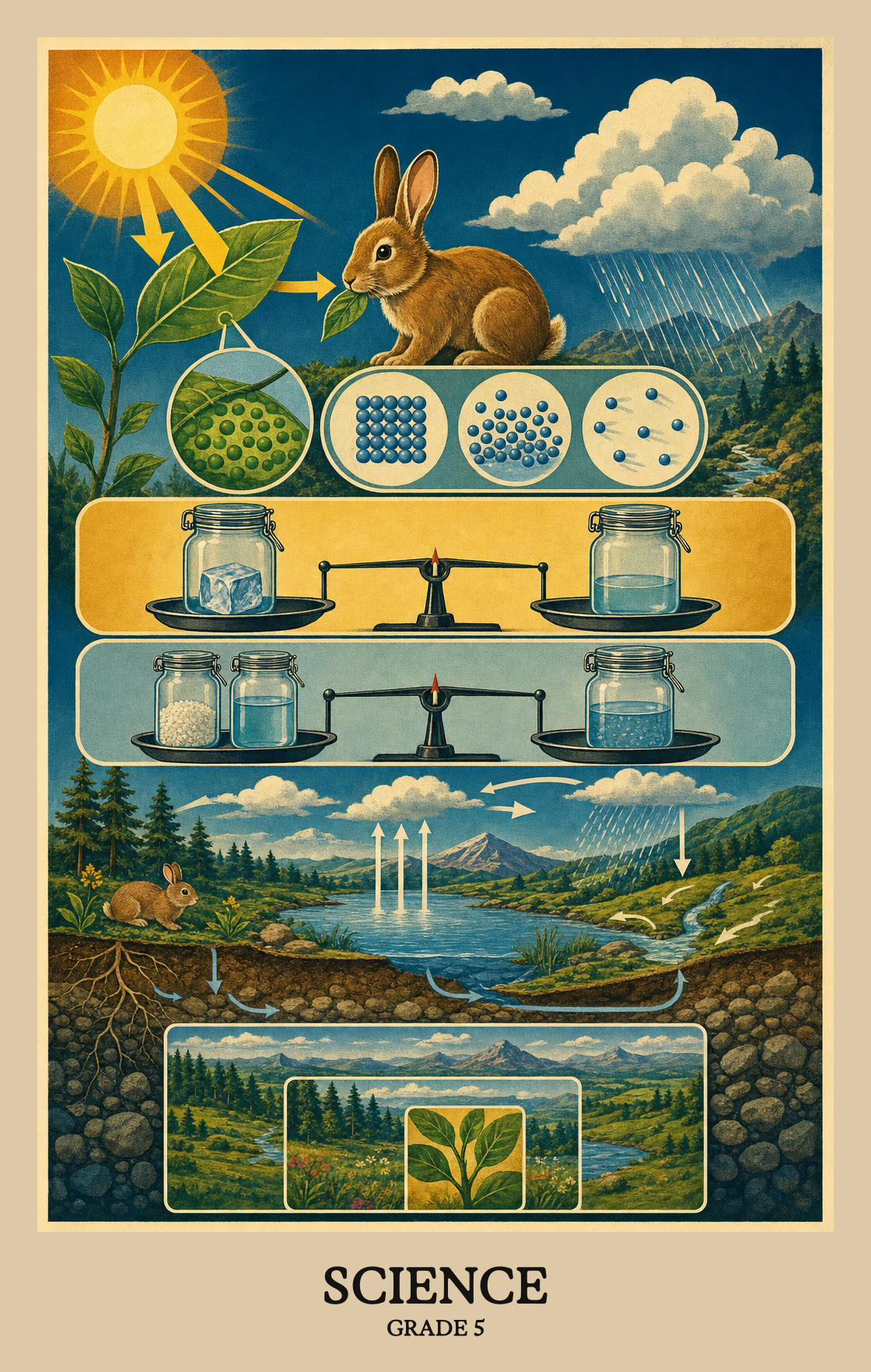
Students explore what everything is made of. They sort materials by properties like hardness and whether they dissolve, and learn that matter is made of particles too tiny to see.
Students mix substances and measure what happens. They see that some mixes make new substances and that the total amount of matter stays the same, even when it looks different.
Students learn why things fall down and why the sun looks so much brighter than other stars. They track shadows and daylight across the year and graph what they notice.
Students follow food and energy through living things. They argue that plants grow mostly from air and water, and trace the energy in a sandwich back to the sun.
Students look at how land, water, air, and living things shape each other. They graph how much of Earth's water is salty versus fresh, and study ways communities protect natural resources.
Students take on a real problem and act like engineers. They write down what counts as success, brainstorm several ideas, and compare them to pick the one most likely to work.
Students argue, using evidence, that the Sun looks brighter than other stars because it is so much closer to Earth, not because it is actually bigger or more powerful than all of them.
Students record and graph patterns in how shadows shift through the day, when day turns to night, and which stars appear in different seasons. The data shows that Earth's movement, not random chance, drives these changes.
Students create a diagram or model showing how Earth's land, water, air, and living things affect each other, such as how rain soaks into soil and helps plants grow.
Students graph how water is divided across Earth, showing that salt water in oceans far outnumbers the fresh water found in rivers, lakes, ice caps, and underground sources.
Students research how real communities use science to protect local land, water, and air. They pull information from multiple sources and put it together to explain the actions people take.
| Standard | Definition | Code |
|---|---|---|
| Why stars look brighter or dimmer from Earth | Students argue, using evidence, that the Sun looks brighter than other stars because it is so much closer to Earth, not because it is actually bigger or more powerful than all of them. | 5-ESS1-1 |
| Shadows, day length, and stars change in patterns | Students record and graph patterns in how shadows shift through the day, when day turns to night, and which stars appear in different seasons. The data shows that Earth's movement, not random chance, drives these changes. | 5-ESS1-2 |
| How Earth's systems affect each other | Students create a diagram or model showing how Earth's land, water, air, and living things affect each other, such as how rain soaks into soil and helps plants grow. | 5-ESS2-1 |
| Where Earth's water is stored | Students graph how water is divided across Earth, showing that salt water in oceans far outnumbers the fresh water found in rivers, lakes, ice caps, and underground sources. | 5-ESS2-2 |
| Protecting local resources and the environment | Students research how real communities use science to protect local land, water, and air. They pull information from multiple sources and put it together to explain the actions people take. | 5-ESS3-1 |
Students identify a real problem worth solving, then set the rules for what a good solution looks like, including what it must do and what limits exist on materials, time, or cost.
Students come up with more than one way to solve a problem, then compare the ideas to see which one fits the rules and limits best. Think of it as choosing the right tool for the job before picking up anything.
| Standard | Definition | Code |
|---|---|---|
| Defining design problems with real limits | Students identify a real problem worth solving, then set the rules for what a good solution looks like, including what it must do and what limits exist on materials, time, or cost. | 5-ETS1-1 |
| Comparing solutions to an engineering problem | Students come up with more than one way to solve a problem, then compare the ideas to see which one fits the rules and limits best. Think of it as choosing the right tool for the job before picking up anything. | 5-ETS1-2 |
Plants don't grow mostly from soil. Students build an argument, using evidence, that plants pull the carbon and water they need to grow mainly from air and rainwater.
Students map out how matter moves through a food web, showing what producers, consumers, and decomposers take in and give back to the environment.
| Standard | Definition | Code |
|---|---|---|
| Where plants get what they need to grow | Plants don't grow mostly from soil. Students build an argument, using evidence, that plants pull the carbon and water they need to grow mainly from air and rainwater. | 5-LS1-1 |
| Food webs and how matter moves | Students map out how matter moves through a food web, showing what producers, consumers, and decomposers take in and give back to the environment. | 5-LS2-1 |
Matter is made of tiny particles too small to see, even under a magnifying glass. Students build a model, like a drawing or diagram, to show how those invisible particles make up everyday objects like water, air, or a sugar cube.
Students measure and weigh substances before and after heating, cooling, or mixing them to show that the total amount of matter stays the same, even when something looks different.
Students sort and identify everyday materials by observing and measuring their properties, like how heavy something is, whether it dissolves in water, or how well it conducts heat.
Students mix everyday materials together and observe whether the result is something new or just the original substances in a different arrangement. The goal is to recognize the difference between a physical mix and a chemical change.
Students gather evidence to show that gravity always pulls objects toward the ground, no matter where they are placed. They practice making a scientific argument using observations, not just stating a fact.
Animals get energy from food, and that food energy traces back to the Sun. Students use diagrams or models to show how sunlight powers plants, plants become food, and that energy moves through animals as they grow, move, and stay warm.
| Standard | Definition | Code |
|---|---|---|
| Invisible particles that make up matter | Matter is made of tiny particles too small to see, even under a magnifying glass. Students build a model, like a drawing or diagram, to show how those invisible particles make up everyday objects like water, air, or a sugar cube. | 5-PS1-1 |
| Matter stays the same when substances change | Students measure and weigh substances before and after heating, cooling, or mixing them to show that the total amount of matter stays the same, even when something looks different. | 5-PS1-2 |
| Identifying materials by their properties | Students sort and identify everyday materials by observing and measuring their properties, like how heavy something is, whether it dissolves in water, or how well it conducts heat. | 5-PS1-3 |
| Mixing substances to make new ones | Students mix everyday materials together and observe whether the result is something new or just the original substances in a different arrangement. The goal is to recognize the difference between a physical mix and a chemical change. | 5-PS1-4 |
| Gravity pulls objects toward Earth | Students gather evidence to show that gravity always pulls objects toward the ground, no matter where they are placed. They practice making a scientific argument using observations, not just stating a fact. | 5-PS2-1 |
| How animals get energy from the Sun | Animals get energy from food, and that food energy traces back to the Sun. Students use diagrams or models to show how sunlight powers plants, plants become food, and that energy moves through animals as they grow, move, and stay warm. | 5-PS3-1 |
A spring grade 5 science test based on the New York State Science Learning Standards. It includes a written portion with multiple-choice and constructed-response questions and a separate hands-on performance task students complete in their school.
The alternate state test for students with the most significant cognitive disabilities. NYSAA replaces the Grade 3-8 tests and Regents exams in ELA, math, and science for the small group of students whose IEP teams qualify them.
Students study how matter is made of tiny particles, how plants grow from air and water, and how energy from the Sun moves through food. They also look at Earth's water, the night sky, and how people protect natural resources. Expect a mix of building models, running small experiments, and making graphs.
Cook together and talk about what changes when things heat, cool, or mix. Look at the Moon and stars on clear nights. Ask why questions during everyday moments, like why a shadow gets longer in the evening or why a plant near the window leans toward the light.
It is a common idea, but plants actually get most of what they need from air and water, with sunlight as the energy source. Soil holds the plant up and provides some minerals. Growing a bean in a wet paper towel with no soil is a quick way to see this at home.
Many teachers start with properties of matter and mixtures because the hands-on work hooks students early. Energy and food webs build naturally from there, then Earth systems and space patterns close the year. Engineering design tasks fit well alongside any unit as a way to apply what students have learned.
Conservation of matter is a sticking point. Students often think matter disappears when something dissolves, melts, or burns. Plan extra time for careful weighing before and after changes, and for talking through where the matter actually went.
Students can build a simple model, explain it in their own words, and back up a claim with data they collected or read on a graph. They should be able to argue, for example, that the Sun looks brighter than other stars because it is closer, and point to evidence for it.
Quite a bit, mostly measuring and graphing. Students weigh substances, measure shadows, and chart amounts of fresh and salt water. Practicing with a ruler, a kitchen scale, and simple bar graphs at home gives students a real boost.
The two engineering goals work best as short design challenges tied to a science unit. Give students a clear problem, a budget of materials, and a time limit, then have them compare two or three possible solutions. A water filter project pairs well with the unit on Earth's water.
Ready students can plan a simple investigation, record measurements without much prompting, and explain a food web or water cycle using a labeled drawing. They should also be comfortable reading a graph and saying what pattern it shows.