Letters, sounds, and book basics
Students learn the names and sounds of every letter, upper and lower case. They practice holding a book the right way, turning pages, and following the words from left to right.
This is the year letters and sounds start to click. Students learn the names and sounds of every letter, then begin blending those sounds into short words they can read on their own. They talk about books they hear, retell what happened, and point out the characters and setting. By spring, students can read simple words like cat and sit, recognize common words like the and is by sight, and use drawing and early writing to share an opinion or tell a small story.
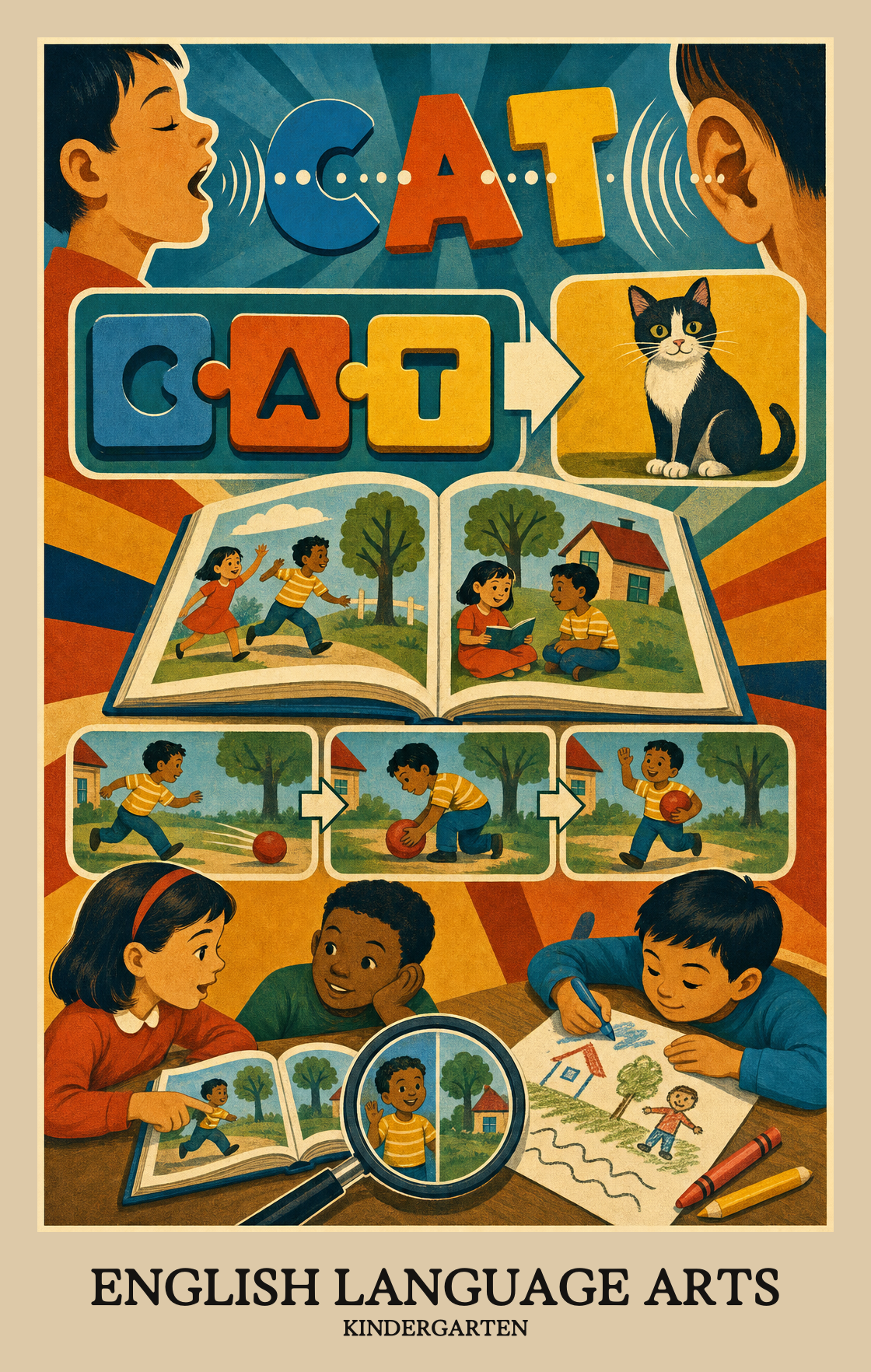
Students learn the names and sounds of every letter, upper and lower case. They practice holding a book the right way, turning pages, and following the words from left to right.
Students play with the sounds inside spoken words. They clap syllables, find rhymes, and stretch a short word into its separate sounds before pushing them back together.
Students start sounding out short words like cat and pin, and learn to spot common words such as the and is on sight. Short, simple books become readable for the first time.
Students retell a story, name the characters and setting, and point out what the pictures add. They also start telling stories and information apart, and ask questions about what a book is saying.
Students mix drawing, talking, and early writing to share an opinion, tell about a topic, or walk through something that happened. They also respond to books through art, acting, or words.
Students take turns in conversations, ask questions when something is unclear, and describe people and places with detail. New words from read-alouds and play start showing up in their own speech.
This standard doesn't apply in Kindergarten. Vocabulary acquisition work begins in second grade.
Students learn new words by hearing, reading, and using them in real activities. When a word has more than one meaning, like "bat," students figure out which meaning fits.
Students talk about how words connect to each other and what they mean. A teacher might ask how "cold" and "hot" are opposites, or what words go with "farm."
Students build their vocabulary through classroom talk, books, and read-alouds, then use those new words when they speak or write.
Words can mean more than one thing. Students learn that a familiar word like "duck" can also be an action, then practice using the new meaning correctly in a sentence.
Word endings and beginnings change a word's meaning. Students use clues like -ed (it already happened), -s (more than one), or un- (the opposite) to figure out what an unfamiliar word means.
Students sort everyday objects, like fruits or shapes, into groups that belong together. Sorting helps them see what makes things alike.
Students learn that words have opposites: big and small, run and stop, happy and sad. They practice matching common verbs and adjectives to their antonyms.
Students practice using describing words by naming things they see in real life, like colorful spots around the house. It connects new vocabulary to places and objects students already know.
Students act out words like walk, march, and gallop to feel the difference between them. Moving their bodies helps them understand that words can describe the same basic action in very different ways.
| Standard | Definition | Code |
|---|---|---|
| Vocabulary skills start in grade 2 | This standard doesn't apply in Kindergarten. Vocabulary acquisition work begins in second grade. | NY-KL3 |
| Learning new words through real experiences | Students learn new words by hearing, reading, and using them in real activities. When a word has more than one meaning, like "bat," students figure out which meaning fits. | NY-KL4 |
| Words and what they mean | Students talk about how words connect to each other and what they mean. A teacher might ask how "cold" and "hot" are opposites, or what words go with "farm." | NY-KL5 |
| Words learned from books and talk | Students build their vocabulary through classroom talk, books, and read-alouds, then use those new words when they speak or write. | NY-KL6 |
| Words with more than one meaning | Words can mean more than one thing. Students learn that a familiar word like "duck" can also be an action, then practice using the new meaning correctly in a sentence. | NY-KL4a |
| Word endings as meaning clues | Word endings and beginnings change a word's meaning. Students use clues like -ed (it already happened), -s (more than one), or un- (the opposite) to figure out what an unfamiliar word means. | NY-KL4b |
| Sorting objects into groups | Students sort everyday objects, like fruits or shapes, into groups that belong together. Sorting helps them see what makes things alike. | NY-KL5a |
| Verbs and adjectives with opposites | Students learn that words have opposites: big and small, run and stop, happy and sad. They practice matching common verbs and adjectives to their antonyms. | NY-KL5b |
| Describing the world with words | Students practice using describing words by naming things they see in real life, like colorful spots around the house. It connects new vocabulary to places and objects students already know. | NY-KL5c |
| Action verbs that mean almost the same thing | Students act out words like walk, march, and gallop to feel the difference between them. Moving their bodies helps them understand that words can describe the same basic action in very different ways. | NY-KL5d |
Students ask and answer simple questions about a book or story they have just heard or read. This builds the habit of thinking carefully about what a text says.
Students listen to a story or a short book, then put it in their own words. They name what happened, who was in it, or what the book was mostly about.
Stories have characters (the people or animals), a setting (where and when it happens), and main events (what occurs). Students identify these basic parts in books they read or hear.
Students pick out words in a story or book that describe feelings like happy or scared, and words tied to the senses like loud or soft.
Students sort books and passages into two groups: stories (made-up characters and events) and informational texts (real facts about the world).
Students name who wrote a book and who drew the pictures, then explain what each person's job was in making the story or information come to life.
Students look at the pictures in a book and explain how they connect to the words on the page.
Students pick out details from a story or book that back up a simple idea, like finding the sentence that shows where an animal lives or why a character felt scared.
Students connect a story to their own life or to something they know about the world. A teacher might ask, "Has this ever happened to you?" or "Where have you seen this before?"
| Standard | Definition | Code |
|---|---|---|
| Asking and answering questions about books | Students ask and answer simple questions about a book or story they have just heard or read. This builds the habit of thinking carefully about what a text says. | NY-KR1 |
| Retelling stories and key details | Students listen to a story or a short book, then put it in their own words. They name what happened, who was in it, or what the book was mostly about. | NY-KR2 |
| Story characters, settings, and events | Stories have characters (the people or animals), a setting (where and when it happens), and main events (what occurs). Students identify these basic parts in books they read or hear. | NY-KR3 |
| Words that show feelings and senses | Students pick out words in a story or book that describe feelings like happy or scared, and words tied to the senses like loud or soft. | NY-KR4 |
| Fiction vs. nonfiction books | Students sort books and passages into two groups: stories (made-up characters and events) and informational texts (real facts about the world). | NY-KR5 |
| Who wrote and drew this book | Students name who wrote a book and who drew the pictures, then explain what each person's job was in making the story or information come to life. | NY-KR6 |
| Pictures and words work together | Students look at the pictures in a book and explain how they connect to the words on the page. | NY-KR7 |
| Finding proof in a book | Students pick out details from a story or book that back up a simple idea, like finding the sentence that shows where an animal lives or why a character felt scared. | NY-KR8 |
| Connecting stories to your own life | Students connect a story to their own life or to something they know about the world. A teacher might ask, "Has this ever happened to you?" or "Where have you seen this before?" | NY-KR9 |
Reading starts with knowing how a book works. Students learn that print moves left to right, that words have spaces between them, and that letters form words on a page.
Students learn that spoken words are built from smaller parts. They practice breaking words into syllables and hearing the individual sounds inside words, like the three sounds in "cat": /k/ /a/ /t/.
Students use letter-sound rules to figure out words they don't recognize yet. This is the decoding work that makes sounding out a new word possible.
Students read simple beginner books out loud, getting enough words right to understand what the story is about.
Reading moves in one direction. Students learn to follow words from left to right and top to bottom, one page at a time.
Reading a written word means matching the letters on the page to the sounds heard when that word is spoken. Students learn that the order of the letters matters.
Words on a page have spaces between them so readers know where one word ends and the next begins. Students learn to spot those gaps in a sentence and point to each word as they read it aloud.
Students name every letter of the alphabet, both capital and lowercase, when they see it on a page.
Students learn which part of a book is the front, which is the back, and where to find the title page inside.
Students listen to a word and name another word that ends with the same sound. This is one of the first steps in learning how spoken words work.
Students clap out syllables in a spoken word, then blend those syllable sounds back into the full word. Think "rain-bow" pulled apart, then put back together.
Students hear a word split into its opening sound and ending chunk, then blend them back into one word. This is early practice in pulling spoken words apart and putting them back together.
Students break a spoken word into its individual sounds and push those sounds back together to make the word again. This is practiced with simple, one-syllable words like "cat" or "dog."
Students swap, add, or remove individual sounds in a short word to make a new one. For example, changing the first sound in "cat" turns it into "bat" or "hat."
Students learn that each consonant letter makes a specific sound, then practice saying that sound aloud. Knowing these sounds is the first step toward sounding out real words.
Students read short words by matching the vowel sound to its spelling. Think "cat," "hop," and "bug" spelled out letter by letter.
Students sound out short, simple words like "cat" or "hop" by matching each letter to its sound. This is the start of reading on their own.
Students recognize words like "the," "is," and "you" on sight, without sounding them out. These are the short words that show up on almost every page of a book.
| Standard | Definition | Code |
|---|---|---|
| How books and print work | Reading starts with knowing how a book works. Students learn that print moves left to right, that words have spaces between them, and that letters form words on a page. | NY-KRF1 |
| Sounds, syllables, and spoken words | Students learn that spoken words are built from smaller parts. They practice breaking words into syllables and hearing the individual sounds inside words, like the three sounds in "cat": /k/ /a/ /t/. | NY-KRF2 |
| Sounding out words | Students use letter-sound rules to figure out words they don't recognize yet. This is the decoding work that makes sounding out a new word possible. | NY-KRF3 |
| Reading simple books with understanding | Students read simple beginner books out loud, getting enough words right to understand what the story is about. | NY-KRF4 |
| Reading left to right, top to bottom | Reading moves in one direction. Students learn to follow words from left to right and top to bottom, one page at a time. | NY-KRF1a |
| Letters stand for the sounds in words | Reading a written word means matching the letters on the page to the sounds heard when that word is spoken. Students learn that the order of the letters matters. | NY-KRF1b |
| Spaces between words in print | Words on a page have spaces between them so readers know where one word ends and the next begins. Students learn to spot those gaps in a sentence and point to each word as they read it aloud. | NY-KRF1c |
| Naming uppercase and lowercase letters | Students name every letter of the alphabet, both capital and lowercase, when they see it on a page. | NY-KRF1d |
| Parts of a book | Students learn which part of a book is the front, which is the back, and where to find the title page inside. | NY-KRF1e |
| Rhyming words | Students listen to a word and name another word that ends with the same sound. This is one of the first steps in learning how spoken words work. | NY-KRF2a |
| Blending and splitting syllables in spoken words | Students clap out syllables in a spoken word, then blend those syllable sounds back into the full word. Think "rain-bow" pulled apart, then put back together. | NY-KRF2b |
| Blending word parts to make sounds | Students hear a word split into its opening sound and ending chunk, then blend them back into one word. This is early practice in pulling spoken words apart and putting them back together. | NY-KRF2c |
| Blending sounds in one-syllable words | Students break a spoken word into its individual sounds and push those sounds back together to make the word again. This is practiced with simple, one-syllable words like "cat" or "dog." | NY-KRF2d |
| Swap sounds to make new words | Students swap, add, or remove individual sounds in a short word to make a new one. For example, changing the first sound in "cat" turns it into "bat" or "hat." | NY-KRF2e |
| Consonant letter-sound match | Students learn that each consonant letter makes a specific sound, then practice saying that sound aloud. Knowing these sounds is the first step toward sounding out real words. | NY-KRF3a |
| Short vowel sounds and spellings | Students read short words by matching the vowel sound to its spelling. Think "cat," "hop," and "bug" spelled out letter by letter. | NY-KRF3b |
| Reading simple one-syllable words | Students sound out short, simple words like "cat" or "hop" by matching each letter to its sound. This is the start of reading on their own. | NY-KRF3c |
| Sight words kids read on their own | Students recognize words like "the," "is," and "you" on sight, without sounding them out. These are the short words that show up on almost every page of a book. | NY-KRF3d |
Talking and listening with classmates and grown-ups, in small groups, big groups, and during play. Students take turns, stay on topic, and respond to what others say.
Students listen to a book, photo, or video and talk about what they notice, like why it has pictures or how it is set up differently from other books they know.
Students listen to a classmate or teacher speak, then ask or answer questions to clear up anything they missed or didn't understand.
Students pick a familiar person, place, or thing and describe it out loud using specific details, not just "it's big" but what color, shape, or sound it has.
Students pick a picture, drawing, or object to help explain something they are talking about. The visual gives listeners something to look at while students describe it.
Students share what they think, feel, or notice out loud, using words to tell others what is on their mind.
Students take turns talking and listening in a back-and-forth conversation, not just saying one thing and stopping. They stay in the discussion long enough to respond to what others say.
| Standard | Definition | Code |
|---|---|---|
| Talking with classmates and adults | Talking and listening with classmates and grown-ups, in small groups, big groups, and during play. Students take turns, stay on topic, and respond to what others say. | NY-KSL1 |
| Talking about books and stories | Students listen to a book, photo, or video and talk about what they notice, like why it has pictures or how it is set up differently from other books they know. | NY-KSL2 |
| Ask and answer questions about what you hear | Students listen to a classmate or teacher speak, then ask or answer questions to clear up anything they missed or didn't understand. | NY-KSL3 |
| Describing familiar people and places | Students pick a familiar person, place, or thing and describe it out loud using specific details, not just "it's big" but what color, shape, or sound it has. | NY-KSL4 |
| Making pictures to support what you say | Students pick a picture, drawing, or object to help explain something they are talking about. The visual gives listeners something to look at while students describe it. | NY-KSL5 |
| Sharing thoughts and feelings out loud | Students share what they think, feel, or notice out loud, using words to tell others what is on their mind. | NY-KSL6 |
| Taking turns in a conversation | Students take turns talking and listening in a back-and-forth conversation, not just saying one thing and stopping. They stay in the discussion long enough to respond to what others say. | NY-KSL1b |
Students pick something they like or think is best and say or draw why. This is the start of opinion writing: taking a side and giving one reason to back it up.
Students pick a topic they know, like a pet or a favorite food, then draw a picture and add words or sentences to share what they know about it.
Students draw, tell, or write about something that happened, putting the events in the order they occurred.
Students respond to a book or something that happened to them by making something: a drawing, a poem, or a short performance. The response shows what they noticed or felt.
Students pick a question they want answered, then help the class look for information together and share what they found.
Students pick a question, then draw a picture, say their answer out loud, or write words to show what they know from a book or something they did.
| Standard | Definition | Code |
|---|---|---|
| Sharing opinions and giving a reason | Students pick something they like or think is best and say or draw why. This is the start of opinion writing: taking a side and giving one reason to back it up. | NY-KW1 |
| Writing facts about things you know | Students pick a topic they know, like a pet or a favorite food, then draw a picture and add words or sentences to share what they know about it. | NY-KW2 |
| Telling stories in order | Students draw, tell, or write about something that happened, putting the events in the order they occurred. | NY-KW3 |
| Respond to a story or experience | Students respond to a book or something that happened to them by making something: a drawing, a poem, or a short performance. The response shows what they noticed or felt. | NY-KW4 |
| Asking questions and finding answers | Students pick a question they want answered, then help the class look for information together and share what they found. | NY-KW6 |
| Sharing what you know through drawing and writing | Students pick a question, then draw a picture, say their answer out loud, or write words to show what they know from a book or something they did. | NY-KW7 |
The annual test New York gives to students who have been identified as English Language Learners. It checks speaking, listening, reading, and writing in English and decides whether a student is ready to exit ENL services.
The placement test New York gives to students within ten school days of enrolling, when a parent survey suggests the student may need English language services. Results decide whether the student is identified as an English Language Learner.
Students learn the names and sounds of every letter, start blending sounds into short words, and read very simple books by the end of the year. They also draw and write to share ideas, opinions, and short stories about things they know.
Read aloud every day and run a finger under the words so students see that print goes left to right. Ask a quick question after the story, like who was in it, where it happened, or what part they liked best.
By spring, students should name all upper and lowercase letters, hear and say the sounds in short spoken words, read a handful of common words like the and is by sight, and sound out simple words like cat or pig.
Not at this age. Many students still confuse letters like b and d or forget a sound now and then. Keep practicing with short, playful sessions, and point out letters on cereal boxes, signs, and books.
Start with letter names and consonant sounds, then move to short vowels, then to blending and segmenting sounds in spoken words. Once students can blend three sounds out loud, begin decoding simple printed words and pair that with a small set of high-frequency sight words.
Talk about new words as they come up in books and daily life, and play sorting games with toys, food, or shapes. Opposites are great too: ask for the opposite of big, fast, or happy while walking or riding in the car.
Segmenting and blending individual sounds in spoken words is the skill that most often needs extra practice, along with short vowel sounds. Build in daily oral warm-ups before students ever look at print, since the spoken work is what makes decoding click.
No. At this stage, writing is a mix of drawing, talking out ideas, and trying to spell some sounds. A picture with a few labels or a dictated sentence counts as real writing.
Look for students who can read short decodable books with simple words, retell a story with a few key details, and write or dictate a sentence or two about a topic. Strong letter-sound knowledge and clear speaking in group conversations are the biggest signals.
Knowing the alphabet song is different from knowing each letter's sound, and reading comes from the sounds. Practice one letter at a time, say its sound, and find words that start with it. Progress in kindergarten is steady, not sudden.