Watching the weather
Students start the year as weather watchers. They notice if it is sunny, rainy, windy, or cold, track what they see each day, and talk about why a forecast matters before a big storm.
This is the year science becomes the habit of looking closely and asking why. Students watch the weather day after day and notice patterns, like which days are sunny and which are cold. They figure out what plants and animals need to live, and how a push or a pull can make something move faster or change direction. By spring, students can describe how sunlight warms the ground and explain why a coat helps on a windy day.
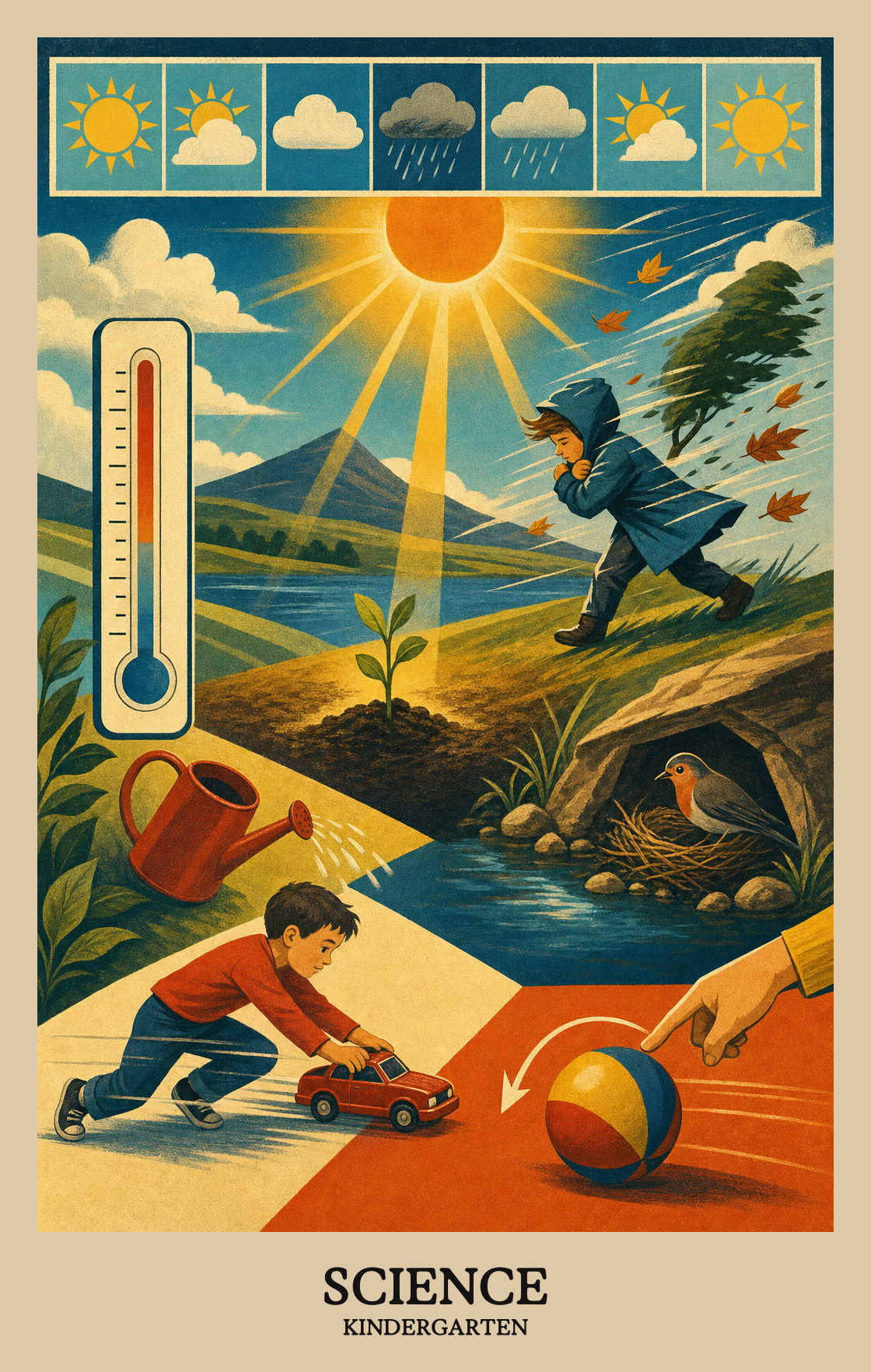
Students start the year as weather watchers. They notice if it is sunny, rainy, windy, or cold, track what they see each day, and talk about why a forecast matters before a big storm.
Students look closely at plants, animals, and people. They notice that every living thing needs food, water, and a place to live, and they match animals to the kinds of places where they can survive.
Students become movers and testers. They push and pull toys and balls to see what makes something go faster, slower, or change direction, and they try simple designs like ramps to steer a rolling object.
Students explore how the sun heats the ground, the sidewalk, and the air. They also melt ice and freeze water to see how heat turns a solid into a liquid, then build a small shade structure to keep an area cool.
Students wrap up the year by looking at how people change the world around them. They talk about ways to help animals, plants, and the local park or playground, and share simple ideas for cutting down on trash and waste.
Students watch and record the weather outside their school or home each day, then look for patterns, like which days tend to be rainy or sunny across a week or month.
Plants and animals change the world around them to survive. Students look at real examples, like beavers building dams or people clearing land, and explain why those changes happen.
Plants and animals live where their basic needs are met. Students use simple models, like drawings or diagrams, to show why a bear lives in a forest or a fish lives in water.
Students learn why weather forecasts matter by asking questions about storms, floods, and other severe weather. They explore how knowing a big storm is coming helps people stay safe and get ready.
Students think of ways people can help protect plants, animals, and nature nearby. They share their ideas through drawing, talking, or writing.
| Standard | Definition | Code |
|---|---|---|
| Tracking local weather patterns over time | Students watch and record the weather outside their school or home each day, then look for patterns, like which days tend to be rainy or sunny across a week or month. | K-ESS2-1 |
| How living things change their environment | Plants and animals change the world around them to survive. Students look at real examples, like beavers building dams or people clearing land, and explain why those changes happen. | K-ESS2-2 |
| Where animals and plants find what they need | Plants and animals live where their basic needs are met. Students use simple models, like drawings or diagrams, to show why a bear lives in a forest or a fish lives in water. | K-ESS3-1 |
| Why we check the weather forecast | Students learn why weather forecasts matter by asking questions about storms, floods, and other severe weather. They explore how knowing a big storm is coming helps people stay safe and get ready. | K-ESS3-2 |
| Ways to protect our local environment | Students think of ways people can help protect plants, animals, and nature nearby. They share their ideas through drawing, talking, or writing. | K-ESS3-3 |
Students watch real plants and animals and look for patterns in what keeps them alive, like needing food, water, or sunlight. The goal is to notice that living things share similar needs.
| Standard | Definition | Code |
|---|---|---|
| What living things need to survive | Students watch real plants and animals and look for patterns in what keeps them alive, like needing food, water, or sunlight. The goal is to notice that living things share similar needs. | K-LS1-1 |
Students sort materials into solids and liquids, then test what happens when temperature changes. A melting ice cube or hardening wax shows that the same material can switch between the two.
Students push and pull objects to see how hard or which direction changes the way those objects move. A harder push moves something farther; a push from a different side sends it a different way.
Students test whether pushing or pulling a toy or ball actually made it go faster, slower, or in a different direction. They look at what happened and decide if their idea worked.
Students watch what happens to sand, soil, and pavement when sunlight hits them. They learn that the sun warms surfaces on Earth.
Students build a small structure, like a shade cover or tent, that blocks sunlight and keeps a surface cooler. The focus is on choosing materials and testing whether the design actually works.
| Standard | Definition | Code |
|---|---|---|
| Solids and liquids change with temperature | Students sort materials into solids and liquids, then test what happens when temperature changes. A melting ice cube or hardening wax shows that the same material can switch between the two. | K-PS1-1 |
| Pushes and pulls move objects | Students push and pull objects to see how hard or which direction changes the way those objects move. A harder push moves something farther; a push from a different side sends it a different way. | K-PS2-1 |
| Pushes and pulls that change how objects move | Students test whether pushing or pulling a toy or ball actually made it go faster, slower, or in a different direction. They look at what happened and decide if their idea worked. | K-PS2-2 |
| Sunlight warms the ground | Students watch what happens to sand, soil, and pavement when sunlight hits them. They learn that the sun warms surfaces on Earth. | K-PS3-1 |
| Building shade to block the sun | Students build a small structure, like a shade cover or tent, that blocks sunlight and keeps a surface cooler. The focus is on choosing materials and testing whether the design actually works. | K-PS3-2 |
The alternate state test for students with the most significant cognitive disabilities. NYSAA replaces the Grade 3-8 tests and Regents exams in ELA, math, and science for the small group of students whose IEP teams qualify them.
Students spend the year noticing the world around them and asking questions about it. They watch the weather, look at plants and animals, push and pull objects, and feel how the sun warms things up. Most of the learning happens through hands-on play and conversation, not worksheets.
Step outside and talk about what you see. Notice if it is sunny, cloudy, windy, or rainy. Watch a bug, water a plant, or feel a sunny spot on the sidewalk versus a shady one. Five minutes of wondering out loud goes a long way at this age.
No. The focus is on observing and explaining in their own words. If a student says the puddle disappeared because the sun was hot, that counts. Fancy terms can wait.
Many teachers start with weather and the sun in early fall while students are still outside often, move into plants and animals, then tackle pushes and pulls in winter, and finish with solids, liquids, and design challenges in spring. Weather observation can run as a daily routine all year.
Building an argument from evidence is the hardest lift. Most students can describe what they saw, but linking that observation to a claim takes modeling all year. Sentence starters like I think this because I saw help a lot.
Bad weather is great science. Talk about what clothes are needed and why, watch puddles form and dry up, or put a cup outside to see how much rain falls. Ask what students think will happen before you look together.
Short and frequent works better than long and rare. Ten to fifteen minutes with ice cubes, ramps, balls, or seeds gives students plenty to observe and talk about. Save longer sessions for design tasks like building a sunshade.
Ready students can describe a pattern they noticed, like the sun rising in the same place or plants needing water. They can plan a simple test, share what they saw, and suggest a small change to make something work better.