Exploring movement ideas
Students start the year trying out different ways to move their bodies through space. They turn pictures, stories, and everyday experiences into short movement ideas of their own.
This is the year dance moves from copying steps to shaping short dances with a clear idea behind them. Students pull from their own lives and stories they know to come up with movements, then practice and polish a piece to show others. They also start naming what they see in a dance and saying what they think it means. By spring, students can perform a short dance they helped create and explain the idea it shows.
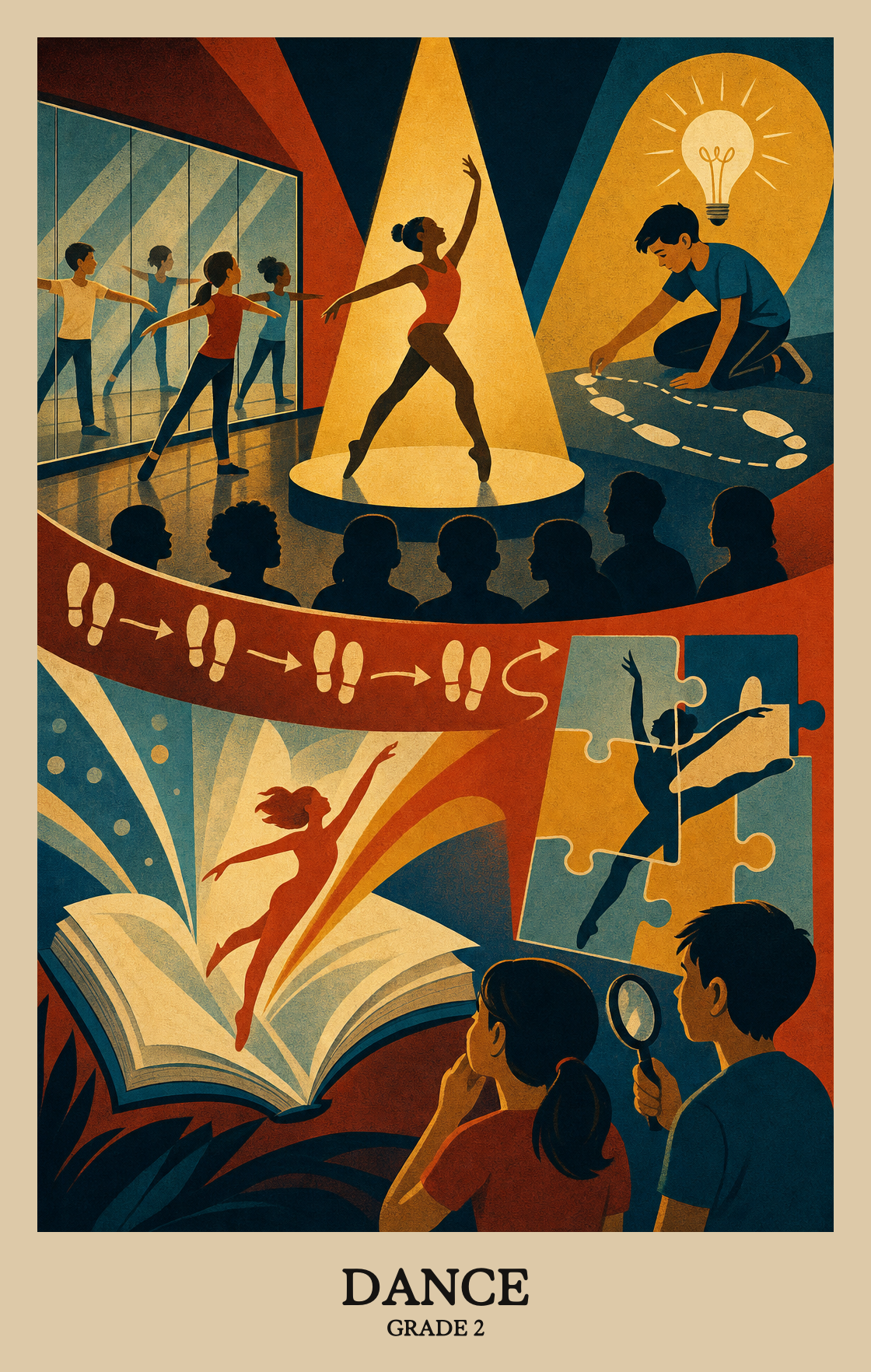
Students start the year trying out different ways to move their bodies through space. They turn pictures, stories, and everyday experiences into short movement ideas of their own.
Students take their movement ideas and put them in order to make a short dance. They practice choices like fast or slow, big or small, and decide what comes first, next, and last.
Students watch dances and describe what they notice. They start to share what a dance might be about and why a dancer made certain choices.
Students polish a dance to perform for classmates or family. They work on clear shapes, steady timing, and showing the feeling or story behind the movement.
By the end of the year, students connect dance to holidays, family traditions, and stories from different places. They use simple criteria to talk about what makes a dance work.
Students connect something from their own life to a dance they create or perform. A memory, a feeling, or an everyday moment becomes the starting point for the movement.
Students connect a dance they learn or create to where it comes from: a culture, a tradition, or a moment in history. Knowing that context helps them understand why the dance looks and feels the way it does.
| Standard | Definition | Code |
|---|---|---|
| Making dance from personal experience | Students connect something from their own life to a dance they create or perform. A memory, a feeling, or an everyday moment becomes the starting point for the movement. | CA-DA:Cn10.2.2 |
| Dance and culture around the world | Students connect a dance they learn or create to where it comes from: a culture, a tradition, or a moment in history. Knowing that context helps them understand why the dance looks and feels the way it does. | CA-DA:Cn11.2.2 |
Students come up with their own movement ideas and start turning them into a short dance. They explore different ways their body can move before settling on what works best.
Students choose movements that go together and arrange them into a short dance that has a clear beginning and end.
Students revisit a dance they made, adjust moves that aren't working, and practice until the piece feels finished and ready to share.
| Standard | Definition | Code |
|---|---|---|
| Coming up with dance ideas | Students come up with their own movement ideas and start turning them into a short dance. They explore different ways their body can move before settling on what works best. | CA-DA:Cr1.2.2 |
| Turning dance ideas into a finished piece | Students choose movements that go together and arrange them into a short dance that has a clear beginning and end. | CA-DA:Cr2.2.2 |
| Finish and polish a dance | Students revisit a dance they made, adjust moves that aren't working, and practice until the piece feels finished and ready to share. | CA-DA:Cr3.2.2 |
Students choose which of their dances to perform and explain why that piece shows their best work.
Students practice a dance piece multiple times, working on body control and coordination, until it's ready to share with an audience.
Students perform a dance and make choices, like how fast or strong to move, to share a feeling or idea with the audience.
| Standard | Definition | Code |
|---|---|---|
| Choosing dances worth performing | Students choose which of their dances to perform and explain why that piece shows their best work. | CA-DA:Pr4.2.2 |
| Practicing a dance before performing it | Students practice a dance piece multiple times, working on body control and coordination, until it's ready to share with an audience. | CA-DA:Pr5.2.2 |
| Perform a dance that means something | Students perform a dance and make choices, like how fast or strong to move, to share a feeling or idea with the audience. | CA-DA:Pr6.2.2 |
Students watch a dance and describe what they notice, such as how the dancer moves fast or slow, or how the arms and legs work together.
Students watch a dance and explain what they think the dancer is feeling or trying to say. They use what they see in the movements to back up their idea.
Students pick a rule for what makes a dance good (like smooth moves or staying in rhythm) and use it to say what works and what could be better in a dance they watch or perform.
| Standard | Definition | Code |
|---|---|---|
| Watching and thinking about a dance | Students watch a dance and describe what they notice, such as how the dancer moves fast or slow, or how the arms and legs work together. | CA-DA:Re7.2.2 |
| What a dance means to you | Students watch a dance and explain what they think the dancer is feeling or trying to say. They use what they see in the movements to back up their idea. | CA-DA:Re8.2.2 |
| Judging what makes a dance work | Students pick a rule for what makes a dance good (like smooth moves or staying in rhythm) and use it to say what works and what could be better in a dance they watch or perform. | CA-DA:Re9.2.2 |
Students learn short movement patterns, make up their own simple dances, perform for classmates, and talk about what they saw. The focus is on body control, rhythm, and putting feelings or stories into movement.
Put on music and let them invent a short dance about something they did that day. Ask what each movement means. Five minutes of moving together in the living room counts.
No. Dance at this level is about exploring how the body moves, not auditioning. Every student is expected to take part, and progress comes from practice and trying ideas, not natural ability.
Start with body awareness and basic movements like jump, turn, and freeze. Move into making short patterns, then small group pieces with a clear beginning, middle, and end. Save performance and peer feedback for once students have something to show.
Students can make up a short dance with a clear idea behind it, perform it for others, and say something thoughtful about a classmate's dance. They can also revise a movement after getting feedback.
Ask what their dance was about and which part was their favorite. Then ask them to show you one move. This pulls out the meaning behind the movement, which matters as much as the steps.
Name what you saw before judging it: the shape, the speed, the moment they paused. Then ask one question about the idea behind the dance. Students this age revise better when feedback is specific and kind.
Students often dance about stories they read, animals they study, or places they learn about. Tying a dance to a book or a science topic makes both stick. It also gives quieter students another way to show what they know.