Family stories and time
Students start the year by looking at their own families. They sort events into long ago and recent, build a timeline of their life, and use photos and interviews to learn family history.
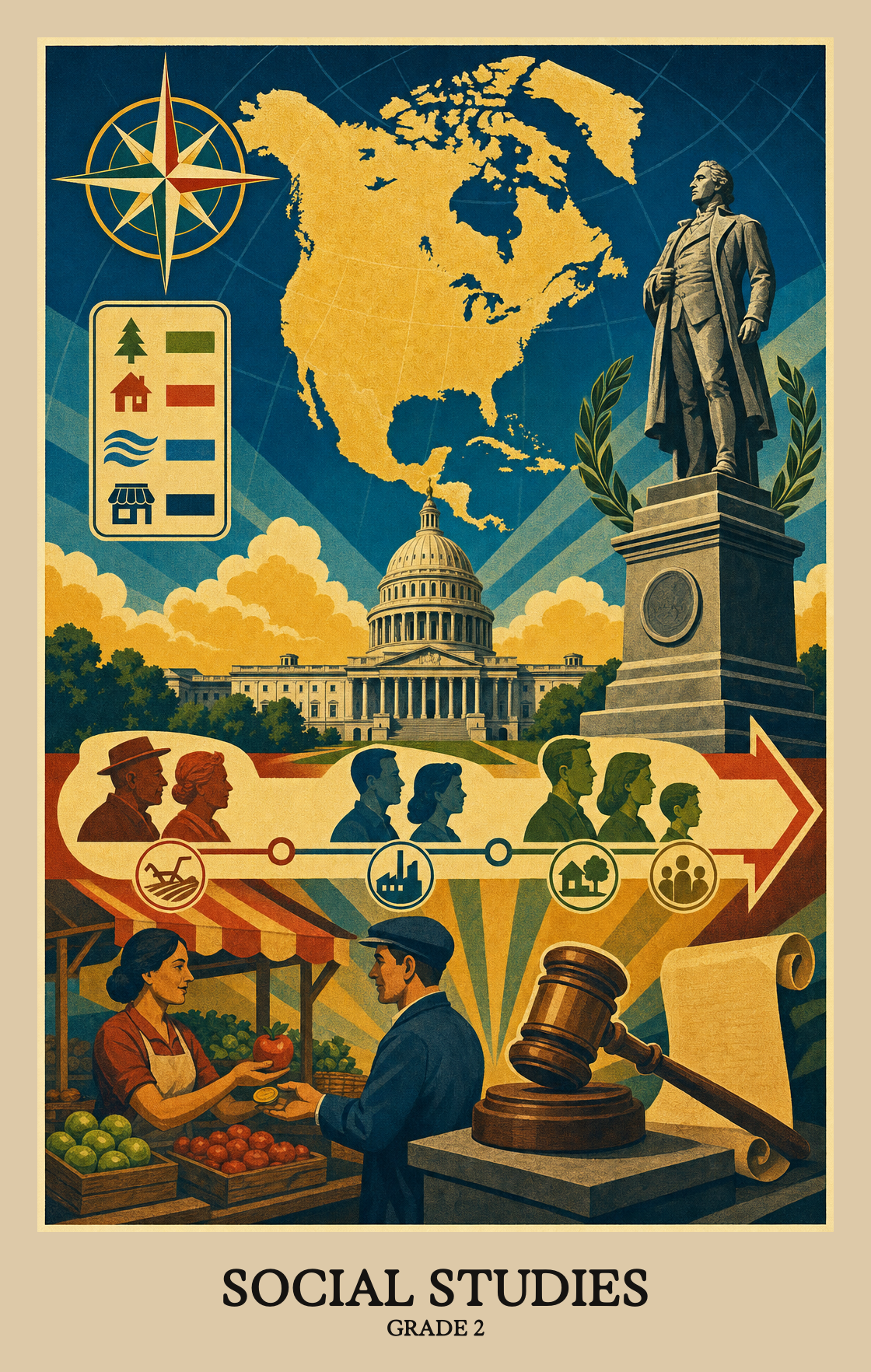
This is the year social studies stretches beyond the classroom to the wider world. Students start using real maps, with a legend and a compass rose, and they learn to label the continent of North America from memory. They look at how families change over generations, how laws get made, and how buyers and sellers depend on each other. By spring, students can read a simple map, place family events on a timeline, and explain why a hero from history mattered.
Students start the year by looking at their own families. They sort events into long ago and recent, build a timeline of their life, and use photos and interviews to learn family history.
Students read and draw simple maps of the classroom, neighborhood, and North America. They learn the parts of a map and find oceans, countries, rivers, and mountains.
Students compare how land is used in busy cities, quieter suburbs, and open farm country in California. They also trace where their ancestors lived and how families moved here.
Students learn how the United States and other countries make laws, decide when laws are broken, and work out problems with each other through trade, treaties, and talking things through.
Students follow food from the farm to the table and see the work of farmers, truck drivers, and stores. They learn how buyers and sellers depend on each other and why resources have limits.
Students close the year with short biographies of people like Abraham Lincoln, Jackie Robinson, and Marie Curie. They talk about character and how one person's choices can help others.
Students sort events into "long ago" and "recent," explaining why something like a family photo from a grandparent's childhood counts as the past while last week's birthday is recent.
Students trace their own family's history by looking at old photos, objects, letters, and interviews with relatives. They use real sources to understand what family life looked like years or generations ago.
Students look at photos, stories, or objects to spot how daily life has changed across generations. They compare what a school day, meal, or chore looked like for a grandparent versus what it looks like today.
Students put key moments from their own lives in order, from earliest to most recent, using a simple timeline or picture sequence.
Students read a map to describe exactly where a place is (its address on the grid) and where it sits compared to nearby landmarks. They practice both ways of saying where something is.
Students use a simple grid (like rows labeled A, B, C and columns labeled 1, 2, 3) to find exact spots on a map of their school or neighborhood.
Students label a blank map of North America from memory, marking countries, oceans, major rivers, lakes, and mountain ranges. They also identify the basic parts of any map: its title, legend, compass direction, scale, and date.
Students find their family's home country or hometown on a map, then explain when their relatives moved to the local area and what brought them here.
Students look at photos or maps of a city, a suburb, and a farm and explain what is the same and what is different about how people use the land in each place.
Students learn how governments make rules and keep communities running, and compare how the U.S. government works with governments in other countries.
Students learn how governments work: who writes the laws, who enforces them, and what happens when someone breaks one. This applies to the U.S. and countries around the world.
Countries try to solve disagreements by talking, making deals, or signing agreements. Students learn the different ways nations work things out, from trading goods to sending diplomats to negotiate on their behalf.
Students learn how buying, selling, earning, and saving work in everyday life. They practice making simple choices about money, like deciding whether to spend or save.
Food gets from a farm to a dinner table through many hands. Students trace how farmers grow food, how workers package and ship it, and how weather and land shape what ends up on the plate, then compare how that process worked long ago to how it works today.
Buyers need sellers to get what they want, and sellers need buyers to stay in business. Students learn how these two roles depend on each other every time goods or services are traded.
When there isn't enough of something (like wood, water, or workers), people have to choose what to make and what to buy. Students learn why limited resources mean not everyone can have everything they want.
Students read about real people from history and explain how one person's choices and courage changed life for others.
| Standard | Definition | Code |
|---|---|---|
| Students differentiate between things that happened long ago and things that… | Students sort events into "long ago" and "recent," explaining why something like a family photo from a grandparent's childhood counts as the past while last week's birthday is recent. | CA-HSS.2.1 |
| Trace the history of a family through the use of primary and secondary sources… | Students trace their own family's history by looking at old photos, objects, letters, and interviews with relatives. They use real sources to understand what family life looked like years or generations ago. | CA-HSS.2.1.1 |
| Compare and contrast their daily lives with those of their parents… | Students look at photos, stories, or objects to spot how daily life has changed across generations. They compare what a school day, meal, or chore looked like for a grandparent versus what it looks like today. | CA-HSS.2.1.2 |
| Place important events in their lives in the order in which they occurred | Students put key moments from their own lives in order, from earliest to most recent, using a simple timeline or picture sequence. | CA-HSS.2.1.3 |
| Students demonstrate map skills by describing the absolute and relative loca… | Students read a map to describe exactly where a place is (its address on the grid) and where it sits compared to nearby landmarks. They practice both ways of saying where something is. | CA-HSS.2.2 |
| Locate on a simple letter-number grid system the specific locations and… | Students use a simple grid (like rows labeled A, B, C and columns labeled 1, 2, 3) to find exact spots on a map of their school or neighborhood. | CA-HSS.2.2.1 |
| Label from memory a simple map of the North American continent, including the… | Students label a blank map of North America from memory, marking countries, oceans, major rivers, lakes, and mountain ranges. They also identify the basic parts of any map: its title, legend, compass direction, scale, and date. | CA-HSS.2.2.2 |
| Locate on a map where their ancestors live | Students find their family's home country or hometown on a map, then explain when their relatives moved to the local area and what brought them here. | CA-HSS.2.2.3 |
| Compare and contrast basic land use in urban, suburban | Students look at photos or maps of a city, a suburb, and a farm and explain what is the same and what is different about how people use the land in each place. | CA-HSS.2.2.4 |
| Students explain governmental institutions and practices in the United States… | Students learn how governments make rules and keep communities running, and compare how the U.S. government works with governments in other countries. | CA-HSS.2.3 |
| Explain how the United States and other countries make laws, carry out laws… | Students learn how governments work: who writes the laws, who enforces them, and what happens when someone breaks one. This applies to the U.S. and countries around the world. | CA-HSS.2.3.1 |
| Describe the ways in which groups and nations interact with one another to try… | Countries try to solve disagreements by talking, making deals, or signing agreements. Students learn the different ways nations work things out, from trading goods to sending diplomats to negotiate on their behalf. | CA-HSS.2.3.2 |
| Students understand basic economic concepts and their individual roles in the… | Students learn how buying, selling, earning, and saving work in everyday life. They practice making simple choices about money, like deciding whether to spend or save. | CA-HSS.2.4 |
| Describe food production and consumption long ago and today, including the… | Food gets from a farm to a dinner table through many hands. Students trace how farmers grow food, how workers package and ship it, and how weather and land shape what ends up on the plate, then compare how that process worked long ago to how it works today. | CA-HSS.2.4.1 |
| Understand the role and interdependence of buyers | Buyers need sellers to get what they want, and sellers need buyers to stay in business. Students learn how these two roles depend on each other every time goods or services are traded. | CA-HSS.2.4.2 |
| Understand how limits on resources affect production and consumption | When there isn't enough of something (like wood, water, or workers), people have to choose what to make and what to buy. Students learn why limited resources mean not everyone can have everything they want. | CA-HSS.2.4.3 |
| Students understand the importance of individual action and character and… | Students read about real people from history and explain how one person's choices and courage changed life for others. | CA-HSS.2.5 |
Students study the past through their own family stories, learn map skills, and explore how communities, governments, and money work. They also read about people from history who made a difference. Most lessons connect a big idea to something students already know from home or the neighborhood.
Tell stories about when relatives were young, where the family has lived, and how daily life was different. Pull out old photos or a baby book and let students ask questions. Even ten minutes of family talk gives them the kind of primary source the class is studying.
Students should label a basic map of North America from memory, including the oceans, the Great Lakes, and the major mountain ranges and rivers. They should also read a simple grid map and point out the title, legend, compass, scale, and date.
Look at a map together when planning a drive, a walk, or a trip to the store. Ask students to find north, guess the distance, or trace the route with a finger. A placemat map of the United States or a globe near the dinner table does a lot of the work.
A common path starts with time and family history in the fall, moves into maps and geography, then shifts to government and economics in the winter, and ends with biographies of people who made a difference. Anchoring each unit in the local community keeps the abstract ideas concrete.
Grid maps, the difference between urban, suburban, and rural places, and the producer and consumer relationship tend to need a second pass. Short sorting activities and quick map warm-ups across the year hold the ideas better than one long unit.
Students should be able to explain in simple words how laws get made, who enforces them, and what happens when someone breaks one. Class rules and classroom jobs are the easiest bridge to the bigger ideas about courts, leaders, and voting.
Students learn that buyers and sellers need each other, that resources are limited, and that food travels from farms through many hands before reaching the table. A trip to a grocery store or farmers market is a strong way to make this real.
Biographies show students that one person's choices and character can change other people's lives. Reading a short biography together at home, then talking about what the person did and why it mattered, reinforces exactly what the class is doing.
By spring, students should place events on a timeline, read and label a basic map, explain why communities have rules, and describe how goods get from producers to consumers. They should also be able to talk about a historical figure and what made that person matter.