Imagining characters and stories
Students dream up characters, settings, and short story ideas. They draw on their own lives and favorite books to invent who a character is and what happens next.
This is the year theater shifts from playing pretend to making choices on purpose. Students invent characters, build short scenes, and rehearse how to make their meaning land for an audience. They also start talking about what worked in a classmate's scene and why, using their own experiences to shape the story. By spring, they can plan a short scene with a clear character and share it in front of the class.
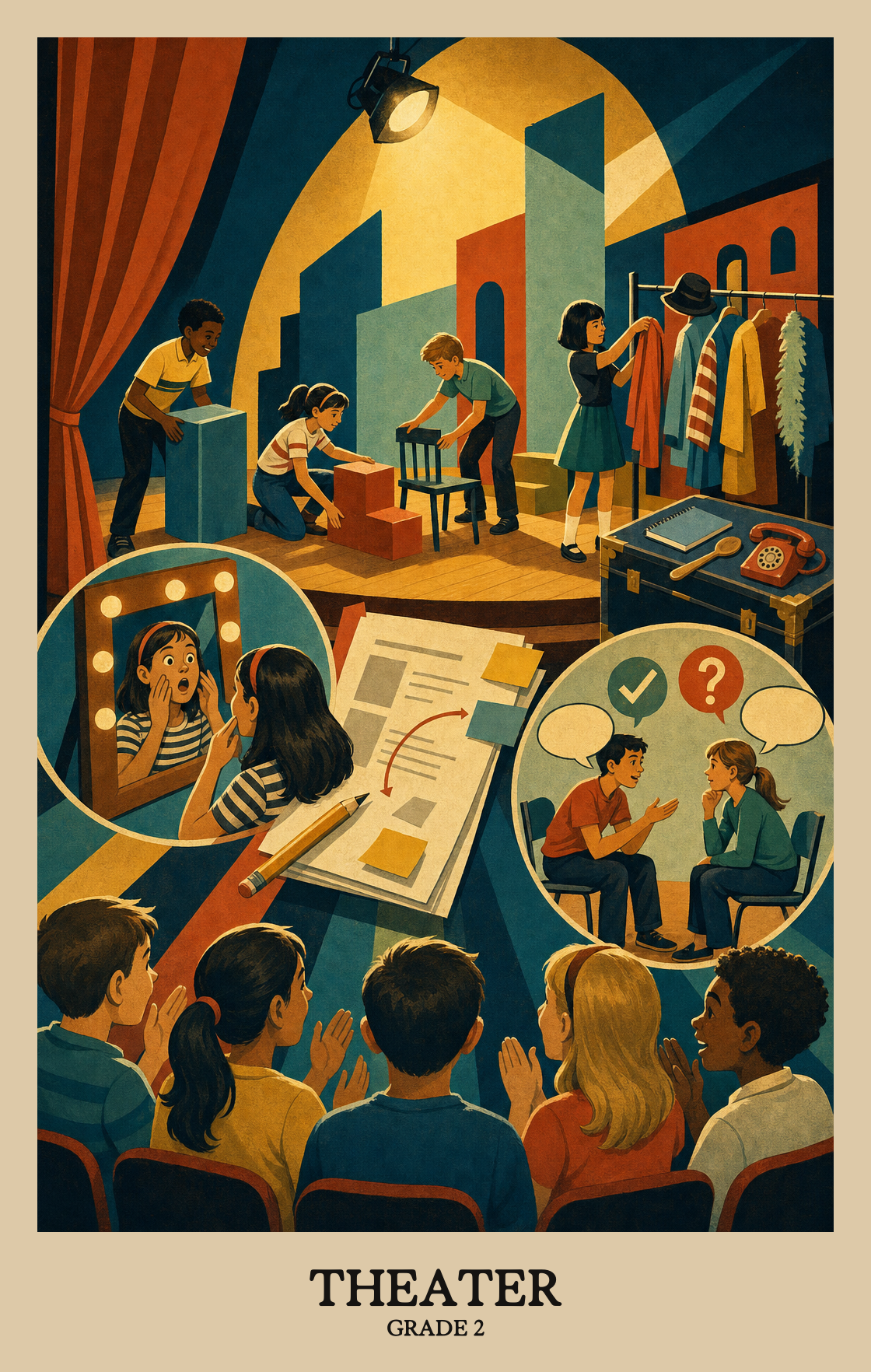
Students dream up characters, settings, and short story ideas. They draw on their own lives and favorite books to invent who a character is and what happens next.
Students work with classmates to organize their ideas into short scenes. They try out different choices, listen to suggestions, and revise what is not working yet.
Students rehearse using their voices, faces, and bodies to show feelings. They learn to slow down, speak clearly, and move with purpose so an audience can follow along.
Students share short scenes for classmates or families. They focus on making the meaning clear and staying in character from start to finish.
Students watch plays and classmate performances and talk about what they saw. They notice the choices actors made and connect the stories to their own lives and communities.
Students connect something from their own life to a character or story, then use that connection to shape how they act, speak, or move in a scene.
Students look at a play, puppet show, or story performance and talk about where it comes from. What place, time, or community shaped it, and what does that tell us about the people who made it?
| Standard | Definition | Code |
|---|---|---|
| Using life experiences to make theater | Students connect something from their own life to a character or story, then use that connection to shape how they act, speak, or move in a scene. | CA-TH:Cn10.2.2 |
| Stories from different times and places | Students look at a play, puppet show, or story performance and talk about where it comes from. What place, time, or community shaped it, and what does that tell us about the people who made it? | CA-TH:Cn11.2.2 |
Students practice coming up with their own ideas for a scene or character and figure out how to bring those ideas to life in a performance.
Students pick an idea for a short play and figure out what happens at the beginning, middle, and end. They make choices about characters and setting to get the story ready to perform.
Students revisit a short scene or character choice, make at least one change to improve it, and practice until the piece feels ready to share.
| Standard | Definition | Code |
|---|---|---|
| Coming up with ideas for a play | Students practice coming up with their own ideas for a scene or character and figure out how to bring those ideas to life in a performance. | CA-TH:Cr1.2.2 |
| Turning a story idea into a scene | Students pick an idea for a short play and figure out what happens at the beginning, middle, and end. They make choices about characters and setting to get the story ready to perform. | CA-TH:Cr2.2.2 |
| Finish and polish a theater piece | Students revisit a short scene or character choice, make at least one change to improve it, and practice until the piece feels ready to share. | CA-TH:Cr3.2.2 |
Students pick a short scene or character to perform and explain why it fits the story they want to tell.
Students practice a scene or monologue more than once, working on how they move, speak, and project their voice so the performance is ready for an audience.
Students perform a short scene or story and make deliberate choices, like tone of voice or movement, to help the audience understand what the piece means.
| Standard | Definition | Code |
|---|---|---|
| Choosing a scene to perform | Students pick a short scene or character to perform and explain why it fits the story they want to tell. | CA-TH:Pr4.2.2 |
| Practicing a scene until it's ready to share | Students practice a scene or monologue more than once, working on how they move, speak, and project their voice so the performance is ready for an audience. | CA-TH:Pr5.2.2 |
| Share what a story means through performance | Students perform a short scene or story and make deliberate choices, like tone of voice or movement, to help the audience understand what the piece means. | CA-TH:Pr6.2.2 |
Students watch a short play or puppet show and describe what they noticed: how the characters moved, what the story felt like, and whether the performance matched what the actor seemed to be trying to do.
Students look at a scene or performance and explain what feeling or idea the performers were trying to share. They point to specific moments that show how they know.
Students look at a classmate's performance and explain what worked and what could improve, using simple agreed-on rules like "Did the actor speak clearly?" or "Could we see the character's feelings?"
| Standard | Definition | Code |
|---|---|---|
| Watching and thinking about a performance | Students watch a short play or puppet show and describe what they noticed: how the characters moved, what the story felt like, and whether the performance matched what the actor seemed to be trying to do. | CA-TH:Re7.2.2 |
| Reading what a performance means | Students look at a scene or performance and explain what feeling or idea the performers were trying to share. They point to specific moments that show how they know. | CA-TH:Re8.2.2 |
| Decide what makes a performance good | Students look at a classmate's performance and explain what worked and what could improve, using simple agreed-on rules like "Did the actor speak clearly?" or "Could we see the character's feelings?" | CA-TH:Re9.2.2 |
Students make up short scenes, act out characters from stories, and try simple movements and voices. A lot of the work is play with a purpose: pretending to be someone else, then talking about why a character acted that way.
Pick a favorite story and ask students to act out one scene as a different character. Ask what the character wanted and how their voice or face should show it. Five minutes of pretend play counts.
No. A hat, a scarf, or a wooden spoon is plenty. The point is for students to try on a character and tell a small story, not to put on a production.
Start with imagination and movement games, then move into building short scenes from familiar stories. Save polishing and sharing work for later in the year, once students are comfortable speaking and moving in front of others.
Two things tend to lag: staying in character for more than a few seconds, and giving useful feedback to a classmate. Plan short, repeated practice for both rather than one big lesson.
Acting out a story helps students think about characters, setting, and what happens next, which is the same work they do in reading. It also gives quiet students a low-pressure way to share ideas.
Students can plan and perform a short scene with a small group, explain who their character is and what they want, and say something specific they liked about a classmate's performance.
Not at all. Many students start the year nervous about acting in front of others. Practicing at home with one familiar person, or acting out a story with stuffed animals, builds confidence without pressure.