Adding and subtracting to 20
Students solve story problems by adding and subtracting numbers up to 20. They learn quick tricks like counting on from a bigger number and making a ten to find answers faster.
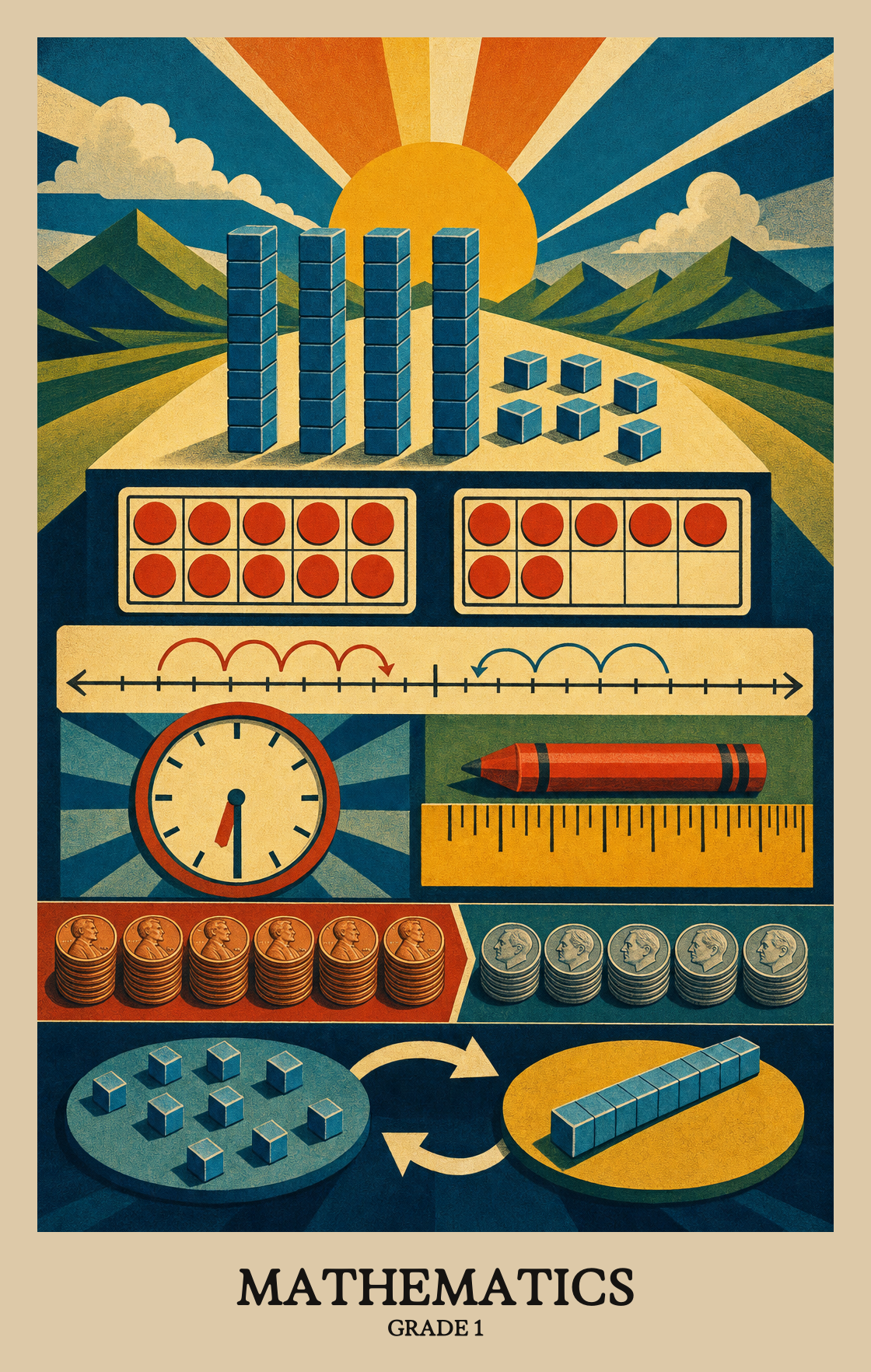
This is the year math grows from counting to thinking in groups of ten. Students see that a number like 47 means 4 tens and 7 ones, and they use that idea to add and subtract larger numbers. They also start measuring with rulers, telling time on a clock, and counting pennies and dimes. By spring, students can add and subtract within 20 and read the time to the half hour.
Students solve story problems by adding and subtracting numbers up to 20. They learn quick tricks like counting on from a bigger number and making a ten to find answers faster.
Students start to see the equal sign as a balance, not just a signal that an answer is coming. They check if number sentences are true and find the missing number in problems like 8 + ? = 12.
Students count, read, and write numbers all the way to 120. They learn that a two-digit number is built from groups of ten and leftover ones, and they compare numbers using the symbols for greater than and less than.
Students add within 100 using drawings and place value. They practice adding a two-digit number and a one-digit number, and they can find ten more or ten less than a number in their head.
Students put objects in order by length and measure with same-size units like paper clips. They tell time to the hour and half hour on analog and digital clocks, and they count pennies and dimes up to one dollar.
Students build and draw shapes, then put smaller shapes together to make bigger ones. They split circles and rectangles into halves and fourths and learn that more equal pieces means smaller pieces.
Shapes have rules that make them what they are. Students learn which features matter (three sides makes a triangle) and which don't (color and size don't change the name), then draw or build shapes that follow those rules.
Students fit basic shapes together to build a bigger shape, then use that new shape to build something bigger still. It's like snapping puzzle pieces together, then treating the whole puzzle as one new piece.
Students cut circles and rectangles into two or four equal pieces, then name each piece a half, a fourth, or a quarter. They also learn that the more equal pieces you cut a shape into, the smaller each piece gets.
| Standard | Definition | Code |
|---|---|---|
| Shapes and what makes them what they are | Shapes have rules that make them what they are. Students learn which features matter (three sides makes a triangle) and which don't (color and size don't change the name), then draw or build shapes that follow those rules. | NY-1.G.1 |
| Building shapes from smaller shapes | Students fit basic shapes together to build a bigger shape, then use that new shape to build something bigger still. It's like snapping puzzle pieces together, then treating the whole puzzle as one new piece. | NY-1.G.2 |
| Splitting shapes into halves and quarters | Students cut circles and rectangles into two or four equal pieces, then name each piece a half, a fourth, or a quarter. They also learn that the more equal pieces you cut a shape into, the smaller each piece gets. | NY-1.G.3 |
Students line up three objects from shortest to longest, then figure out which of two objects is longer by comparing each one to a third object, like a piece of string or a stick.
Students measure how long something is by lining up small objects end to end, like paper clips along a pencil, with no spaces between them. Then they count how many fit and give the length as a whole number.
Students sort objects or answers into up to three groups, count how many are in each group, and compare the groups to find which has more or fewer.
Students read a clock and write the time when the hour or minute hand lands on the hour or half-hour. They also learn what "o'clock" and "half past" mean.
Students learn to tell a penny, nickel, dime, and quarter apart by sight, name what each coin is worth, and write that amount using the cent symbol.
Students count a mix of dimes and pennies and find the total value in cents, up to one dollar. They practice skip-counting by tens for dimes, then add on the pennies one at a time.
| Standard | Definition | Code |
|---|---|---|
| Comparing lengths with three objects | Students line up three objects from shortest to longest, then figure out which of two objects is longer by comparing each one to a third object, like a piece of string or a stick. | NY-1.MD.1 |
| Measuring length with same-size units | Students measure how long something is by lining up small objects end to end, like paper clips along a pencil, with no spaces between them. Then they count how many fit and give the length as a whole number. | NY-1.MD.2 |
| Sorting and comparing data in charts | Students sort objects or answers into up to three groups, count how many are in each group, and compare the groups to find which has more or fewer. | NY-1.MD.4 |
| Telling time to the hour and half-hour | Students read a clock and write the time when the hour or minute hand lands on the hour or half-hour. They also learn what "o'clock" and "half past" mean. | NY-1.MD.3a |
| Coins, their values, and the ¢ symbol | Students learn to tell a penny, nickel, dime, and quarter apart by sight, name what each coin is worth, and write that amount using the cent symbol. | NY-1.MD.3b |
| Counting dimes and pennies | Students count a mix of dimes and pennies and find the total value in cents, up to one dollar. They practice skip-counting by tens for dimes, then add on the pennies one at a time. | NY-1.MD.3c |
Starting from any number below 120, students count forward, stop on any number, and write it down. They can also look at a group of objects and write the matching number.
Students learn that every two-digit number is made of tens and ones. The number 34, for example, means 3 groups of ten and 4 leftover ones.
Students look at two numbers and decide which is bigger, smaller, or equal by checking the tens place first, then the ones place. They record the result using the symbols >, =, and <.
Students add numbers up to 100 by grouping tens with tens and ones with ones, using drawings or blocks to show their thinking. Sometimes combining the ones creates a new group of ten.
Students pick a two-digit number and figure out what it becomes after adding or subtracting 10, all in their head. Then they say how they knew, without counting up or back.
Students subtract tens from tens, like 70 minus 40, using blocks or drawings and explain how they got the answer.
| Standard | Definition | Code |
|---|---|---|
| Counting, reading, and writing numbers to 120 | Starting from any number below 120, students count forward, stop on any number, and write it down. They can also look at a group of objects and write the matching number. | NY-1.NBT.1 |
| Tens and ones in two-digit numbers | Students learn that every two-digit number is made of tens and ones. The number 34, for example, means 3 groups of ten and 4 leftover ones. | NY-1.NBT.2 |
| Comparing two-digit numbers with >, =, and < | Students look at two numbers and decide which is bigger, smaller, or equal by checking the tens place first, then the ones place. They record the result using the symbols >, =, and <. | NY-1.NBT.3 |
| Adding two-digit numbers within 100 | Students add numbers up to 100 by grouping tens with tens and ones with ones, using drawings or blocks to show their thinking. Sometimes combining the ones creates a new group of ten. | NY-1.NBT.4 |
| Adding and subtracting 10 in your head | Students pick a two-digit number and figure out what it becomes after adding or subtracting 10, all in their head. Then they say how they knew, without counting up or back. | NY-1.NBT.5 |
| Subtracting tens from tens | Students subtract tens from tens, like 70 minus 40, using blocks or drawings and explain how they got the answer. | NY-1.NBT.6 |
Word problems ask students to add or subtract using numbers up to 20. Students figure out what's missing, whether that's the starting number, the change, or the result.
Adding three numbers at once, not just two. Students read a short story problem and combine three small numbers to find a total of 20 or less.
Changing the order of two numbers being added gives the same answer, and students use that idea as a shortcut. Instead of memorizing every fact from scratch, they spot patterns to add and subtract faster.
Subtraction is just addition in reverse. Students solve a subtraction problem by asking "what number do I add to get there?" so 9 minus 4 becomes "4 plus what equals 9?"
Counting up or back on a number line is one way to add or subtract. Students practice connecting that counting pattern to writing an addition or subtraction sentence.
The equal sign means both sides of a math sentence have the same value. Students decide whether addition and subtraction equations are true or false, like checking if 6 = 3 + 3 is correct.
Students find the missing number in an addition or subtraction problem, no matter where the blank appears. The missing piece might come at the start, middle, or end of the equation.
Students practice adding and subtracting numbers up to 20 using mental shortcuts. They might count up from a number, break numbers apart to make a ten first, or use what they know about addition to help with subtraction.
Adding and subtracting numbers up to 10 from memory, without counting on fingers or pausing to figure it out.
| Standard | Definition | Code |
|---|---|---|
| Addition and subtraction word problems within 20 | Word problems ask students to add or subtract using numbers up to 20. Students figure out what's missing, whether that's the starting number, the change, or the result. | NY-1.OA.1 |
| Adding three numbers in word problems | Adding three numbers at once, not just two. Students read a short story problem and combine three small numbers to find a total of 20 or less. | NY-1.OA.2 |
| Addition tricks that make math faster | Changing the order of two numbers being added gives the same answer, and students use that idea as a shortcut. Instead of memorizing every fact from scratch, they spot patterns to add and subtract faster. | NY-1.OA.3 |
| Finding the missing number in subtraction | Subtraction is just addition in reverse. Students solve a subtraction problem by asking "what number do I add to get there?" so 9 minus 4 becomes "4 plus what equals 9?" | NY-1.OA.4 |
| Counting up and back to add and subtract | Counting up or back on a number line is one way to add or subtract. Students practice connecting that counting pattern to writing an addition or subtraction sentence. | NY-1.OA.5 |
| What the equal sign means | The equal sign means both sides of a math sentence have the same value. Students decide whether addition and subtraction equations are true or false, like checking if 6 = 3 + 3 is correct. | NY-1.OA.7 |
| Finding the missing number in equations | Students find the missing number in an addition or subtraction problem, no matter where the blank appears. The missing piece might come at the start, middle, or end of the equation. | NY-1.OA.8 |
| Adding and subtracting within 20 | Students practice adding and subtracting numbers up to 20 using mental shortcuts. They might count up from a number, break numbers apart to make a ten first, or use what they know about addition to help with subtraction. | NY-1.OA.6a |
| Add and subtract within 10 | Adding and subtracting numbers up to 10 from memory, without counting on fingers or pausing to figure it out. | NY-1.OA.6b |
All New York public school students take this math test in the spring of grade 3. It covers the Next Generation grade 3 standards, with multiple-choice and constructed-response questions.
The alternate state test for students with the most significant cognitive disabilities. NYSAA replaces the Grade 3-8 tests and Regents exams in ELA, math, and science for the small group of students whose IEP teams qualify them.
Students should add and subtract within 20, count to 120, and read and write numbers up to 100. They should also tell time to the hour and half hour, measure with a ruler, and name coins. Fluency with addition and subtraction within 10 is the big one.
Practice small sums and differences in short bursts, three or four minutes at a time. Ask quick questions while making dinner or driving, like seven plus three or ten minus four. Aim for quick recall on facts within 10 by spring.
Students learn that a two-digit number like 34 means three tens and four ones. They bundle groups of ten with sticks, beans, or coins, then write the number. This is the bridge to adding bigger numbers later.
Start with counting, addition, and subtraction within 20, since fluency within 10 anchors everything else. Move into place value and two-digit addition by midyear. Save measurement, time, money, and shapes for shorter units woven through the year.
Making ten and decomposing numbers to add across ten are the stickiest. Telling time to the half hour also trips students up, especially on analog clocks. Plan to revisit both in short review blocks across the spring.
No. Finger counting is a normal step and helps students see how numbers come apart and back together. Over the year, push gently toward strategies like counting on from the bigger number and making ten.
Let students sort pennies, nickels, dimes, and quarters from a jar and count the pennies and dimes together. Point at the clock at bedtime or snack time and ask what hour or half hour it shows. Five minutes a few times a week is plenty.
Students cut circles and rectangles into two or four equal pieces and call them halves, fourths, or quarters. They should also see that four pieces of a pizza are smaller than two pieces of the same pizza. No symbols like 1/2 are needed yet.
Look for quick recall of sums and differences within 10, comfort adding a two-digit and one-digit number, and the ability to find 10 more or 10 less in their head. They should also measure with a ruler and tell time to the half hour.