Watching the sky
Students watch the sun, moon, and stars and look for patterns they can predict. They notice how the amount of daylight shifts as the seasons change.
This is the year science becomes about looking for patterns in the everyday world. Students watch the sun, moon, and stars and notice how daylight shifts with the seasons. They explore how sound comes from things that shake, how we only see objects when light hits them, and how baby plants and animals look a lot like their parents but not exactly. By spring, students can explain why a flashlight helps you see in the dark and point out a pattern in nature they noticed themselves.
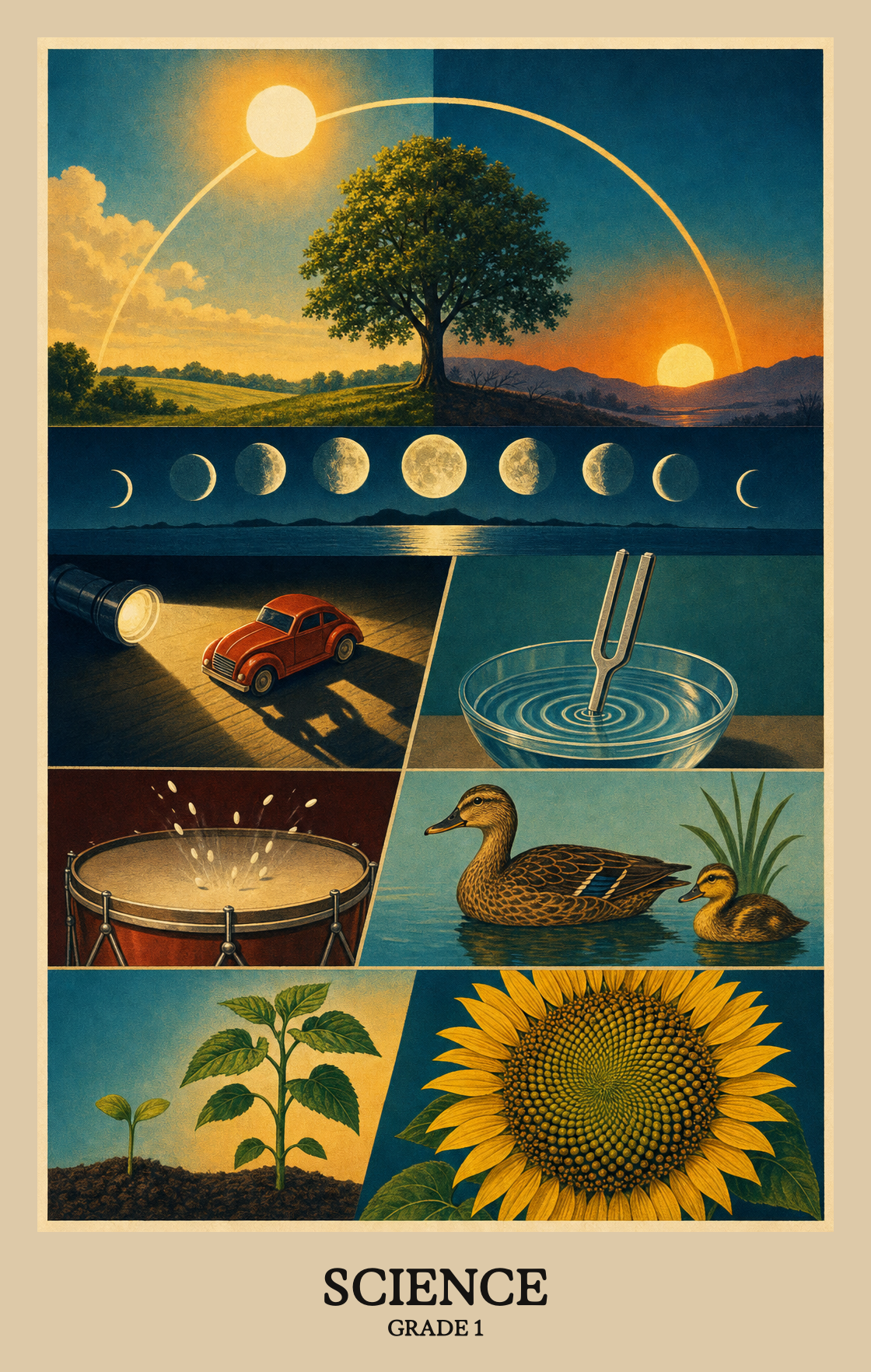
Students watch the sun, moon, and stars and look for patterns they can predict. They notice how the amount of daylight shifts as the seasons change.
Students plan small experiments to show that things that vibrate make sound, and that sound can make things move. They test rubber bands, drums, and their own voices.
Students figure out that objects are only visible when light hits them. They test how different materials block, bend, or let light pass through, then design a tool that uses light or sound to send a message across the room.
Students look at how plants and animals use their body parts to survive, then borrow those ideas to design something useful for people. A burr becomes Velcro, a beak becomes a tool.
Students read and watch how parents care for their young and notice patterns that help babies survive. They also see that young plants and animals look like their parents but are not exactly the same.
Students watch how the Sun, moon, and stars move across the sky and look for patterns. They learn to predict where those objects will appear based on what they have seen before.
Students track how daylight changes across the seasons, noticing that summer days stay light longer and winter days get dark earlier.
| Standard | Definition | Code |
|---|---|---|
| Patterns in the sun, moon, and stars | Students watch how the Sun, moon, and stars move across the sky and look for patterns. They learn to predict where those objects will appear based on what they have seen before. | 1-ESS1-1 |
| How daylight changes through the year | Students track how daylight changes across the seasons, noticing that summer days stay light longer and winter days get dark earlier. | 1-ESS1-2 |
Students look at how an animal or plant uses its body parts to survive, then design something that works the same way. A bird's hollow bones might inspire a lightweight bridge; a cactus spine might inspire a sharp tool.
Students read books and watch videos to find patterns in how animal parents and their young behave. They look at what those behaviors have in common and how each one helps the young animal stay alive.
Students look at plants and baby animals to figure out what they inherited from their parents and what looks different. A puppy looks like its parent dog, but not exactly.
| Standard | Definition | Code |
|---|---|---|
| Copying nature to solve problems | Students look at how an animal or plant uses its body parts to survive, then design something that works the same way. A bird's hollow bones might inspire a lightweight bridge; a cactus spine might inspire a sharp tool. | 1-LS1-1 |
| How parents help their young survive | Students read books and watch videos to find patterns in how animal parents and their young behave. They look at what those behaviors have in common and how each one helps the young animal stay alive. | 1-LS1-2 |
| How baby plants and animals resemble parents | Students look at plants and baby animals to figure out what they inherited from their parents and what looks different. A puppy looks like its parent dog, but not exactly. | 1-LS3-1 |
Students shake or tap objects to discover what makes sound, then watch how sound waves can make other objects wiggle in return. The investigation runs both ways: vibration creates sound, and sound creates vibration.
Students observe what happens when light is blocked or removed from an object. They use what they notice to explain why objects can only be seen when light shines on them.
Students shine a light beam at objects made of different materials and watch what happens. They find out which materials let light through, block it, or bend it.
Students build a simple device, like a flashlight signal or a tin-can phone, that sends a message across a room or down the hall. The focus is on using light or sound to solve a real communication problem.
| Standard | Definition | Code |
|---|---|---|
| Vibrations make sound | Students shake or tap objects to discover what makes sound, then watch how sound waves can make other objects wiggle in return. The investigation runs both ways: vibration creates sound, and sound creates vibration. | 1-PS4-1 |
| Seeing objects in light and shadow | Students observe what happens when light is blocked or removed from an object. They use what they notice to explain why objects can only be seen when light shines on them. | 1-PS4-2 |
| What blocks or bends light | Students shine a light beam at objects made of different materials and watch what happens. They find out which materials let light through, block it, or bend it. | 1-PS4-3 |
| Build a device that sends light or sound signals | Students build a simple device, like a flashlight signal or a tin-can phone, that sends a message across a room or down the hall. The focus is on using light or sound to solve a real communication problem. | 1-PS4-4 |
The alternate state test for students with the most significant cognitive disabilities. NYSAA replaces the Grade 3-8 tests and Regents exams in ELA, math, and science for the small group of students whose IEP teams qualify them.
Students watch the world and look for patterns. They notice how the sun and moon move across the sky, how baby animals grow, and how light and sound behave. Most lessons involve doing something and then talking about what happened.
Step outside and look at the sky together. Point out where the sun rises, when the moon is visible during the day, or how the sky looks darker earlier in winter. Short noticing moments add up to real understanding.
Try the question out instead of looking up the answer right away. If a child asks why the spoon looks bent in water, get a glass and a spoon and test it. Guessing first, then checking, is exactly how science works at this age.
Many teachers start with sound and light in the fall, move into life science and animal parents and babies in winter, and finish with sun, moon, and seasons in spring. That order lets students log daylight changes across real months.
Students often mix up that we see objects because light bounces off them, not because eyes send something out. The idea that sound is vibration also takes repeated hands-on practice with rubber bands, drums, and tuning forks before it sticks.
Not at this age. Students should be able to describe what they observed in their own words and use a few key terms like vibrate, reflect, pattern, and offspring when it fits. Understanding the idea matters more than the label.
Design tasks work best when they copy something from nature. Building a cup-and-string phone for sound, a flashlight signal for night messages, or a coat inspired by a polar bear gives students a real problem and a clear way to test their idea.
Pick a regular time each week to check sunrise, sunset, and how the sky looks. Track it on a simple chart from September to June. By spring, students can see for themselves that days got shorter and then longer again.
Students should be able to describe a pattern they noticed, explain how a young animal is like and unlike its parent, and show that sound comes from something vibrating. Clear explanations of simple investigations matter more than knowing facts.